DbcultAccessing Vault...
5.6/10
Senior Film Conservator
A definitive 5.6/10 rating for a film that redefined the boundaries of cult cinema. Shoe Palace Pinkus remains a cornerstone of transgressive art.
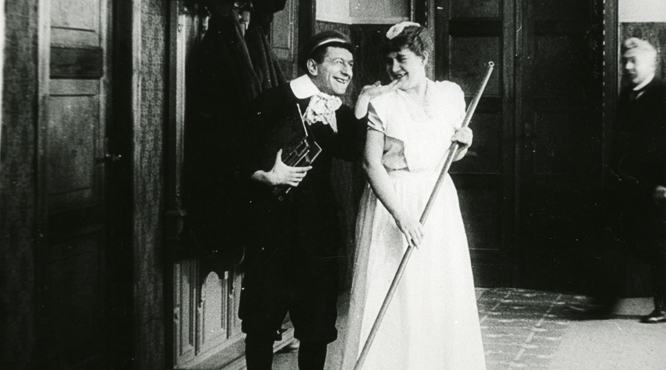
To witness Shoe Palace Pinkus (1916) is to observe the primordial soup of cinematic wit. Long before the sophisticated drawing-room comedies of the 1930s, Ernst Lubitsch was refining a specific brand of ethnic, high-energy slapstick that served as a mirror to the burgeoning urbanity of Wilhelmine Germany. In this film, Lubitsch does not merely direct; he inhabits the screen as Sally Pinkus, a character who embodies the restless ambition of the Jewish diaspora within the commercial heart of Berlin. Unlike the somber moralizing found in contemporary works like Dante's Inferno, Pinkus operates in a world where morality is secondary to momentum. The film opens not with a lecture, but with a rebellion—a classroom expulsion that sets the stage for a mercantile odyssey.
The shoe store in this film functions as more than a backdrop; it is a theatrical stage where class hierarchies are both reinforced and subverted. Pinkus, with his oversized personality and undersized social standing, navigates these spaces with a mixture of obsequiousness and audacity. When he transitions from the cramped, dusty shop of his first employer to the sterile, 'upmarket' salon, the cinematography reflects a shift in aspiration. While a film like Nuori luotsi might find drama in the rugged landscapes of nature, Lubitsch finds it in the curve of a heel and the polish of a floor. The 'Shoe Palace' itself, once realized, is a phantasmagoria of consumerism, a temple to the foot where Pinkus reigns supreme.
In the broader context of 1916 cinema, Pinkus stands as a radical departure from the melodramatic weight of the era. If we look at the heavy-handed pathos of The Face in the Moonlight, Lubitsch’s work feels almost weightless, driven by a syncopated rhythm that anticipates the jazz age. The physical comedy here is not merely for the sake of a laugh; it is a survival mechanism. Pinkus’s flirtations, which repeatedly cost him his livelihood, are an assertion of humanity against the drudgery of labor. This rebellious spirit is echoed in the thematic undercurrents of A Militant Suffragette, where the disruption of social norms is the primary engine of the plot. However, while the suffragette seeks political agency, Pinkus seeks the agency of the self-made man.
One of the most intriguing elements of the film is the relationship between Pinkus and his wealthy benefactress, played by Else Kentner. In many films of this period, such as A Change of Heart or Was He a Coward?, the intervention of the upper class often carries a tone of condescending charity. In Shoe Palace Pinkus, the dynamic is far more transactional and flirtatious. Pinkus doesn't just receive help; he charms it out of existence. He weaponizes his vulnerability, turning the 'poor boy' trope on its head. This manipulation of social dynamics is a precursor to the sophisticated gender play Lubitsch would later perfect in Hollywood. It is a far cry from the stark, often fatalistic consequences seen in O Crime de Paula Matos, where social boundaries are iron-clad and unforgiving.
The visual language of the film is surprisingly modern. Lubitsch uses the camera to emphasize the textures of the merchandise—the leather, the silk, the intricate laces. This fetishization of the object is something we might expect in a much later film like La fièvre de l'or, yet here it is used to define Pinkus’s world. His obsession with shoes is not just a job; it is a vocation. The way he handles a boot is akin to how a jeweler handles a diamond. This level of detail elevates the film from a simple comedy to a sociological document of early 20th-century retail culture. It contrasts sharply with the sweeping, often impersonal epics like Spartacus (1913), focusing instead on the lilliputian details of daily life.
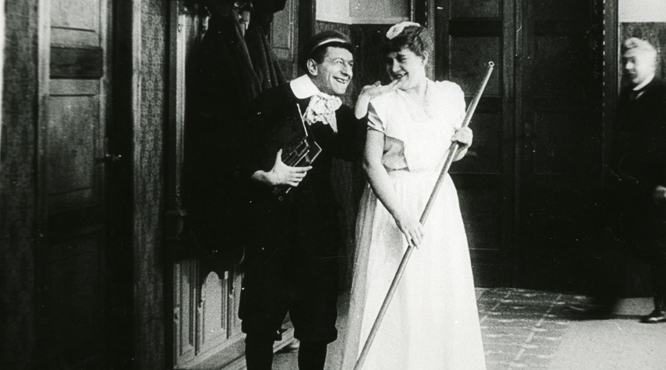
The screenplay, a collaboration between Hanns Kräly and Erich Schönfelder, is a masterclass in escalating absurdity. Each 'firing' of Pinkus is scripted with increasing complexity, ensuring that the audience never tires of the repetitive structure. This narrative discipline is something often lacking in the more rambling productions of the time, such as The Last Egyptian. By keeping the stakes personal and the setting contained, the writers allow Lubitsch’s performance to breathe. The dialogue intertitles are punchy, eschewing the flowery prose that bogged down many silent dramas. This lean approach to storytelling ensures that the focus remains on the physical comedy and the expressive faces of the cast, including the delightful Ossi Oswalda.
While Shoe Palace Pinkus is ostensibly a light comedy, it carries the weight of the Jewish-German experience. Pinkus is an outsider, not just because of his behavior, but because of his heritage. His drive to succeed, to build a 'palace' with his name on it, is a classic immigrant narrative. It shares a thematic kinship with My Old Dutch, which explores the endurance of the working class, though Lubitsch replaces sentimentality with satire. Pinkus doesn't want sympathy; he wants a storefront. The film’s refusal to lean into tragedy, even when Pinkus is at his lowest, is a testament to the resilience of the character and the vision of the director.
Looking back from a century’s distance, the film remains remarkably vibrant. It avoids the static, stage-bound feel of many early silents, such as Sealed Valley. Instead, it feels alive with the energy of a city in flux. The 'Shoe Palace' itself becomes a symbol of the modern age—extravagant, slightly ridiculous, and utterly captivating. It is a precursor to the department store spectacles that would follow in cinema, and it established Lubitsch as a filmmaker who understood the intersection of desire and commerce. Unlike the grim contracts of Drakonovskiy kontrakt, Pinkus’s contract with the world is one of joy and opportunism.
The performances are uniformly excellent, with Fritz Rasp and Guido Herzfeld providing the perfect stoic foils to Lubitsch’s kinetic energy. The editing is brisk, moving the story along with a confidence that belies the film's age. While a film like The College Orphan might struggle with pacing, Shoe Palace Pinkus feels like a well-oiled machine. The use of light in the final 'Palace' scenes creates an atmosphere of opulence that was quite advanced for 1916, utilizing the reflective surfaces of the shoes to bounce light around the frame, a technique that adds a layer of visual sophistication to the slapstick.
Ultimately, Shoe Palace Pinkus is a celebration of the underdog who refuses to stay down. It is a film about the audacity of hope and the power of a well-fitted shoe. In the vast landscape of early cinema, where films like Cooee and the Echo explored the fringes of empire, Lubitsch chose to explore the center of the shop floor. In doing so, he created a timeless character and a blueprint for the modern comedy. Sally Pinkus is not just a clerk; he is the spirit of the 20th century—ambitious, flawed, and perpetually in motion. This film is an essential artifact for anyone wishing to understand the evolution of the comedic form and the birth of one of cinema’s greatest directorial voices.
IMDb 7.6
1931
Community
Log in to comment.