DbcultAccessing Vault...
6.6/10
Senior Film Conservator
A definitive 6.6/10 rating for a film that redefined the boundaries of cult cinema. The Challenge remains a cornerstone of transgressive art.
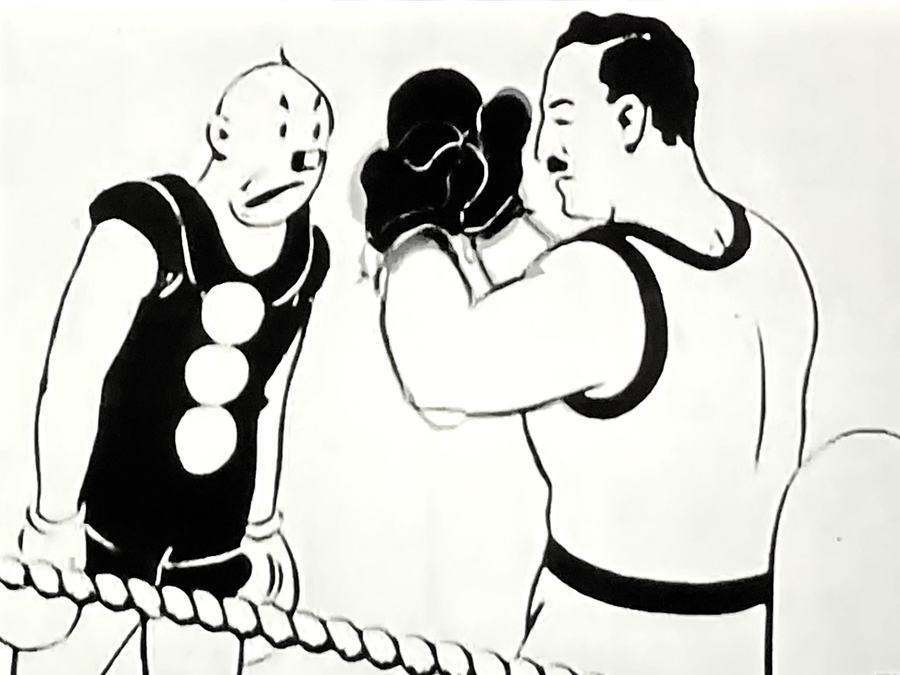
Max Fleischer’s The Challenge is less a cartoon than a bare-knuckled hallucination inked onto nitrate, a 1922 time-capsule that detonates the moment the snore leaves the animator’s throat.
Picture the scene: a cramped Brooklyn studio, amber light bleeding through venetians, dust motes orbiting a slumped Max Fleischer like minor planets. One seismic snore later, the cosmos splits. From the Bristol board rises the Inkwell Clown—calligraphic sinew, moon-white gloves, eyes that glint with the insolence of a bootlegger. He does not tip-toe; he erupts, a graffiti insurgent yanking his creator into the ring.
Round one: the paper arena folds into a roiling Möbius strip. Perspective forgets its job; the horizon slouches until it becomes a tightrope. Max—rendered as a bobble-headed avatar—lurches awake, fountain pen still clenched like a baton. The Clown jabs, and the nib spews a comet of ink that solidifies into boxing tape. No title card intercedes; the duel is instantaneous, a jazz riff of violence.
Fleischer’s camera, forever drunk on corkscrews, pirouettes 270° so that the punch lands in our lap. The glove smears across the emulsion, leaving a slug-trail of carbon that refuses to sit flat; it bubbles, crusts, then flakes away like burnt sugar. In 1922, this was sorcery. A century on, it still feels like someone welded a graffiti tag to reality and then taught it to bruise.
Compare it to Oil’s Well That Ends Well where the gag is geology; here the gag is ontology. The ground is not terra firma but a sneaky accomplice that tilts whenever the Clown needs a cheap uppercut. Gravity signs no contract; it moonlights as a comedic stooge.
Sound? Silent, yet the short clacks and wheezes inside your skull. Each punch lands with a phantom rim-shot; you swear you hear the graphite squeal as it smears. It’s the same synesthetic prank Felix pulls at the Fair, but Fleischer cranks the sensory roulette until the ball bounces out of the wheel.
The Clown’s glove inflates to Macy’s-parade proportions, then pin-pricks back to walnut size—an elastic insult to Euclidean dignity. Max counters by erasing the Clown’s mouth mid-smirk; the mouth, now free-agent, scuttles across the page like a centipede and latches onto the artist’s ankle, nibbling his sock into a lace doily. Nothing in Mit Herz und Hand fürs Vaterland dares such ontological vandalism.
Halfway through, the film slyly quotes itself: the snore returns as audio-ink, a visual onomatopoeia that billows into a cumulus of Zzz’s. The letters solidify into scaffolding; the fighters climb, duel, and demolish the alphabet like spiteful librarians. Imagine if The Adventurer’s cliffside chase was rewritten by a drunken typesetter, and you’re close.
Technical heresy abounds. Fleischer flips between 8s and 12s on ones, letting arcs stutter into Cubist flicker. The result is a pugilistic strobe that anticipates the jitter-cam brawls of 21st-century action cinema. animators today spend millions to fake what this 35-cent strip achieves with sprockets and hubris.
Gender? Irrelevant. Romance? Banished. The sole courtship here is between creator and creation, a toxic tango that makes Holy Smoke look like a polite handshake. The Clown wants autonomy; Max wants control. Neither gets either, and that is the joke that keeps on rupturing.
Watch the final ten seconds: Max tears the sheet from the disc, crumples it, hurls it toward camera. The paper ball, now planet-sized, swallows the lens. Fade to black—but the crumple lingers as an after-image, a charcoal scar on your retina. The film doesn’t end; it exfoliates onto the viewer.
Restoration nerds whisper that the surviving 35 mm is a fourth-generation print, scarred by vinegar syndrome and spider-webbed scratches. Embrace those scars; they’re scar tissue from the fight itself. Every fleck of emulsion lost is a missing tooth in the grin of cinema’s first ontological brawl.
So, is it a masterpiece? Masterpiece is too stately a word—too velvet-rope. The Challenge is a back-alley knockout, a moonshine punch that leaves you concussed with possibilities. It won’t comfort like The Girl at Home, nor titillate like All Kinds of a Girl. Instead, it grabs animation by the ink-stained collar and demands to know who’s drawing whom.
Go in expecting slapstick; exit questioning the scaffolding of reality. That, dear reader, is the rarest jab any film—animated or otherwise—can land.
If you crave more carnival chaos, chase Midnight Gambols or the delirious Playmates. For quieter blasphemies, Hypocrisy and The Slavey await. But start here—where the first punch is thrown by the hand that drew it.
IMDb 6.2
1918
Community
Log in to comment.