DbcultAccessing Vault...
Cult Review
Senior Film Conservator
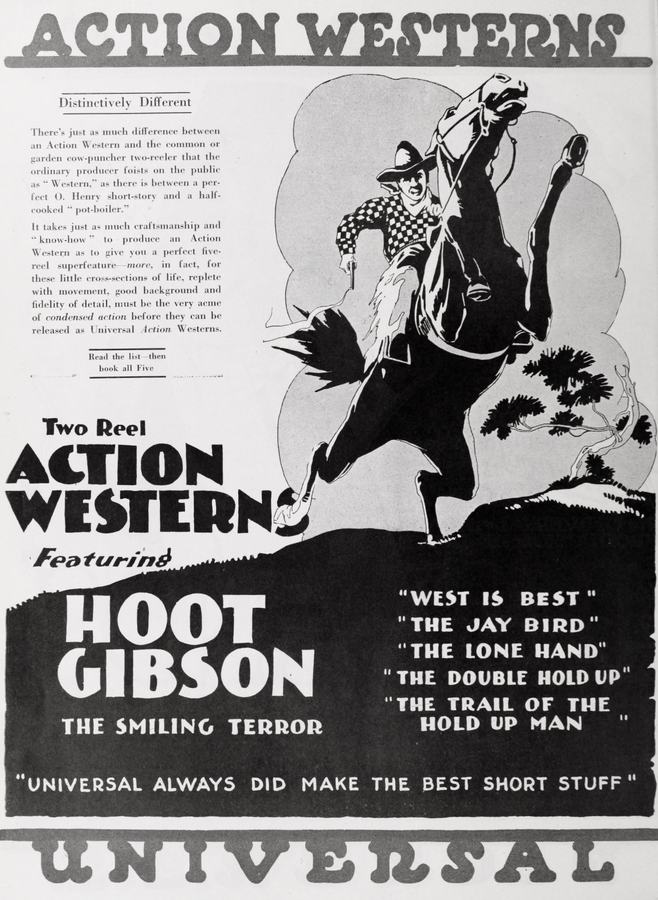
If celluloid could bruise, The Lone Hand would be mottled violet and rust—an eighteen-reel poem scrawled with chalky hoofprints across the slate of 1920. Arthur Henry Gooden’s screenplay arrives like a wanted poster inked with smoke, and director Lambert Hillyer frames each scene as if chiaroscuro itself wore spurs.
Forget the dime-novel simplicity of "good guy poses as bad guy." This is a morality pantomime where identity is a shirt you can rip off, but the skin beneath stays branded. The detective—never named, only referred to as "the drifter" in intertitles—slides into the gang by staging a holdup so flamboyant it feels choreographed by Satan himself. Yet every stolen dollar weighs like a brick in the foundation of a future gallows. When the masked riders demand he prove loyalty by torching a wheat field, flames fork skyward like orange neurons, and you sense the whole prairie is thinking.
Hoot Gibson, usually a grinning rope-trick, compresses his charisma into a squint that reads like a question mark. His cheekbones are geological; every close-up looks surveyed by the U.S. Geological Office. Opposite him, Josephine Hill’s Mary is no wilting petticoat—she reloads a Winchester with the bored efficiency of a seamstress threading needles. Watch her eyes when the drifter confesses his deception: pupils flare like struck matches, love and accusation braided into a single rope.
Charles Brinley as the lead villain Blackie chews so much scenery he leaves splinters on the lens, yet the performance works because Blackie is a man who suspects he’s trapped inside someone else’s dime-novel and decides to relish the clichés. The moment he peels off his mask—revealing a face cratered by smallpox—silence itself seems to recoil.
Cinematographer George Barnes shot moonlight like it owed him money. Notice the sequence where riders silhouette against a cyanotype dusk: the grain swarms like locusts, turning the sky into a living stipple engraving. Interiors are lit by kerosene halos that flirt with under-exposure; faces bloom out of murk only when emotion spikes, so tension itself becomes the key light.
The film’s most enduring image arrives when the drifter, wounded, drags himself through a half-finished church whose skeletal steeple frames Orion’s belt. Blood drips onto raw pine, and the droplets look black—sin made visible. It’s a shot John Ford would echo nine years later in Three Bad Men, but here it feels primal, almost pagan.
Gooden’s intertitles refuse mere exposition. One card reads: "He counted the coins—each a silver liar." The sentence lingers longer than dialogue ever could; the mind fills the sonic void with clinking metal and moral nausea. Another card appears mid-shootout—"Bullets do not discriminate between confession and deceit"—flashing like a subliminal curse.
Unlike The Lady Outlaw where femme agency arrives pistol-first, The Lone Hand secretes power through absence. Mary’s father is off-screen lassoed by debt; the town’s marshal is comically inept. The prairie becomes a widow before our eyes, and women must till both soil and strategy. When Mary bargains with Blackie to spare her cattle, the camera lowers to child-height, turning her into a colossus. It’s a subversive visual coup in a genre that normally measures manhood in spur length.
Gooden’s earlier scenario Cupid’s Hold-Up played banditry for slapstick. Here he flips the coin: romance is a vestigial organ, survival the only heartbeat. Likewise, the masked gang motif resurfaces in The Stolen Play, but while that film treats disguise as narrative gimmick, The Lone Hand weaponizes it as epistemological meltdown—who are any of us when the mask stays on long enough to graft into skin?
Modern viewers conditioned to ADHD montage may twitch at the film’s deliberate slack. Yet that slack is the rope the drama tightens around your throat. The first reel spends four uninterrupted minutes watching a telegraph clerk tap out a warning; the metronomic clicks become diegetic percussion, foreshadowing the shootout in Morse. Hillyer trusts that tension accrues like alkali crust on a dry lakebed—crack it too soon and you’ve got nothing but tasteless dust.
Why isn’t The Lone Hand lionized beside The Great Train Robbery? Because prints vanished into archives mislabeled as Come Out of the Kitchen shorts. A 2018 nitrate discovery in a Butte, Montana barn—nestled beside moth-eaten copies of Flirts and Fakirs—restored only 63% of the footage. The gaps survive as stills, creating a stroboscopic artifact that feels eerily intentional, as if memory itself refuses total recall.
Watch No Country for Old Men and then The Lone Hand back-to-back; you’ll notice the same moral fatigue, the same conviction that landscape is destiny. The Coens’ Anton Chigurh is simply Blackie reborn without the horse. Even the coin-flip fatalism of A Romance of the Underworld finds its embryonic echo in the drifter’s gambit—every disguise is a coin spun in mid-air.
This is not a relic; it is a gauntlet hurled across a century. It argues that identity is the final American frontier, wilder than any sagebrush expanse. The film leaves you standing in that half-built church, smelling pine sap and cordite, wondering whether the roof will ever be finished—or whether faith itself is just another mask we strap on before the ride.
Seek it out however you can: 16mm society screening, torrent seeded by some cine-obsessive in Perth, or the Museum of Modern Art’s flickering digital transfer. Watch it alone at 2 a.m. when the world feels counterfeit; let its grainy ghosts gallop across your living-room wall. And when the final intertitle cuts to black—"The law has but one face—yours"
Rating: ★★★★½ out of 5
IMDb 5.9
1916
Community
Log in to comment.