DbcultAccessing Vault...
Cult Review
Senior Film Conservator
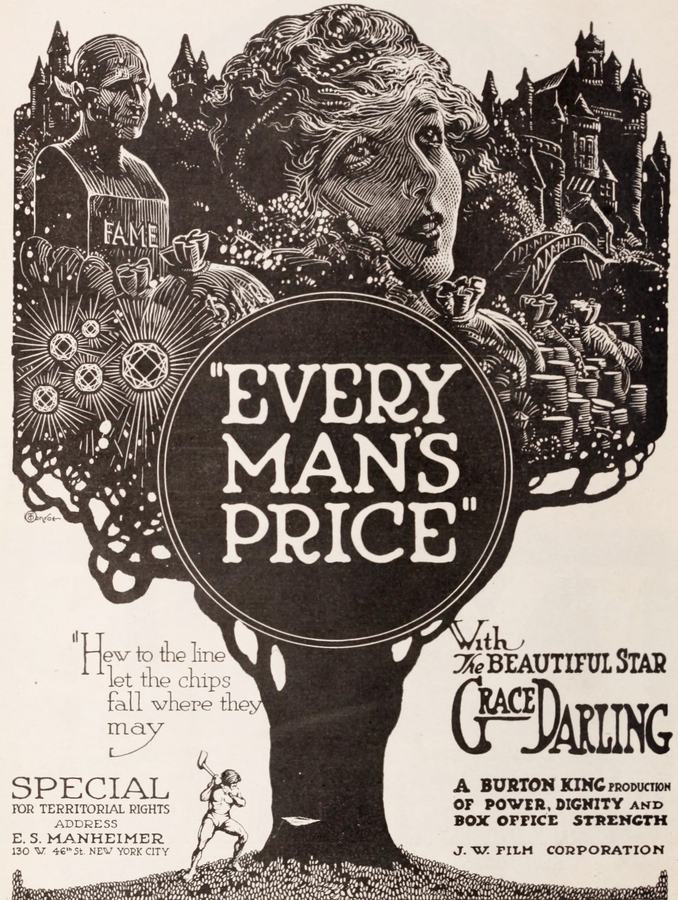
Everyman’s Price
A 1920s melodrama where duty, love, and moral ambiguity collide
Everyman’s Price, a 1920s-era cinematic artifact, unfolds like a chess match of conscience. Directed with meticulous restraint, the film’s narrative machinery is both its greatest strength and its most confounding quirk. At its core, the story orbits Bruce Steele (E.J. Ratcliffe), a District Attorney whose crusade against food profiteering spirals into a personal odyssey of sacrifice. Steele’s initial moral certainty—rooted in his role as a public servant—crumbles as he confronts the shadowy entanglements of Ethel Armstrong (Nita Naldi), a woman whose father’s transgressions blur the lines of justice and affection.
The film’s first act establishes Steele as a man of principle, his interactions with investigators marked by a clipped, almost mechanical precision. His proposal to Ethel, a gesture of earnest sincerity, is undercut by the audience’s foreknowledge of her family’s complicity in the very crimes he investigates. Here, the script by F. McGrew Willis employs a deft layering of irony, positioning Steele as both protagonist and pawn in a game he cannot see the rules of. The abrupt dissolution of his engagement to Ethel—triggered by the investigators’ report—serves as a narrative fulcrum, shifting the tone from courtroom procedural to psychological dissection.
What follows is a study in the fragility of institutional power. Steele’s dismissal of the case against Henry Armstrong (Charles Waldron) is not merely a legal maneuver but a symbolic act of surrender. The scene where Steele interrupts the trial, invoking a lack of evidence, is staged with a deliberateness that mirrors his internal conflict. The camera lingers on his face, capturing a flicker of resignation as he recognizes the futility of his pursuit. This moment is the film’s emotional axis, around which the subsequent plot contrivances revolve—a forgery subplot involving Armstrong’s son and Steele’s brother that feels less like a narrative convenience and more like a thematic necessity.
Nita Naldi’s portrayal of Ethel is a masterclass in understated vulnerability. Her performance transcends the archetype of the conflicted heiress, imbuing Ethel with a quiet desperation that resonates long after the credits roll. The chemistry between Naldi and Ratcliffe is electric, their scenes together charged with a tension that oscillates between romantic longing and existential dread. When Ethel breaks her engagement, the exchange is less a dialogue and more a collision of wills, each actor telegraphing the weight of unspoken consequences.
Charles Waldron’s Henry Armstrong is a study in calculated menace, his every gesture a reminder of the corrupting influence of wealth. The film’s moral compass is deliberately ambiguous; Armstrong is neither wholly villainous nor entirely sympathetic. His orchestration of the forgery case—a plot device that reunites Steele and Ethel—exposes the film’s preoccupation with redemption through absurdity. The resolution, wherein Armstrong releases his hoarded foodstuffs, feels less like a triumph of justice and more like a pragmatic gesture to avert further scandal.
The film’s pacing is brisk, its dialogue clipped to the point of terseness. Scenes transition with the abruptness of a stage play, a stylistic choice that emphasizes the artificiality of the characters’ world. Yet, this very artificiality becomes its strength; the heightened drama allows for a deeper exploration of ethical paradoxes. Steele’s eventual reconciliation with Ethel is not a happy ending in the traditional sense but a bittersweet acknowledgment of compromise—a recognition that love and duty are not mutually exclusive but exist on a spectrum of sacrifice.
Comparisons to other films of the era, such as Judy of Rogues’ Harbor or The Hellion, are instructive. Like these works, Everyman’s Price is steeped in the melodramatic traditions of early cinema, yet it distinguishes itself through its nuanced handling of class and morality. The food profiteering subplot, while anachronistically specific to its time, remains a compelling metaphor for the enduring tension between corporate greed and public welfare—a theme that resonates with disquieting relevance in the 21st century.
Technically, the film is a marvel of its era. The cinematography, though rudimentary by modern standards, employs shadow and light to create a chiaroscuro effect that mirrors the moral ambiguity of its characters. The score, a subtle blend of piano and strings, underscores the emotional beats without overpowering the dialogue. The editing is taut, with cross-cutting effectively heightening the stakes of Steele’s dual investigations—both legal and personal.
What lingers most after watching Everyman’s Price is the sense of inevitability that pervades its narrative. Steele’s journey is not one of transformation but of acceptance. His final embrace of Ethel is not a resolution but a truce, a mutual understanding that their love exists within a framework of compromise. The film’s ending, with its release of hoarded foodstuffs and the implied rehabilitation of Armstrong, is less a denouement than a coda to a larger, unresolved story of systemic corruption.
In the pantheon of early 20th-century cinema, Everyman’s Price occupies a curious space. It is neither a masterpiece of technical innovation nor a groundbreaking narrative experiment, yet it remains a compelling artifact of its time. Its exploration of moral relativism, the fragility of institutional authority, and the personal costs of public service speaks to a universal human condition. For modern audiences, it serves as a reminder of the enduring power of cinema to interrogate the complexities of the human soul, even within the constraints of its era’s storytelling conventions.
Ultimately, Everyman’s Price is a film of contradictions. It is both a period piece and a timeless meditation on ethics; a melodrama that resists easy resolution. For those willing to engage with its layered ambiguity, it offers a rewarding experience that transcends the limitations of its genre. As a historical document, it is invaluable; as a cinematic work, it is a testament to the enduring power of stories that refuse to simplify the human experience.
IMDb —
1936
Community
Log in to comment.