DbcultAccessing Vault...
3.7/10
Senior Film Conservator
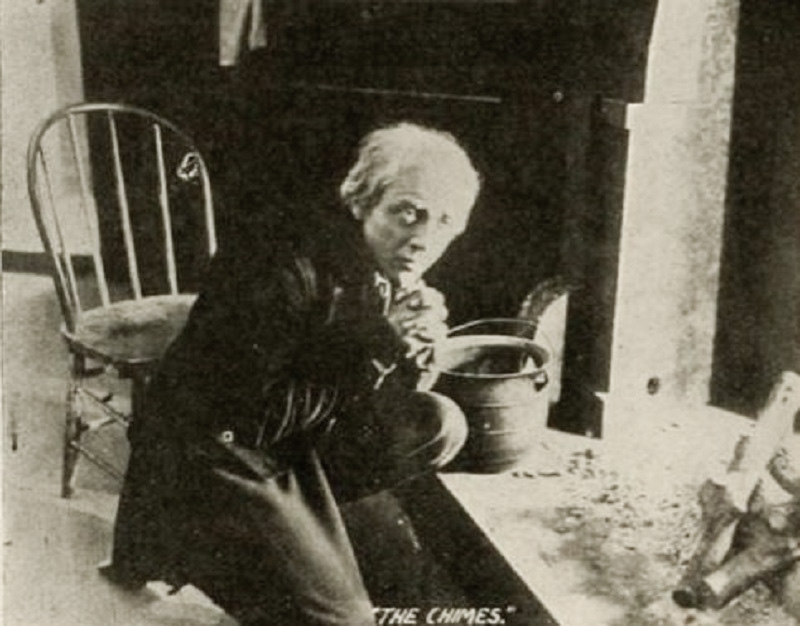
A definitive 3.7/10 rating for a film that redefined the boundaries of cult cinema. The Chimes remains a cornerstone of transgressive art.
The screen, a trembling rectangle of silver nitrate, births a city that seems exhaled from a dying chimney. The Chimes (1914) does not merely adapt Dickens’ novella—it distills its phantasmagoric marrow until every frame clangs like iron tongues in a frost-bitten throat. Director Thomas Bentley, armed with the economy of early cinema, lets silence itself become a character: the gaps between intertitles echo the pauses between tolling bells, so that even the act of reading becomes an auditory hallucination.
Harry Hitchcock’s Trotty Veck is no jolly gnomish postman but a hunched atlas whose shoulder-blades jut like broken wings. Watch the way his fingers, stained the color of wet chestnuts, tremble when he pockets Alderman Cute’s pamphlet on “Economical Wedlock”—a scrap of paper that weighs more than lead. Hitchcock acts with his back; every vertebra seems to recite the Lord’s Prayer backwards in defeat.
Enter William Fern (Alfred Hemming) clutching Lil like a parcel of breathing snow. Their silhouettes, framed against a doorstep only wide enough for a coffin, compress centuries of rural dispossession into one shot. The toddler’s mittens—outgrown, thumb-holes agape—are the single most devastating detail I have seen in any silent social tract, including Uncle Tom’s Cabin or What 80 Million Women Want. When Trotty lights a rush-wick the flare consumes half the frame, as though the camera itself were rationing photons.
Cue the dream sequence, conjured with double exposures that prefigure Trilby’s hypnotic hysteria but surpass it in moral ferocity. The belfry set is an Escher woodcut rendered in plywood: ropes thick as pythons ascend into darkness, and the bells—played by mallet-wielding spirits—become metallic moons that wax with guilt. Trotty climbs; the camera tilts 45° so that every stair is a moral precipice. Superimposed atop, the future bleeds through: Meg’s wedding gown yellowed into shroud, Richard’s muscular forearms now skeletal from delirium tremens.
Editors of the era usually slice action into staccato bursts; here the cut arrives only when the chimes strike, creating a cadence that feels predestined. You do not watch the montage so much as submit to its gravitational toll.
William Terriss essayed the baronial ogre Bowley with a grin that splits his waxed moustache like a ruptured seam. In top-hat and white kid gloves he arrives at Meg’s attic to “rescue” Lil, yet Bentley blocks the scene so that Bowley’s shadow—projected by a low kerosene lamp—swallows the entire child. Later, inside the palatial townhouse, Lil’s dollhouse is larger than Trotty’s entire flat: a visual gag that scalds. The sequence where she is banished into the rain, infant in arms, recalls Manon Lescaut’s desperate exiles but swaps baroque despair for soot-black social realism.
Faye Cusick’s Meg stands upon the stone parapet while fog horns from unseen barges groan like civic disapproval. The Thames below is painted onto the backdrop with cobalt varnish so glossy it mirrors her hem. One boot, patched sole upward, teeters over the void—a visual haiku about women’s labor literally hanging by a thread. The intertitle flashes: “Would the bells mourn her, or merely resume their arithmetic?” No other film of the period, not even the fatalist After Sundown, dares implicate the audience so directly.
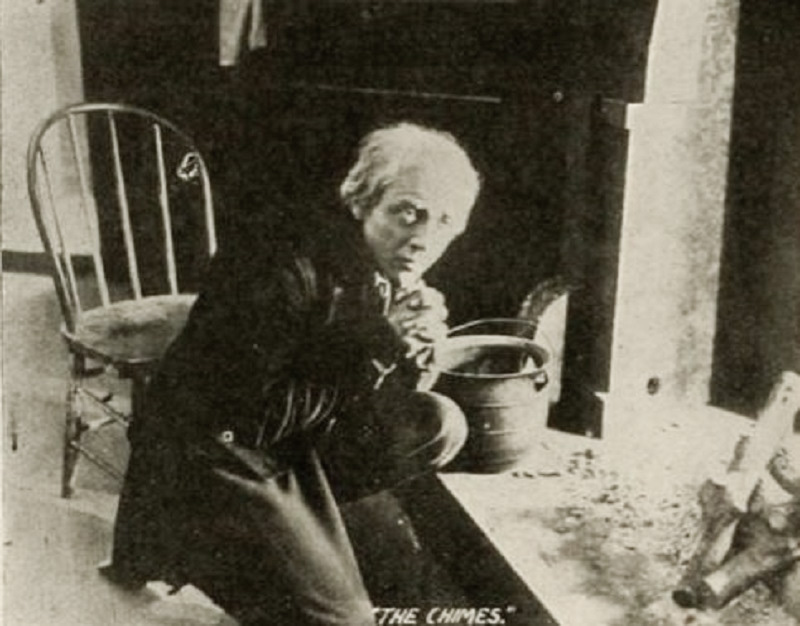
Morning. Trotty bolts upright, the fire dead, the bells now tinny and impotent. Yet knowledge has armed him. He storms Bowley’s drawing-room not with torches but with parchment: a “People’s Charter of Wedlock” drafted in the margins of last night’s dream. The camera reverses roles—suddenly the baron sits below frame while Trotty towers, literally shot from a trench dug into the set floor. When Bowley signs, the quill snaps; ink splatters the lens, a meta-flicker that acknowledges cinema’s own complicity in spectacle-making.
Vinnie Burns as Lil matures across a single dissolve: her plaits lengthen, eyes hollow, yet she never loses the semi-divine glow of a Pre-Raphaelite martyr. Compare her to Milly Terriss’ turn in Red and White Roses where innocence is played for saccharine effect; here the pathos is surgical. Tom Terriss’ Richard, reduced to a gin-soaked silhouette, conveys ruin via gait alone—he lists like a skiff whose ballast has shifted.
DoP Tom White (unrelated to the actor) exposes stock to candlelight by nesting reflectors of polished tin behind the flames. Result: skin-tones acquire a liver-spotted authenticity, while backgrounds recede into umber abyss. Note the moment Trotty ascends the bell-tower: the camera’s iris closes until the frame is a keyhole; sparks from his lantern become galaxies. It anticipates the cosmic melancholy of One Hundred Years Ago yet predates it by seven years.
Contemporary exhibitors received a cue-sheet urging carillon recordings to be played alternately with Chopin’s Marche Funèbre. Imagine the dissonance: celestial chimes versus funeral march—capitalist pomp versus proletarian threnody. Some regional houses substituted live spoken-word, reciting Dickens’ prose during the reel-change; those screenings reportedly ended in congregational sobbing so loud it drowned the projector’s racket.
Released the same year that Lloyd George’s budget speech warned of “national efficiency,” the film weaponized Christmas sentiment to indict workhouse morality. The Daily Sketch called it “a pudding laced with vitriol,” while the Clarion praised its “bell-toned clarion for class revolt.” Echoes ripple toward The Coming Power (1917) and beyond.
Why then does The Chimes slumber in archive vaults while multiple Carol adaptations glut screens? Perhaps because its optimism is earned rather than bestowed; it demands we sign our own charter before the bells fall silent. The film survives in a 35mm tinted print at the BFI, mis-catalogued under “misc Dickensiana,” awaiting the 4K scan that will resurrect its cobalt Thames and orange ember glow for a generation newly fluent in class rage.
Until then, listen for the echo: every time modern cinema stages a dream-premonition (In the Bishop’s Carriage, Sylvi), it borrows, knowingly or not, from Trotty’s moon-lit belfry. The bells keep tolling; the question is whether we wake in time to edit the future.
IMDb 6.6
1918
Community
Log in to comment.