DbcultAccessing Vault...
Cult Review
Senior Film Conservator
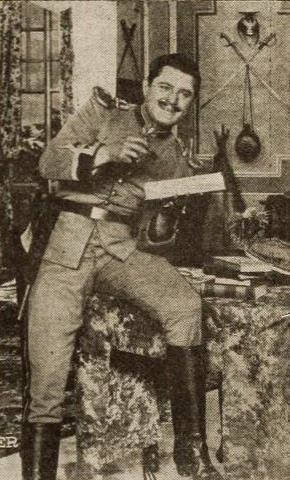
Imagine, if you will, a world where artillery shells whistle like off-key tenors and the only rations sweeter than hope are the last dregs of chocolate drops clinging to a Swiss mercenary’s pocket. Ernst Lubitsch, had he squinted through the celluloid of 1915, might have recognised a soulmate in this one-reel confection, for The Chocolate Soldier pirouettes along the knife-edge between bayonet and boudoir with the same feather-light cynicism that would later define Die Tangokönigin. Yet here the tango is replaced by a militarised mazurka, its steps choreographed by Leopold Jacobson and Rudolph Bernauer, librettists who understand that every waltz is merely a war in evening clothes.
The film opens on a tableau vivant of Balkan opulence: epaulettes glitter like mica flakes, sabres scrape parquet floors, and Nadina—played by Alice Yorke with the porcelain poise of a bisque doll who has read too much Schopenhauer—floats through drawing-rooms scented with tuberose and pre-war ennui. Enter William H. White as Major Spiridoff, a man whose moustache wax has barely dried before the telegram arrives: Serbia mobilises. In the grammar of silent cinema, war is never declared; it simply materialises, a cut that shreds the intertitle into shrapnel.
Cut to the Servian encampment, where Tom Richards’s Lieutenant Bumerli lounges like a boulevardier who has misplaced his café. Richards plays him with the slippery charm of a cat burglar auditioning for sainthood, eyes flicking between map and mirror, calculating angles of escape and seduction with equal ardour. When the Bulgarian cavalry charges, the camera—still tethered to static long shots—nonetheless thrums with kinetic dread; smoke pots smudge the horizon, and the defeat feels less like history than like a personal affront dealt to fortune itself.
What follows is a master-class in spatial erotics: Bumerli scrambles over the garden wall of Colonel Popoff’s estate—an Eden pock-marked by topiary bayonets—and scales Nadina’s balcony with the nimble shame of a man breaking into his own fate. Inside, the set decorators cram every inch of frame with lace, ostrich plumes, and the faint shimmer of vulnerability. The chocolate moment—Bumerli producing his last sugar-shelled bullets—plays like communion re-scripted by a prankish deity: here, the body of Christ is 70 % cacao and the blood is adrenaline.
Nadina’s decision to stash him behind damask curtains is less mercy than curiosity; Yorke lets a micro-smile bloom at the corner of her mouth, the expression of a woman who realises that danger, properly marinated, tastes remarkably like romance. Lucille Saunders’s Mascha and an uncredited Aurelia complete the triad of conspirators, each woman secreting a photograph into the coat’s lining like masons tucking talismans into cornerstone. The camera lingers on these insertions with the reverence of a fetishist, hinting that identity itself is a palimpsest: soldier, lover, debtor, forger of signatures on the heart.
When Bumerli dons the Bulgarian coat, the film stages its most slyly subversive gag: enemy cloth becomes second skin, nationalism reduced to a matter of tailoring. The pawn-shop interlude—rendered through a brisk insert shot of a brass token—signals the liquidity of wartime identity; one hock of metal and linen, and yesterday’s deserter transmutes into today’s diplomat. Compare this to the rigid tribal markings in The Redemption of White Hawk, where costume change equals spiritual absolution; here, it is merely a sleight-of-hand performed by capitalism and desire.
Peace, signed off-screen with the briskness of a cancelled cheque, herds our delegates—now including Bumerli and Popoff—back into drawing-room civility. The coat resurfaces, photographs intact, and the film’s comic engine revs into farce. Each woman, desperate to retrieve her likeness, barges into masculine space like a semaphore of panic. Jacobson and Bernauer understand that in 1915 the photographic portrait is still a quasi-magical object: a sliver of soul, a hostage to scandal. When Bumerli redistributes the images incorrectly, the gag spirals into metaphysical prank: love itself misdelivered, identity mis-sorted like letters in a wartime postal sack.
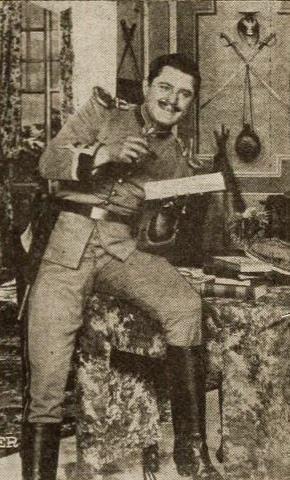
The climactic duel—shot in a garden whose hedges mimic amphitheatre walls—eschews the flailing chaos of Nelson-Wolgast Fight and instead opts for a crisp choreography: blades spark, Bumerli disarms Alexis with the polite efficiency of a maître d’ uncorking champagne. The defeated rival’s instantaneous rebound into Mascha’s arms feels less like narrative expedience than a silent admission that erotic supply chains, like military ones, reroute swiftly once the central conflict evaporates.
Surviving prints—tinted amber for interiors, cyan for night exteriors—lend the film a subconscious temperature gauge: love glows hearth-warm, danger shivers moon-cold. The amber passages bloom like backlit honey, coaxing out the brocade patterns on settees and the satin sheen of Nadina’s robes. Meanwhile, the sea-blue nocturnes envelop Bumerli’s escape with aqueous menace, as though the world itself has turned to brine and only chocolate sustains buoyancy.
Pay attention to the off-hand financial haggling between Alexis and Colonel Popoff: dowries tallied like reparations, a reminder that the film’s levity floats atop a substratum of transactional flesh. When Nadina snaps the engagement ring back at Alexis, the gesture carries the snap of a tradesman rejecting counterfeit coin. Her final acceptance of the “chocolate soldier” is thus not mere romantic fulfilment but a woman seizing the means of affective production, wresting matrimony from market square to balcony aerie.
Silent-film acting risks the semaphore of hysteria, yet Alice Yorke calibrates her responses to the millimetre: a half-step back registers panic, the flutter of lashes translates to entire sonnets. Tom Richards counterbalances with swagger subdued into something approaching wry self-awareness; his Bumerli knows he is both hero and hoax, and the twinkle in his eye solicits complicity from the audience. Together they achieve that rare silent-era chemistry where intimacy feels pilfered in real time, as though we, too, are hiding behind the arras.
Released the same year that Fantomas: The Mysterious Finger Print was serialising anarchic crime across Europe, The Chocolate Soldier offered a softer anarchism: the overthrow of martial masculinity by confectionery tenderness. Its DNA can be traced to Lubitsch’s later operettas, to Renoir’s Grand Illusion, even—whisper it—to the bittersweet battlefields of Martin Eden, where love again collides with class and uniform.
A miniature rococo symphony stuffed inside a tin box, The Chocolate Soldier survives as both wartime escapism and sly social satire. Its gender politics, while period-true, permit flashes of proto-feminist steel; its visual wit predates the sophisticated sign-play of In the Bishop’s Carriage. Most crucially, it reminds us that war, for all its iron clangour, can be—and frequently was—defused by a handful of chocolate drops and the audacity of three women who understood that the most lethal weapon is not the sabre but the photograph slipped into a pocket, waiting to detonate at the next peace banquet.
Watch it for the amber glow, stay for the sea-blue chill, and leave humming the impossible sweetness of a world where enemies taste like dessert and love letters arrive in the wrong envelopes—yet somehow still reach the right heart.
IMDb —
1927
Community
Log in to comment.