DbcultAccessing Vault...
Cult Review
Senior Film Conservator
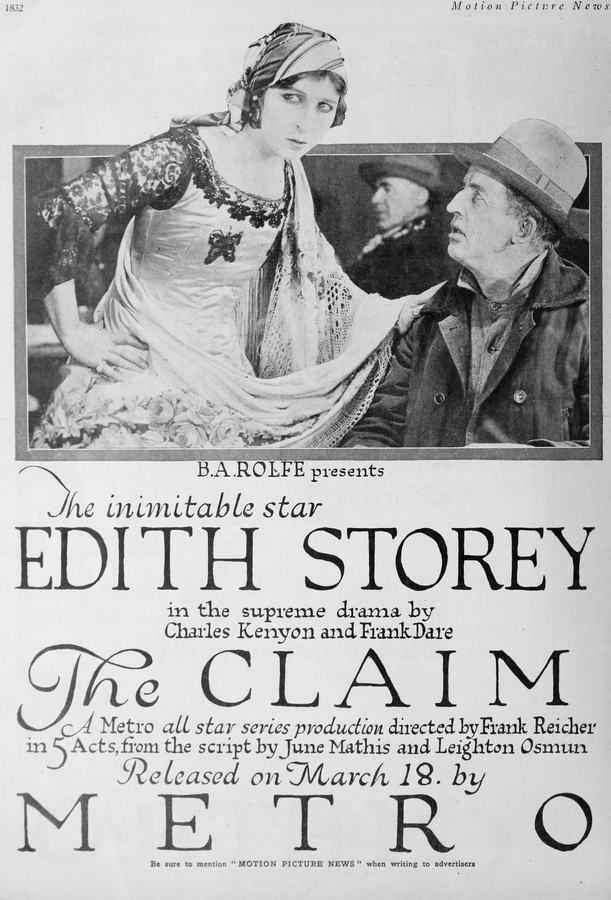
Stepping back into the hallowed, hushed halls of early 20th-century cinema, we encounter a work that, despite its age, still pulsates with a raw, human drama that many contemporary films struggle to capture. The Claim, a 1918 silent film directed by Frank Reicher, based on the narrative ingenuity of June Mathis, Charles Kenyon, Frank Dare, and Leighton Osmun, is more than just a historical artifact; it's a testament to the enduring power of storytelling, a masterclass in melodrama that explores the darkest corners of human desperation and the brightest flares of maternal love and sacrifice. In an era where visual storytelling was paramount, and dialogue was conveyed through intertitles, this film manages to weave a tapestry of emotions so intricate and profound, it compels the modern viewer to lean in, to feel, and to understand.
At its core, The Claim is a searing examination of the consequences of avarice and the moral compromises forced upon individuals by societal pressures. The narrative kicks off with Blackie Jerome, a character whose moral compass is conspicuously absent, prioritizing financial gain over marital vows and paternal responsibility. His abandonment of Belle, his wife, and their innocent infant, Goldie, for the allure of a wealthier union with Kate MacDonald, sets in motion a chain of events that are as tragic as they are inevitable. This initial act of betrayal isn't merely a plot device; it’s the seismic tremor that shatters the lives of all involved, creating ripples that extend far beyond the immediate moment. It’s a stark reminder that choices, particularly those driven by selfish ambition, carry an immense, often devastating, weight.
The immediate fallout of Blackie’s perfidy is swift and brutal. John MacDonald, Kate’s brother, upon learning of Blackie’s deceitful past, takes matters into his own hands, delivering a fatal blow to the gambler. This act of violent justice, occurring precisely as Belle arrives, paints a grim tableau of fate. Belle, now a widow, destitute and alone with an infant, finds herself trapped in a societal vice. The film, through its stark portrayal, implicitly critiques the limited options available to women in such dire circumstances during that period. Unable to provide for Goldie, Belle faces an unbearable choice: either watch her child suffer alongside her or give her a chance at a better life, even if it means relinquishing her. Her decision to abandon Goldie, while heartbreaking, is presented not as a act of malice, but as a desperate, wrenching sacrifice born of utter powerlessness. It’s a thematic thread echoed in countless melodramas of the era, where the struggles of the working class and the plight of women were often brought to the forefront, perhaps even in films like Congestion or The Derelict, which often explored the grim realities of poverty and social disenfranchisement.
Years later, Belle resurfaces, no longer the broken woman she once was, but a cabaret singer with a dream: to train as an opera singer. This aspiration, however noble, requires funds she doesn’t possess, leading her down a morally ambiguous path. She blackmails John and Kate MacDonald, who, in a twist of dramatic irony, have adopted Goldie. This pivotal plot point is where the film truly begins to explore the complexities of right and wrong. Is Belle justified in her blackmail, given her past suffering and her current ambitions? Or is she merely another opportunist, albeit one driven by a different kind of desperation than Blackie? The film doesn't offer easy answers, instead plunging the viewer into a moral quagmire, forcing contemplation on the nature of justice and retribution. The writers, June Mathis, Charles Kenyon, Frank Dare, and Leighton Osmun, demonstrate a keen understanding of human fallibility and the gray areas that define our choices.
The climax of the blackmail subplot is nothing short of emotionally devastating. When Belle finally comes face-to-face with her grown daughter, Goldie, the facade of calculated vengeance crumbles. Mignon Anderson's portrayal of Belle is particularly poignant here; her silent tears, her trembling hands as she holds the blackmail check, convey a torrent of conflicting emotions. The maternal bond, dormant for so long, erupts with an undeniable force, compelling her to tear up the check, effectively destroying her chance at an operatic career for the sake of her child. This act of self-abnegation is the film's beating heart, a powerful assertion that some connections transcend all material desires and past grievances. It’s a moment that resonates with the universal theme of a mother's selfless love, a theme explored in countless narratives, perhaps even finding echoes in the grand sacrifices depicted in films like Christus, albeit in a secular context of human devotion.
Yet, the narrative doesn't allow for a simple, fairytale ending. Belle, having reclaimed Goldie, soon faces another agonizing choice. Goldie, having known only the MacDonalds as her parents, pleads to return to them. This scene, more than any other, highlights the complexity of love and belonging. Belle's ultimate decision to return Goldie, despite her own profound longing, is an act of supreme maternal sacrifice. It is a testament to her love for Goldie that she prioritizes her daughter's happiness and stability over her own desire for reunion. This is where the film truly transcends mere melodrama, delving into the profound depths of selfless love. It's a nuanced portrayal of a mother's struggle, often unseen in films that might opt for a more conventional happy ending. The nuanced emotional landscape of this decision is where the film truly shines, demonstrating a sophisticated understanding of human psychology that belies its early cinematic origins.
The success of The Claim rests heavily on the shoulders of its cast, particularly Mignon Anderson as Belle. Silent film acting, often maligned as overly theatrical, in skilled hands becomes a powerful, expressive art form. Anderson's ability to convey Belle's journey – from despairing mother, to ambitious singer, to conflicted blackmailer, and finally to self-sacrificing parent – without uttering a single word, is remarkable. Her facial expressions, her gestures, her very posture speak volumes, communicating the inner turmoil and resilience of her character with compelling authenticity. Wheeler Oakman as John MacDonald also delivers a nuanced performance. His initial impulsiveness in dealing with Blackie evolves into a more protective and ultimately loving demeanor, showcasing a character arc that is both believable and emotionally satisfying. The supporting cast, including Fred Malatesta, Edith Storey, Paul Weigel, and Marian Skinner, contribute to the rich tapestry of the film, each playing their part in advancing the intricate plot and deepening the emotional resonance. The pacing of the film, characteristic of its era, allows for moments of quiet contemplation alongside bursts of dramatic action, ensuring that the audience is fully immersed in the unfolding narrative. The visual storytelling, guided by Reicher, uses framing and composition to enhance the emotional impact, drawing the viewer's eye to key expressions and interactions.
Beyond the immediate narrative, The Claim delves into broader societal themes relevant to its time, and indeed, to ours. The stark contrast between Belle's destitution and the MacDonalds' wealth highlights the class disparities that often dictated life's trajectories. Blackie's initial choice is driven by this very disparity, seeking to elevate his status through marriage. Belle's subsequent struggle, her abandonment of Goldie, and her turn to blackmail are all direct consequences of her lack of economic power. The film, in its own way, critiques a system that offered so little recourse to those at the bottom. Furthermore, the theme of redemption is central. John MacDonald, initially portrayed as a vengeful figure, ultimately finds love and forms a family with Belle, suggesting that even drastic past actions can be overcome by evolving circumstances and genuine affection. This journey from vengeance to love is a powerful undercurrent that elevates the film beyond a simple melodramatic plot. It's a reminder that human beings are capable of change, of growth, and of finding solace in unexpected places. The moral ambiguities presented in the plot, particularly Belle's blackmail, echo questions of justice and revenge seen in other films of the period, such as Fate's Boomerang, which often explored the complex interplay of human actions and their unforeseen consequences.
The writers, June Mathis, Charles Kenyon, Frank Dare, and Leighton Osmun, deserve particular commendation for crafting a narrative that, while adhering to the conventions of silent melodrama, manages to imbue its characters with genuine psychological depth. The motivations, conflicts, and ultimate resolutions feel earned, even when they stretch the bounds of conventional storytelling. The progression of Belle’s character, from a victim of circumstance to an active, if flawed, agent in her own destiny, is particularly well-developed. The choice to have Goldie plead to return to the MacDonalds, rather than simply accepting her birth mother, adds a layer of realism and heartbreak that distinguishes the film from more simplistic narratives. This refusal to shy away from the difficult, messy realities of human relationships is a hallmark of strong screenwriting, ensuring that the emotional impact is maximized without resorting to cheap sentimentality.
The film concludes with John MacDonald professing his love for Belle, leading to their marriage. This resolution, while perhaps seeming a touch convenient to modern sensibilities, serves as a powerful symbol of reconciliation and the forging of a new family unit from the ashes of past tragedies. It suggests that shared trauma, empathy, and the capacity for forgiveness can pave the way for unexpected bonds. John, who once acted as a violent arbiter of justice, now becomes Belle's partner, offering her the stability and love she was denied at the film's outset. It's a resolution that, while providing a sense of closure, doesn't erase the complexities that preceded it, instead suggesting a future built on understanding and mutual respect. This kind of nuanced ending, where characters find solace after immense struggle, is a common trope in classic cinema, often offering a glimmer of hope amidst the darkness, much like the thematic undertones found in The Little Liar or Johanna Enlists, which often championed resilience and the human spirit.
The aesthetic of The Claim, typical of its time, relies on stark contrasts and dramatic compositions. The use of lighting to highlight emotional states, the carefully crafted intertitles that serve as both dialogue and narrative exposition, and the overall rhythm of the editing all contribute to an immersive experience. While contemporary audiences might initially find the acting style and pacing unfamiliar, a willingness to engage with the film on its own terms reveals a sophisticated understanding of visual storytelling. The absence of spoken dialogue forces a heightened reliance on visual cues, making every gesture, every glance, every tear profoundly significant. This is where silent cinema truly excels, in its ability to communicate universal emotions through a language that transcends words.
In conclusion, The Claim stands as a compelling example of early American cinema's capacity for profound emotional depth and intricate narrative construction. It’s a film that asks difficult questions about morality, sacrifice, and the enduring power of familial bonds. The performances, particularly Mignon Anderson's, are captivating, drawing the viewer into Belle's tumultuous journey. The film's ability to evoke such strong emotions through purely visual means is a testament to the skill of its creators and the inherent power of the silent film medium. It serves as a valuable historical document, offering insights into the social mores and dramatic conventions of its era, while simultaneously delivering a timeless story of human struggle and eventual, if hard-won, peace. For aficionados of silent cinema, or anyone interested in the foundational narratives that shaped the art form, The Claim is not merely an interesting watch; it is an essential experience, a reminder of the foundational strength of storytelling before the advent of sound changed everything. It’s a powerful exploration of the human heart, capable of both immense cruelty and boundless love, often within the same individual, a truly captivating cinematic journey worthy of rediscovery. The layers of human experience, from the depths of despair to the heights of selfless affection, are meticulously rendered, leaving a lasting impression that echoes long after the final frame has faded. This film, like many of its era, such as The Edge of the Abyss, delves into the moral complexities and emotional struggles that define our existence, proving that compelling drama is timeless, regardless of how it is presented. Its continued relevance lies in its unflinching portrayal of the human condition, making it a masterpiece that continues to resonate with contemporary audiences willing to engage with its unique cinematic language.
IMDb —
1917
Community
Log in to comment.