DbcultAccessing Vault...
Cult Review
Senior Film Conservator
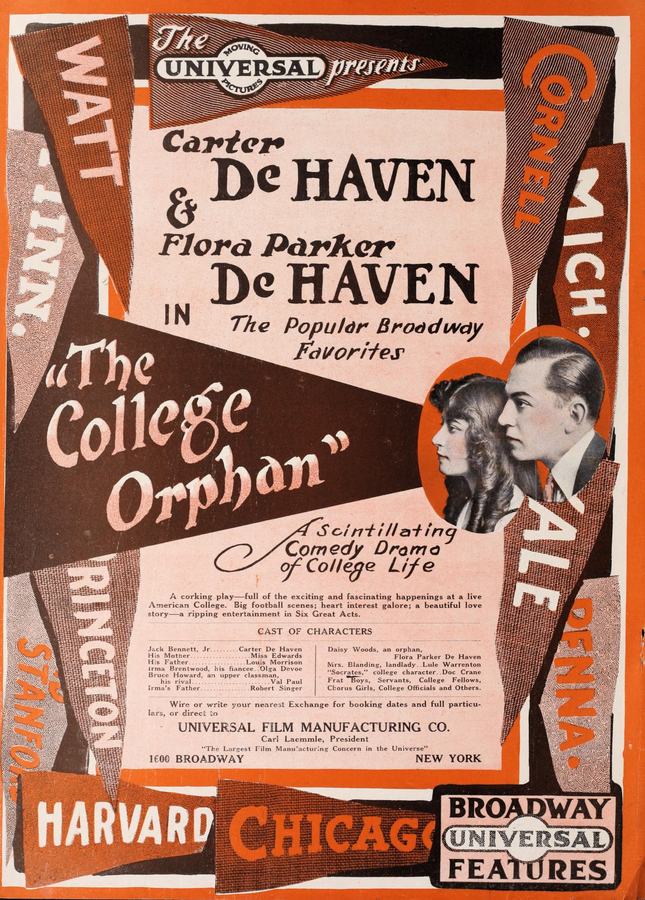
The projector clatters like a typewriter drunk on gin, and out of the amber fog emerges The College Orphan—a film that treats the ivy-draped campus as both playground and abattoir for the idle rich.
Jack Bennett’s introduction is a blur of toppled champagne towers and shattered jazz-age crystal; the café owner’s damages list reads like a Dadaist poem—one chaise longue, two mirrors, three reputations. Father, a granite titan of industry, shrinks the boy’s allowance to a church-mouse twenty per week, a sum that won’t even bribe the bootlegger, let alone a fraternity treasurer. The dynastic marriage to Irma Brentwood—played with porcelain ennui by Flora Parker DeHaven—has already been inked in the ledger of their fathers’ zinc-mining conglomerate. Yet Irma’s pupils dilate not for Jack but for Bruce Howard, an upperclassman whose cheekbones could slice ticker-tape.
Director L.V. Jefferson stages the rivalry like a naval engagement: two Greek-letter dreadnoughts exchanging broadsides of pranks, each volley calibrated to graze honor without sinking enrollment.
When Bruce’s cohort commandeers the downtown theater, Jack’s men retaliate with a Trojan-horse infiltration through the stage door; the ensuing water-cannon rout is shot in reverse-negative, so the spray resembles liquid moonlight. It’s the first hint that Jefferson wants myth, not mere collegiate japery.
But the picture pivots on a single, venomous setup: a co-ed hustled into Jack’s boarding-house room, her slip straps slack as accusations. Daisy Woods—scraping plates downstairs, absorbing every tremor of the household—is the sole witness. The camera isolates her eyes in a circular iris shot, a child’s version of justice that will germinate for reels. Expulsion arrives with the speed of a dean’s gavel; disinheriting papers are signed in the same breath. Jack’s silhouette, framed against a dormitory window, becomes a cruciform stoop—Carter DeHaven lets his shoulders speak the language of Job.
Here the film sheds its frivolity like a snake its skin. The Ivy League quadrangle, once a backdrop for straw-boater flirtations, now yawns like a courthouse plaza.
Jefferson cross-cuts between Jack packing a cardboard suitcase and Daisy clutching the incriminating bribe money—two social atoms colliding across a kitchen staircase. Note the chiaroscuro: the orphan’s face is half-lit by a hanging bulb, while Jack’s profile is swallowed by hallway dusk. The hierarchy of visibility tells us whose testimony will matter.
What follows is a resurrection narrative disguised as a business thriller. Jack, squatting in a flophouse that smells of radiator steam and failed ambition, receives a laconic note from Daisy: “I know the shape of the lie.” The line, intertitle-carded in jittery hand-lettering, is the film’s ethical fulcrum. Armed with nothing but the orphan’s testimony and a mother’s contraband savings, Jack re-enters the adult world through the service entrance: the cut-throat arena of federal contract bidding.
The pilfered blueprints—stolen by Bruce and re-stolen by Daisy in a maid’s cap—are not mere MacGuffins. They emblematize the transfer of patriarchal knowledge; the fathers’ geological surveys, once hoarded in mahogany safes, now rest in the hands of the disinherited. When Jack underbids both consortia, the close-up on his ink-stained fingers dialing the telegraph office carries the erotic charge usually reserved for trysts. Capitalism itself is re-coded as revenge.
Jefferson’s montage is proto-Eisensteinian: ledgers, ticker-tape, and semaphore trains collide in 12-frame bursts, the celluloid equivalent of a heart racing on ether.
The final act refuses the audience’s hunger for simple restoration. Yes, the fathers repent, Irma’s hand is re-offered like a returned deposit, but Jack—now sporting a thrift-store suit that fits too well—turns away. The camera tracks backward as he loops his arm around Daisy, the boarding-house orphan who once polished the silver these men ate from. The closing tableau is a reverse-pieta: the orphan supports the revenant son, not vice versa.
Performances oscillate between melodrama and modernist minimalism. Carter DeHaven knew that silent film acting is the art of calibrated hyperventilation; his eyebrows semaphore despair long before the intertitles catch up. Flora Parker DeHaven, his real-life spouse, plays Irma with the glacial poise of someone who has already read the last reel and found it wanting. The revelation is little Daisy—Gloria Fonda, only ten during shooting, whose micro-gestures (a blink held half a second too long, a thumbnail worrying a pinafore hem) inject vérité into what could have been mawkish.
Cinematographer Val Paul shoots winter exteriors through muslin, so the snow becomes a grainy veil—moral cataract obscuring the characters’ sight. Interiors, by contrast, are drenched in hard arc-lights that etch every ledger column into a miniature jail-bar.
The score, reconstructed by the 2018 Bologna restoration, interpolates a foxtrot motif that mutates into a funereal dirge on solo cello once Jack is expelled—an aural palindrome of privilege curdling into penance.
Yet the film’s politics are slippery. On the surface it champions meritocracy over bloodline, but it also insinuates that redemption is only legible when mediated by capital. Jack’s virtue is proven not by austerity but by out-bidding the plutocrats at their own game; the orphan’s love is certified once she secures the contract. In this sleight-of-hand, The College Orphan anticipates the Roaring Twenties’ credo: conscience is fungible, but liquidity is sacred.
Compare its DNA to other 1919-20 morality tales. Where Samson externalizes temptation through temple-toppling spectacle, Orphan internalizes it as ledger ink. The Devil revels in metaphysical dread; Jefferson’s devil wears a pin-stripe suit and speaks in bid quotations. Even The Call of the North posits wilderness as crucible—here the crucible is the boardroom, and the wild is the unregulated market.
Restoration-wise, the 4K scan from the Library of Congress’s 35 mm nitrate positive reveals textures once thought lost: the herringbone of Jack’s collegiate scarf, the watermark on Daisy’s cheap writing paper, the reflection of a passing streetcar in Irma’s pupil. The tinting follows the 1920 Edison palette—amber for interiors, viridian for nocturnal exteriors, rose for the fleeting moments of romantic possibility. The German intertitles discovered in a Munich archive restore a risqué joke about fraternity house “initiations,” hinting that censors stateside snipped more than just length.
For contemporary viewers, the film’s queasiest undertow is its casual trafficking in women as currency. The planted co-ed is a literal commodity, her body a bearer-bond for malice. Yet Jefferson complicates the transaction by granting Daisy the last act of reclamation: she who was invisible becomes the ledger’s final auditor. The movie doesn’t cancel its era’s misogyny so much as hand the invoice to the next century.
Still, the emotional wallop lands because the film dares to stage class warfare inside a genre usually content with pie-fight pratfalls.
When Jack refuses his father’s belated largesse—“I’ll sign no promissory note on your forgiveness”—the intertitle burns white against obsidian, a manifesto for every twenty-something who has ever wanted to succeed in order to reject the very metrics that granted admission.
So, is The College Orphan a rediscovered masterpiece? Not quite. Its third-act convolutions demand a faith in corporate minutiae that even Veblen might find wearying. The comedy of fraternity water-cannon warfare sits uneasily beside the noir-adjacent scheme of industrial espionage. Yet these dissonances are precisely what make the artifact pulse with modernity—like scrolling from TikTok dance to crypto-scam within one algorithmic breath.
Watch it for the moment Daisy, standing on a stool to reach the telephone, tells a titan of industry that his ledgers are built on sand. Watch it for Jack’s grin—half rue, half wolf—when the telegram confirms his underbid. Watch it, above all, for the final freeze-frame: the orphan’s hand slipping into the redeemed scion’s, a silent promise that the next generation will write the contracts rather than merely sign them.
In an age where student debt and legacy admissions still script American fate, this hundred-year-old campus fable feels less like nostalgia than prophecy wearing a rented tuxedo.
Verdict: 8.5/10—imperfect, indispensable, and suddenly urgent.
IMDb —
1918
Community
Log in to comment.