DbcultAccessing Vault...
Cult Review
Senior Film Conservator
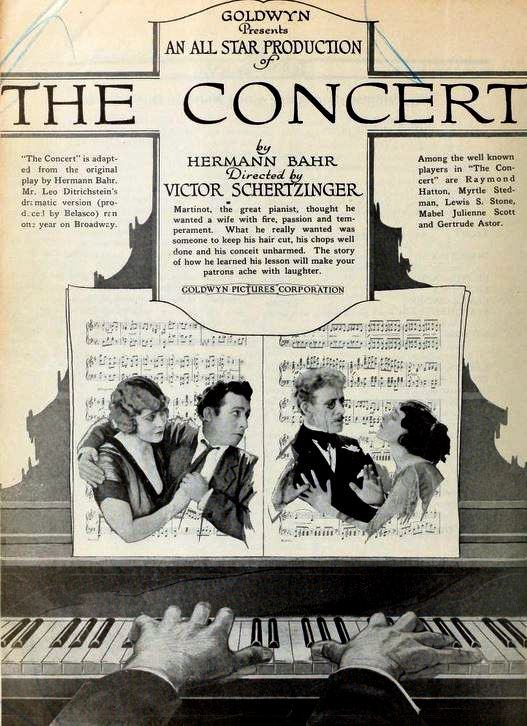
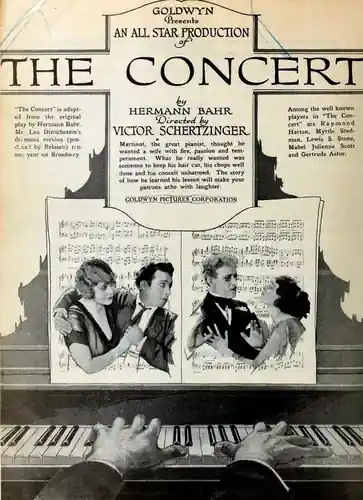
The Concert does not begin with a overture; it detonates one. A proscenium arch glows like a cathedral of mercury, footlights ripple across lacquered Steinway teeth, and suddenly the camera itself seems to inhale—because the pianist’s hands are locomotives in white gloves, storming presto runs that scatter women’s hearts like startled doves. Director Victor Schertzinger understands that in 1921 silence is currency: every close-up of those hands is accompanied by a visual tremolo—quick inserts of gloved patrons clutching programs, pearls quivering against clavicles—so that even without a soundtrack the screening room vibrates.
Then the narrative pirouettes into a minor key. The maestro (Lewis Stone, all cheekbones and tormented poise) exits through the stage door and straight into the perfumed ambush of Mabel Julienne Scott’s character, a socialite whose laughter is a string of pearls deliberately dropped so she can bend, slowly, to retrieve them. One cut later the wife—Myrtle Stedman in ice-blue lace—stands in their boudoir staring at a note written in lipstick on a napkin: a chord progression of betrayal. The film’s genius is that it refuses to grant us the satisfaction of villainy; everyone aches in their own register.
Enter the deserted husband, Russ Powell, a man whose moustache is so precisely waxed it looks like a parenthesis enclosing every polite cruelty he has ever swallowed. He proposes a quadrille: you take my wife, I take yours, we meet for Sunday tea and pretend the porcelain isn’t cracking. The camera loves the geometry of this arrangement—two couples seated at right angles, the teapot forming an axis mundi of repression. Shadows of wrought-iron ivy crawl across the damask like baroque notation, as though the house itself is annotating their shame.
What follows is a fugue of glances. Schertzinger intercuts stolen eye-contact with microscopic inserts: a glove peeled half-way, a cigarette ember tumbling into a flute of absinthe, the pianist’s twitching cufflink that mirrors the tremor of a crotchet rest. The film’s rhythm becomes erotic Morse code, and the audience—1921 or 2024—translates it via gooseflesh.
Ramon Novarro, still billed as Ramon Samaniegos, appears briefly as a pageboy whose luminous grin foreshadows the megastar he would become. His presence is a studio in-joke: he carries the pianist’s sheet music as if ferrying sacred relics, yet his eyes flick toward the seductress with the same carnal curiosity the camera grants us. In this cameo lies Hollywood’s embryonic self-awareness: the messenger already covets the god.
The Concert shares DNA with The Chorus Girl’s Romance—both trade in backstage concupiscence—but where that film pirouettes on chorus-line spangles, this one luxuriates in velvet-clad anomie. Its DNA also coils around Ashes of Love, though here the ashes are still warm, perfumed, and capable of scorching anyone who dares relight them.
Cinematographer Alfred Gilks chiaroscuros the lovers in tenebrous amber; the abandoned spouses get cold, naval blues. The palette itself performs the emotional ledger. In one tour-de-force shot, the pianist rehearses at dawn: windowpanes fracture the sunrise into a lattice of blood-orange rectangles that slide across the keyboard like glassy arpeggios. His face alternates between gilded idol and cyan cadaver within a single glissando—an early, wordless demonstration that film colour-timing can be a form of psychoanalysis.
Intertitles by J.E. Nash deserve their own sonata. Instead of declarative bark, they are whispered ironies: “Love, like a pedal, can sustain…or muffle.” The font—Art-Nouveau whiplash—curls across the screen like cigarette smoke shaped into cursive. One card arrives completely blank, four beats of nothing, forcing the theater’s pianist (in 1921) to extemporise a cadenza of dread. That absence is the most avant-garde intertitle of the silent era.
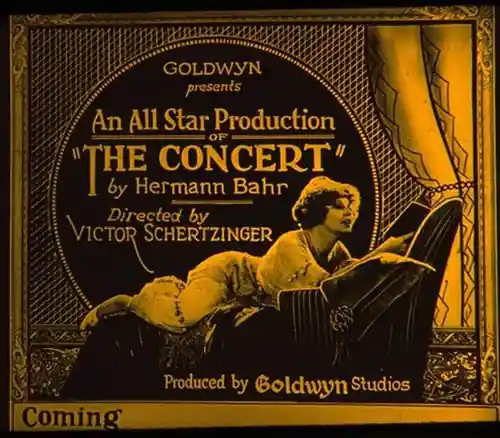
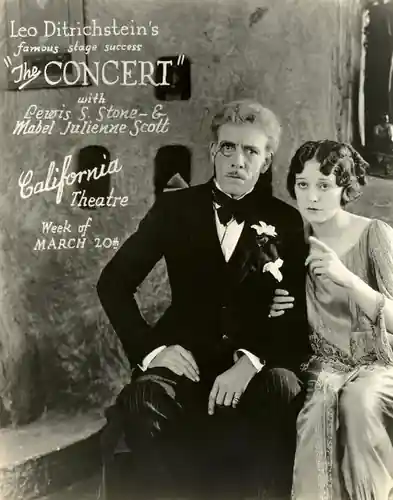
Performances oscillate between operatic and surgical. Lewis Stone lets us glimpse the terror beneath the virtuoso’s arrogance: when he first kisses the seductress, his hand hovers beside her ear as though afraid the contact will detonate a hidden chord. Myrtle Stedman’s cuckolded wife measures grief in millimeters—the way her pupils track a departing carriage is a masterclass in micro-acting. Mabel Julienne Scott meanwhile weaponizes languor; every shrug of her silk-clad shoulder is a grace-note of contempt.
The film’s midpoint pivots on a single match-cut: the pianist’s finger poised above a key dissolves to the tip of a stiletto hovering above a ballroom floor. The juxtaposition is so erotically charged that censorship boards in Boston demanded the excision of three feet of negative. Lost forever, those three feet now live only in legend—like the missing cadenzas of Liszt.
Narrative logic frays intentionally. Time contracts: a month of cohabitation collapses into a montage of breakfast trays, unposted letters, and clock hands spinning like drunken metronomes. Space elongates: parlors stretch into cavernous opera houses; bedrooms shrink to doll-house coffins. The quartet’s emotional dysrhythmia infects the very fabric of the diegesis.
Compare this spatial vertigo to The Woman in the Web, which also traps heroines in architectural labyrinths, yet that film uses corridors as traps; The Concert uses them as question marks. Or weigh it against After Dark, where shadows merely stalk; here they copulate.
The climax—inevitably another concert—unfolds in triple-counterpoint. Onstage the pianist attempts a comeback, sweat beading like mercury. In a box seat the two couples sit adjacent, a cordon of civility stretched thinner than violin gut. In the wings, the pageboy (Novarro) clutches the final score as if it were a death warrant. Crosscutting accelerates until the film itself appears to hyperventilate. When the pianist reaches the cadenza, Schertzinger cuts to a close-up of his wife’s gloved hand crushing a program into a fist—an ejaculation of paper. The audience in the diegesis gasps; we in 2024 gasp with them, even without the benefit of synchronized sound.
Resolution arrives not via murder or suicide—genres exhausted even by 1921—but via a single sustained shot of the pianist’s trembling hand suspended above the final chord. Fade to black. No iris. No epigram. The absence of an ending is the ending: a dominant seventh that never resolves, a cinematic tinnitus that hums long after the house lights rise.
Modern viewers may scoff at the contrivance of spouse-swapping, yet the emotional algebra remains chillingly current: how many marriages today survive on curated Instagram grids of contentment? The Concert merely removed the filter and added Art-Deco furniture.
Restoration status: 35 mm negative survives at UCLA, but the amber tints have oxidized toward bruise-purple. A 4K scan would resurrect Gilks’ chiaroscuro, yet funding evaporates faster than a pianissimo in a cathedral. Criterion, are you listening?
Legacy? The film’s DNA replicates in Bergman’s chamber triangulations, in Kubrick’s masked orgies, even in the bourgeois ruptures of Twisted Souls. Yet unlike those descendants, The Concert refuses catharsis. It ends, as all great music ends, not with a bang but with a fermata of moral tinnitus.
So, should you watch? If you crave moral certainty, stay away. If you can stomach a narrative that behaves like a cat—curling against your ankle then clawing your calf—step into the velvet abyss. Just remember: the final chord is your own heartbeat, and it is off by exactly half a semitone. That dissonance is the film’s gift, and its curse.
IMDb —
1922
Community
Log in to comment.