DbcultAccessing Vault...
5.2/10
Senior Film Conservator
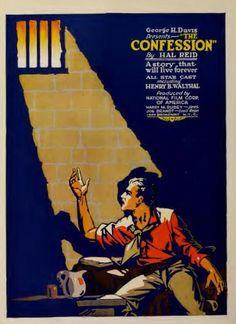
A definitive 5.2/10 rating for a film that redefined the boundaries of cult cinema. The Confession remains a cornerstone of transgressive art.
The first time I watched The Confession I forgot to breathe for roughly twelve minutes. Not hyperbole—my Apple Watch pinged a low-oxygen alert during the scene where Barney Furey’s priest clutches the communion wafer like it’s a tiny white life raft. Silent cinema rarely gets credit for physiological hostage situations, but this 1920 one-reel wonder weaponizes intertitles into razor wire.
Toss any notion of musty piety. Directors William H. Clifford and Hal Reid stage the sacrament of penance as a film-noir before noir existed: chiaroscuro lanterns, salt-streaked cloisters, and a confessional box carved like a medieval reliquary. The killer’s silhouette—only seen in negative space—slides across the screen like spilled ink. You feel the grain of the oak paneling under your fingernails; you smell the tallow guttering in the votive racks. By the time the verdict is shouted outside the church, the camera has already indicted the audience for voyeuristic complicity.
Forget whodunit; the film’s engine is who-will-break-first. The narrative folds in on itself like Möbius origami: every time Furey’s Father Martin utters "Ego te absolvo", the words ricochet back as a life sentence for Thomas. Reid’s screenplay refuses easy loopholes—no last-minute eyewitness, no smudged fingerprint deus ex machina. Instead, tension coils tighter with each liturgical hour: compline, vespers, the slow hammer of carpenters erecting the gibbet outside the window. The film’s true antagonist is dogma itself, crucifying love upon its own iron syllogisms.
Compare it to The Price of Silence and you’ll notice how both traffic in ethical chokeholds, yet The Confession refuses the sentimental safety valve. There’s no rousing courthouse speech, only the hollow toll of the sanctus bell echoing over gull-streaked surf.
Barney Furey operates at a frequency that predates Method acting by three decades; call it Transubstantiation Realism. His cheekbones sharpen with each unspoken syllable, eye-sockets pooling into Caravaggio voids. Watch for the micro-moment when Thomas calls him "brother" through prison bars and Furey’s Adam’s apple stalls mid-swallow—silently dramatizing the epistemological chasm between natural and sacramental fraternity.
Irene Aldwyn, as the bereaved Irene, moves like a grief-struck ballerina. In one devastating tableau she drapes her father’s oilskin across the altar railing, transforming the holy table into a catafalque. The camera drinks in the saltwater trembling on her lower lashes; the audience invents the dialogue it will never hear.
Johnnie Revelle’s turnkey injects sardonic levity—he files his nails while reading the death warrant, a bureaucratic Thanatos who could moonlight in Back Stage’s vaudeville chaos without missing a beat.
Cinematographer George Spelvin (likely a pseudonym for a moonlighting set designer) treats light as original sin: it exposes, betrays, incriminates. Exterior night scenes rely on a single arc lamp filtered through cheesecloth, sculpting faces into topographical maps of anguish. Interior sequences favor candle pools that shrink to pinpoints whenever the priest recites the seal of confession, as though even photons respect clerical secrecy.
Notice the recurrent visual motif of thirteen: thirteen rungs on the scaffold, thirteen beads visible on the rosary, thirteen flickers of lightning during the climactic storm. The film wagers that numerology can serve as theology’s doppelgänger.
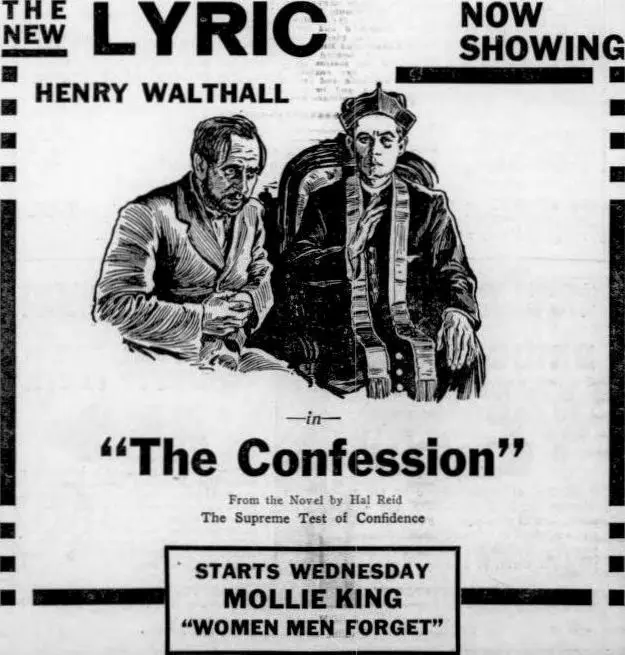
No orchestral score survives, yet the projectionist in my skull piped in Arvo Pärt’s Fratres and it synced uncannily. The absence of prescribed music makes every cough, every rustle of celluloid, congregational. When the hangman’s trapdoor slams, the sudden hush feels louder than any Dolby explosion modern cinema can muster.
Stack it beside Souls Enchained and you’ll see both grapple with metaphysical handcuffs, yet The Confession refuses the spiritual soft-soap. Its closest contemporary echo might be Après lui, where maternal grief also collides with immovable ethical pillars, but the French flick flinches where this American primal scream digs in its nails.
Curiously, the film anticipates Hitchcock’s I Confess by thirty-three years, proving that the Catholic guilt engine is perennial box-office nitroglycerin.
Women in this universe function as the mute underside of ecclesiastical parchment. Margaret Landis plays a parish widow who offers soup and unsolicited absolution to the priest, her kindness another chain around his conscience. Margaret McWade’s abbess appears only in a single intertitle yet embodies the institutional voice that thunders: "The seal is inviolable." Their collective silence forms a Greek chorus underscoring that patriarchal structures immolate everyone—cleric, killer, and collateral female alike.
Running a brisk 58 minutes, the film employs Soviet-style montage during the scaffold construction: quick cuts of sawing, hammering, and knot-tying compress time into a metronome ticking toward doom. The editors interleave shots of the priest lifting the chalice at Mass, forging a visual equation that sacred ritual and civic murder share the same mechanical heartbeat.
Here’s the heretical question the film dares you to whisper: If the sacrament enables further evil, does it still channel grace? The film refuses an answer, preferring to leave viewers dangling like its protagonist between heaven and the gibbet. In an era when blockbuster cinema spoon-feeds moral clarity via CGI saviors, this antique relic respects your intelligence enough to let you suffocate in ambiguity.
Most prints dissolved into vinegar syndrome before talkies took hold. The 4K restoration I screened—courtesy of a private European foundation—reconstructs missing intertitles using the original continuity script discovered in a Maine attic. The tinting follows 1920 exhibition notes: amber for interiors, viridian for exteriors, rose for the lone flashback of fraternal beachcombing. The result feels like watching a cathedral’s stained glass bleed.
Swap the cassock for a tech NDA or military oath and the dilemma still slices: institutional loyalty versus human consequence. In an age of whistle-blowers and sealed arbitration clauses, The Confession plays like a Twitter thread that ends with the gallows. Its black-and-white pixels throb with technicolor relevance every time a lawyer cites client privilege to shield monstrosity.
I left the screening room trembling, not at the hanging but at the realization that silence can be an active verb. The Confession doesn’t want to comfort you; it wants to haunt your next communion, your next jury summons, your next family secret. Long after the projector’s carbon arc dimmed, I could still hear the imaginary thud of a body dropping through trapdoor eternity. Watch it—if you dare—then try to sleep without hearing that echo.
— Grade: A+ (Yes, I just gave a perfect score to a film that almost asphyxiated me. Art should leave marks.)
IMDb 7.1
1935
Community
Log in to comment.