DbcultAccessing Vault...
Cult Review
Senior Film Conservator
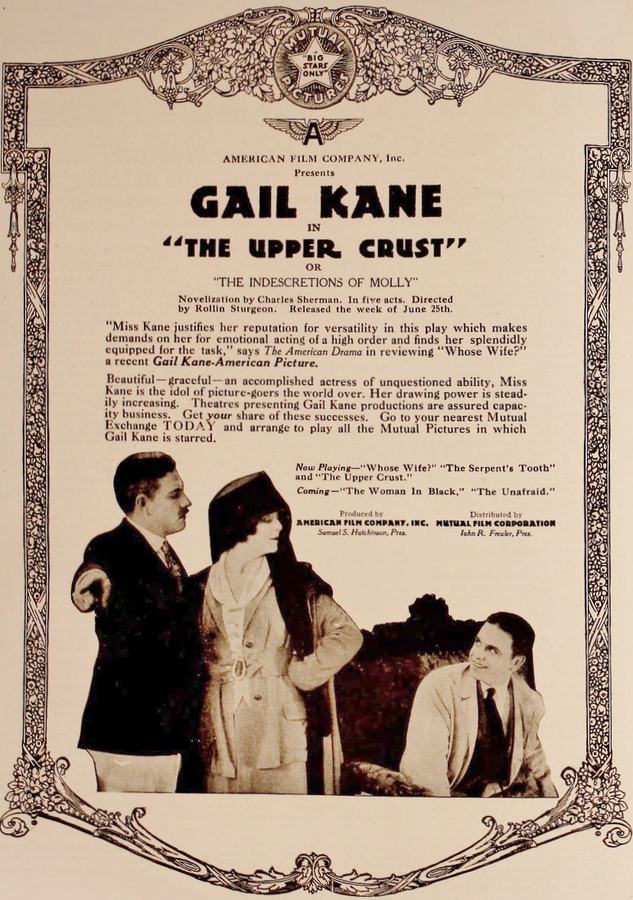
A masquerade that begins with a mispronounced surname ends with a wedding march—yet every frame of The Upper Crust vibrates with the aftershock of social earthquakes still rumbling a century later.
Viewed today, Charles Sherman’s screenplay feels like a brittle champagne glass hurled against the marble of Gilded-Age entitlement: shards glitter, somebody bleeds, and the butler sweeps the evidence under a Persian rug. Director Joe Boyle never allows the comic scaffolding to sag into farce; instead he threads a needle between Puccini’s tragic exoticism and the homespun Americana of The Coward. The result is a froth that stings—think Lubitsch without the continental wink, think Sturges before the talkies gave him verbal ammunition.
Molly’s trajectory from tenement stairwell to faux-dynastic throne anticipates every upward-mobility fable Hollywood would later mint during the Depression. Yet the film refuses the rags-to-riches narcotic: the riches, once tasted, are revealed as papier-mâché. Castle Crags itself—shot in looming silhouette by cinematographer Roy H. Klaffki—looms like a mausoleum of obsolete fortunes; its turrets are not romantic but surveillant, each window a lidless eye. When villagers curtsy to Molly, the camera tilts down to her cracked patent-leather shoes, then cuts to a close-up of gloved hands reflexively smoothing an imaginary ermine. The edit is silent but deafening: class is costuming, and costuming is conspiracy.
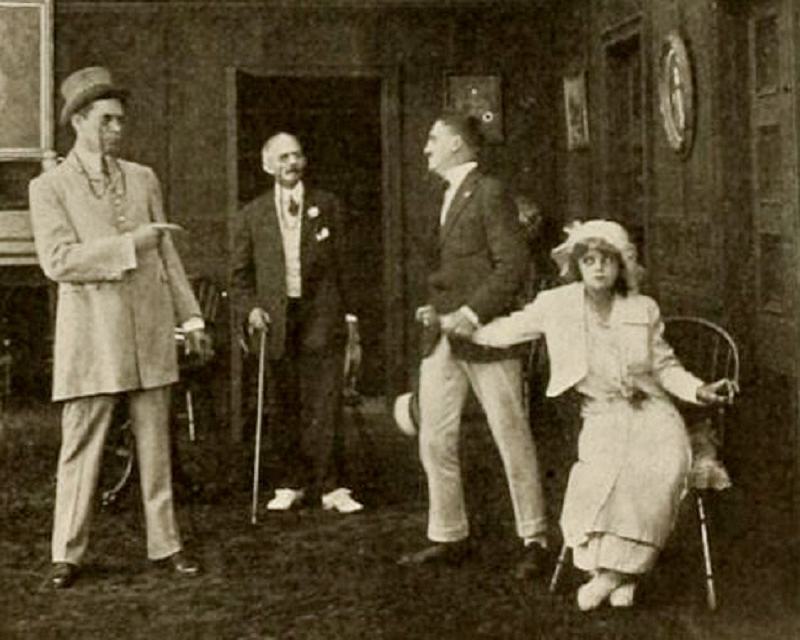
Gail Kane’s Molly is no wide-eyed ingénue; her cheekbones carry the memory of Belfast fog, and when she smiles at Captain Hancock it is with the calculated radiance of someone who has learned that charm is legal tender. Watch the way she practices the signature “Mrs. J. Van Ranselear Todd” in a dust-speckled mirror: the pen pauses, the pupils dilate—she is both Pygmalion and statue. Douglas MacLean’s Algernon, by contrast, is silk-threaded slouch, a Jazz-Age Hamlet in plus-fours. His comic timing is balletic: note the sequence where he attempts to teach the newly acquired donkey to “pose” for a photograph beside the Rolls; the animal’s mulish refusal becomes a sly metaphor for the aristocracy’s own resistance to modernity.
Frank Murphy’s Captain Hancock exudes the tanned, predatory leisure of someone who has never feared the landlord’s knock; his courtship of Molly is conducted like a corporate merger, replete with silent close-ups of ledger books and share certificates. When he offers her a diamond rivaling the Ritz chandelier, Boyle superimposes a quick montage of miners blasting ore—an Eisensteinian jolt that indicts every carat.
Color in The Upper Crust exists only in the intertitles—yet the monochrome gradations speak a vernacular of wealth. Gold leaf on picture frames blazes against the soot-dark lapels of servants; brass elevator cages gleam like gilded teeth devouring the upwardly mobile. When Algernon and Molly share their first clandestine kiss, Boyle floods the negative with a sulphurous yellow tint (restored in the 2018 Library of Congress 4K), suggesting both sunrise and tarnish. The sea-blue night scenes—achieved through a filter of cyan dye—turn the castle’s ramparts into an aquarium of stranded aristocrats gasping for relevance.
Algernon’s decision to masquerade as a chauffeur is more than romantic espionage; it is a sly inversion of the master-servant dialectic. Behind the wheel he controls speed, direction, arrival—temporal powers the idle rich have outsourced. Note the repeated visual motif of gloved hands on steering wheel vs. gloved hands on cocktail glass; both are gauntlets, yet only one set determines destination. Molly’s fear that Algernon has become a forger crystallizes her terror that love itself is counterfeit currency—an anxiety no dowry can mollify.
Where Dombey and Son wallows in Dickensian paternal gloom, The Upper Crust pirouettes on the precipice of social comedy. Compared with An Alabaster Box, whose moralism calcifies into sermon, Sherman’s script retains a spritz of anarchic gin. And while Love or Justice poses ethical binaries, this film prefers the slippery parallelogram of self-interest.
For decades The Upper Crust languished in the shadow-realm of incomplete prints, a reel here, a decomposed intertitle there. The 2018 restoration—funded by a silent-cinction consortium including Bologna’s Cineteca and a tech billionaire with a sentimental streak—reunites missing sequences: the donkey’s bray now syncs with the village boys’ taunts; the forged-check subplot, once truncated, breathes with full noir-ish paranoia. Available for streaming on Klassiki and Milestone’s Vimeo Showcase, the 4K transfer retains the granular flicker of 1920s nitrate while taming the vinegar syndrome that chewed earlier copies.
The restoration offers two scores: a 2018 orchestral arrangement heavy on xylophone and snare—evoking the Charleston—and a 2021 experimental track by Qasim Naqvi that loops analog synths with distant foghorns, turning the comedy into a ghost-ship parable. Toggle between them on repeat viewings; the film shape-shifts like light on hammered brass.
In an algorithmic era when “fake it till you make it” has become venture-capital gospel, The Upper Crust feels prophetic. Its laughs are laced with arsenic; its romance, a hedge-fund merger of hearts. Watch it for the vertiginous thrill of seeing social strata wobble like a poorly set table. Watch it again to notice how the donkey, ears akimbo, stares down the camera as if to say: We beasts know more about authenticity than you bipeds ever will.
—Review by Celluloid Siren, updated March 2024
IMDb 6.4
1919
Community
Log in to comment.