DbcultAccessing Vault...
5.3/10
Senior Film Conservator
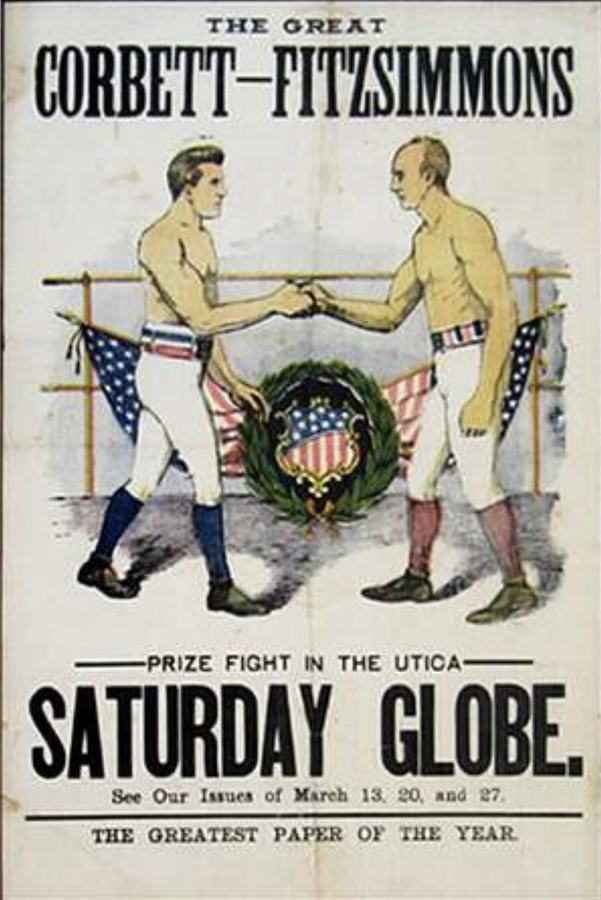
A definitive 5.3/10 rating for a film that redefined the boundaries of cult cinema. The Corbett-Fitzsimmons Fight remains a cornerstone of transgressive art.
To approach The Corbett-Fitzsimmons Fight merely as a sports documentary is to miss the forest for the trees, or more accurately, the entire landscape for a single, albeit pivotal, match. This 1897 production, an endeavor of staggering ambition for its time, is nothing less than a foundational text in the global cinematic lexicon. It is the very first feature film, a daring assertion that the moving image could sustain an audience's attention for more than a few fleeting minutes, and in doing so, it irrevocably broadened the horizons of what cinema was, and what it could become. It is a historical artifact, a technological marvel, and a cultural touchstone all rolled into one, a raw, unvarnished capture of an event that reverberated through the public consciousness of the late 19th century.
In an era dominated by 'actualities' – short, single-shot films depicting everyday scenes, snippets of vaudeville, or staged comedic gags – the concept of filming an entire boxing match, from the opening bell to the final, decisive blow, was revolutionary. The match itself, between the reigning heavyweight champion James J. Corbett, the charismatic 'Gentleman Jim,' and the formidable challenger Bob Fitzsimmons, known for his devastating solar plexus punch, was a monumental event. Held on St. Patrick's Day in Carson City, Nevada, it drew an immense crowd and captivated a nation. The decision to film this entire spectacle, and to exhibit it as a continuous, feature-length presentation, was a stroke of entrepreneurial genius and technical audacity. Enoch J. Rector, often credited with the camera work and direction, employed a massive 1,100-foot roll of film, a scale virtually unheard of. The logistical challenges alone – transporting equipment to a remote location, ensuring consistent light over a prolonged period, and developing such an enormous quantity of film – speak volumes about the pioneering spirit behind this project. This was not just a film; it was an industrial undertaking, a grand experiment in the nascent medium's capacity.
The film's original runtime exceeded 100 minutes, a duration that dwarfed anything that had come before. This length was critical; it shifted cinema from being a mere novelty, a brief distraction, to a sustained experience. Audiences were no longer just catching a glimpse; they were immersed. The very act of sitting through such a long film required a different kind of engagement, fostering the collective viewing experience that would define cinema for decades. It demonstrated that film could tell a story (even a real-time, unfolding one) with a beginning, middle, and end, paving the way for the narrative features that would soon dominate the industry. The impact was immediate and profound, proving that there was a viable commercial model for longer-form cinematic content, and that the public had an appetite for it.
What Rector and his team captured was not just a boxing match, but a slice of raw, unvarnished reality. The film presents the fight with a stark, almost brutal honesty. The camera, positioned at a fixed angle, offers an unblinking gaze upon the square ring. There are no dramatic close-ups, no sweeping pans, none of the sophisticated cinematic language we associate with sports broadcasting today. Instead, we are given a wide, static shot that allows the viewer to absorb the entirety of the action within the frame. This 'objective' viewpoint, while perhaps born of technical limitations, imbues the film with an almost anthropological quality. We see the fighters move, feint, and strike with a clarity that must have been astonishing to contemporary audiences, accustomed only to static photographs or fleeting glimpses. The dust, the sweat, the expressions of pain and determination – all are rendered with a visceral immediacy.
The drama of the fight itself is inherent, requiring no artificial embellishment. Corbett, the more refined boxer, attempts to outmaneuver Fitzsimmons, a powerful slugger. The ebb and flow of the match, the shifts in momentum, the brutal efficiency of Fitzsimmons's eventual victory via a body blow – it all unfolds before the viewer's eyes with a compelling, unmanufactured tension. The film captures the raw athleticism and the sheer brutality of professional boxing in the late 19th century, serving as a vital historical document of the sport itself. The audience's reactions, visible in the periphery of the frame, add another layer of authenticity, reminding us that this was a public spectacle, a shared experience that film was now making accessible to an even wider public.
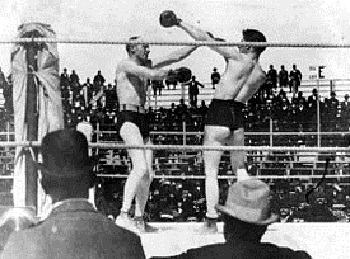
The challenges faced by the filmmakers were immense. The 'Lumière Kinetograph,' or a similar large-format camera, was a cumbersome beast. Film stock was fragile and expensive, and the process of shooting for over an hour and a half continuously was a logistical nightmare. The film had to be developed and printed with painstaking care, a process that itself was prone to error and spoilage. The very act of projecting such a long film presented its own difficulties, from maintaining consistent lamp intensity to preventing the nitrate film from catching fire – a not-uncommon occurrence in early cinema. That any significant portion of this film survives today, let alone that it was successfully exhibited across the country, is a testament to the dedication and ingenuity of its creators.
While we praise its pioneering spirit, it is also important to acknowledge the film's inherent limitations from a modern perspective. The fixed camera position, while historically significant, naturally restricts the visual dynamism. There is no editing in the modern sense, no cuts to emphasize specific moments or shift perspective. The narrative is purely chronological, dictated by the real-time unfolding of the event. Yet, these 'limitations' are precisely what give the film its unique power. They force the viewer to engage with the raw image, to search for detail, to interpret the action within the confines of the frame. It is a form of cinematic direct cinema, decades before the term was coined, a testament to the power of simply observing. The graininess, the occasional flicker, the imperfections inherent in early film stock, all contribute to its antique charm, reminding us of its age and its monumental place in history. These aren't flaws; they are the fingerprints of its creation, markers of its temporal distance and the technological hurdles overcome.
The Corbett-Fitzsimmons Fight was more than just a film; it was a cultural phenomenon. Its exhibition sparked immense public interest, demonstrating the power of cinema to bring distant, high-profile events directly to the masses. It democratized access to spectacles that were once exclusive to those who could afford a ticket and travel to the venue. This film established a precedent for the role of media in shaping public perception and creating shared national experiences. It fueled the nascent celebrity culture surrounding athletes and entertainers, turning figures like Corbett and Fitzsimmons into household names even for those who never saw them fight live. The film's success undoubtedly encouraged further investment in cinematic technology and production, accelerating the medium's development.
Its legacy extends far beyond its immediate impact. By proving the viability of the feature-length format, it laid crucial groundwork for the development of narrative cinema. While this film documented reality, it showed that audiences were willing to commit to a sustained viewing experience, a fundamental prerequisite for fictional storytelling on screen. It directly influenced the burgeoning genre of sports documentaries and newsreels, demonstrating how film could serve as a powerful historical record. Every subsequent feature film, every long-form documentary, owes a debt to this audacious experiment. It is a testament to the vision of its creators that they saw beyond the short 'actualities' and envisioned a future where cinema could truly encapsulate and transmit entire events, stories, and experiences.
Watching The Corbett-Fitzsimmons Fight today is an exercise in historical appreciation. It's a journey back to the very moment cinema realized its potential for scale and sustained engagement. It forces us to consider the medium's origins, stripped bare of all the complex techniques and conventions we now take for granted. It's a stark reminder of the pioneering spirit, the sheer ingenuity, and the raw ambition that characterized the earliest days of filmmaking. This is not just a film about a boxing match; it is a film about the birth of an art form, captured with a clarity and daring that remains profoundly resonant.
In its unyielding focus, its daring length, and its unadorned presentation of a pivotal moment, The Corbett-Fitzsimmons Fight transcends its simple subject matter. It is a profound statement on the power of the moving image, a declaration of cinema's ability to not only record but to elevate reality into spectacle, and to preserve fleeting moments for eternity. It stands as a vital, irreplaceable piece of cultural heritage, a testament to the innovators who, against all odds, forged the very foundations of the art form we cherish today. Its significance is not merely historical; it is fundamentally existential to the understanding of cinema itself.
IMDb —
1918
Community
Log in to comment.