DbcultAccessing Vault...
Cult Review
Senior Film Conservator
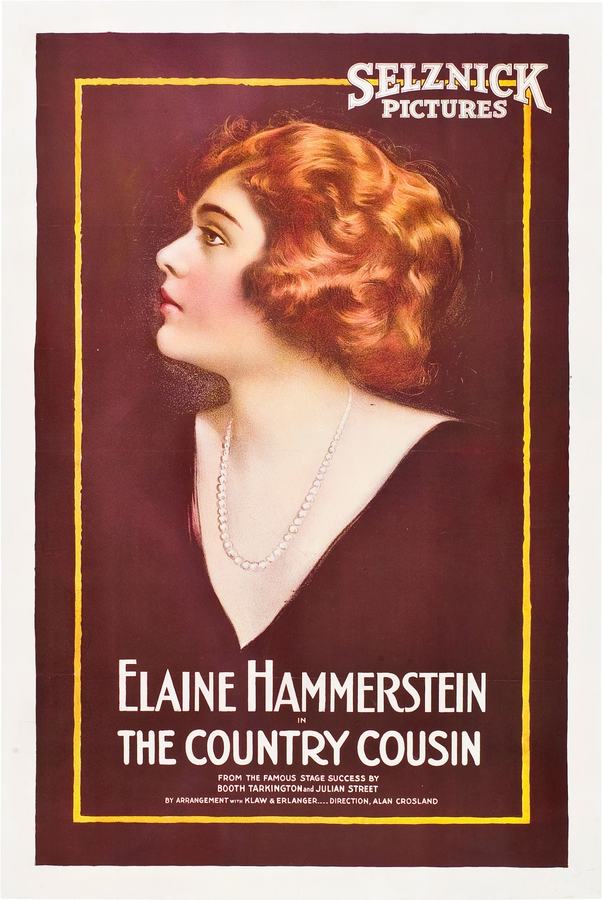
The year 1919 marked a pivotal juncture in American cinema, a period where the medium began to transcend its nickelodeon origins to embrace the complexities of social commentary. At the heart of this evolution lies The Country Cousin, a film that serves as both a cultural artifact and a blistering critique of the burgeoning American class divide. Directed by Alan Crosland and adapted from the stage play by the formidable Booth Tarkington and Julian Street, this production by Selznick Pictures Corporation is a masterclass in thematic tension. It doesn't merely present a story; it orchestrates a collision between the perceived purity of the agrarian heartland and the perceived moral decay of the metropolitan elite.
Booth Tarkington’s influence on this narrative cannot be overstated. Much like his work in The Gentleman from Indiana, Tarkington explores the inherent nobility of the Midwestern spirit. In The Country Cousin, the character of Nancy Price, portrayed with a stoic luminosity by Elaine Hammerstein, is the living embodiment of this ethos. Nancy is not a caricature of a 'rube'; she is a woman of agency, a manager of land and livestock whose hands are calloused by labor and whose mind is sharpened by necessity. When she enters the New York milieu, she is not dazzled by the chrome and velvet; she is repulsed by the lack of utility. This contrast is a recurring motif in silent era dramas, yet here it feels visceral rather than theatrical.
The plot functions as a surgical examination of human greed. Eleanor Howitt’s inheritance serves as the honey that attracts the wasps. Her father, played with a subtle, oily desperation by Bigelow Cooper, and Maude, the stepmother whose vanity is matched only by her debt, represent a specific type of urban predator. They do not want Eleanor; they want her liquidity. This predatory dynamic is something we see echoed in other contemporary works like The Butterfly Girl, where social climbing is treated as a blood sport. However, The Country Cousin grounds its stakes in the personal sacrifice of Nancy, elevating it above mere melodrama.
Elaine Hammerstein delivers a performance that defies the exaggerated histrionics often associated with 1919 cinema. Her Nancy Price is a beacon of stillness in a sea of frantic movement. While the New York socialites flutter and preen—reminiscent of the high-society archetypes in The Cabaret—Hammerstein moves with a grounded purpose. Her chemistry with Walter McGrail, who plays the initially insufferable George Tewksbury Reynolds, III, is built on a foundation of intellectual combat. Their early exchanges are not flirtatious; they are ideological battles. Reynolds views Nancy as an anomaly, a creature from a forgotten epoch, while she views him as a decorative parasite.
The supporting cast provides a vivid tapestry of early 20th-century types. Genevieve Tobin’s Eleanor is the perfect foil—impressionable, soft, and dangerously naive. Her descent into the 'fast' life of the city is portrayed with a cautionary urgency that mirrors the moralistic tone of films like Forbidden. The inclusion of Lumsden Hare and Margaret Seddon adds a layer of gravitas to the production, ensuring that the familial betrayals carry genuine emotional weight.
Visually, The Country Cousin utilizes lighting and set design to delineate its two worlds. The Ohio sequences are flooded with naturalistic light, emphasizing the openness of the fields and the honesty of the farmhouse. In contrast, the New York interiors are claustrophobic, filled with ornate clutter and shadow. This visual dichotomy serves to reinforce the narrative’s skepticism of the 'Gilded Age' remnants that still clung to the city’s social structures. One cannot help but compare this to the atmospheric tension found in The Face in the Dark, though here the darkness is moral rather than literal.
The pivotal party scene, where Archie Gore (a wonderfully boorish Gilbert Rooney) induces Eleanor's intoxication, is a marvel of silent storytelling. The camera captures the swirling chaos of the event, the blurred boundaries of propriety, and the sudden, sharp clarity of Nancy’s intervention. When Nancy takes the fall for Eleanor, the film pivots from a social satire into a profound exploration of reputation. In 1919, a woman’s reputation was her only currency; Nancy’s willingness to bankrupt her own standing to save her cousin is an act of radical altruism that resonates far more deeply than the romantic resolutions of Angel of His Dreams.
Perhaps the most intriguing arc is that of George Tewksbury Reynolds, III. Initially, he is the quintessential fop, a man whose identity is tied to his lineage and his tailor. His transformation is not sparked by a sudden realization of love, but by a realization of his own inadequacy. Nancy’s rejection of him is not a romantic coy play; it is a dismissal of his entire way of life. This prompts a fascinating reversal: the city man must seek the country to find his soul. His journey to Ohio to learn farming is a narrative beat that predates the 'back to the land' movements of later decades. It suggests that the cure for the malaise of modernity is the grit of the soil.
This theme of redemption through labor is a cornerstone of Tarkington’s philosophy. It’s a stark contrast to the darker resolutions found in Who Killed Simon Baird? or the tragic undercurrents of The Law of Nature. In The Country Cousin, nature is not a cruel mistress but a benevolent teacher. The final scenes, showing Reynolds in the fields, represent a harmonization of the classes—a hope that the best of the city can be tempered by the wisdom of the country.
To view The Country Cousin solely as a romance is to do it a disservice. It is a film deeply concerned with the changing status of women. Nancy Price is a 'New Woman' of a different sort. She is not the flapper of the 1920s, but she is independent, financially literate, and socially uncompromising. She manages her own destiny, a trait that sets her apart from the more traditional heroines seen in The Glorious Lady or My Unmarried Wife. Her strength is not derived from her beauty, but from her character—a shift in cinematic priorities that was quite progressive for its time.
The film also touches upon the predatory nature of the patriarchy. Eleanor’s father is the primary antagonist, a man who views his daughter as an asset to be liquidated. This critique of the patriarchal family structure adds a layer of cynicism that balances the film’s more sentimental moments. It reminds the viewer that the 'good old days' were often fraught with the same transactional cruelty we see in the modern age. This nuanced approach to family dynamics is something that sets this film apart from more straightforward melodramas like Old Brandis' Eyes.
While some might find the film's moralizing to be a product of its time, its core message remains surprisingly relevant. In an era of digital influencers and performative wealth, the story of a woman who rejects the hollow spectacle in favor of tangible reality feels incredibly modern. The film’s skepticism of the 'metropolitan elite' continues to echo in our current political and cultural discourse. It is a reminder that the tension between the 'somewheres' (the Nancys of the world) and the 'anywheres' (the Reynolds of the world) is a foundational American conflict.
Technically, the film is a testament to the high production standards of Selznick Pictures. The cinematography by George J. Folsey (though early in his career) shows glimpses of the brilliance that would later make him a legend. The pacing is deliberate, allowing the characters to breathe and the themes to settle. It lacks the frenetic action of Sealed Orders or the adventurous spirit of The Fighting Grin, but it gains a psychological depth that those films lack. It is a 'talky' silent film, where the dialogue titles are sharp, witty, and essential to the character development.
In conclusion, The Country Cousin is a vital piece of silent cinema that deserves more than a mere footnote in history. It is a sophisticated satire, a moving drama, and a fascinating window into the American psyche at the end of the first World War. It challenges the viewer to look beyond the surface, to value substance over style, and to recognize that sometimes, the most radical thing one can do is to remain true to one's roots. Whether you are a fan of Tarkington's literary work or a student of early film history, this movie offers a rich, rewarding experience that transcends its century-old origins. It is a cinematic harvest that continues to yield fruit for those willing to engage with its fertile soil.
A bucolic triumph over urban vanity, preserved in the amber of silent celluloid.
IMDb 5.4
1935
Community
Log in to comment.