DbcultAccessing Vault...
Cult Review
Senior Film Conservator
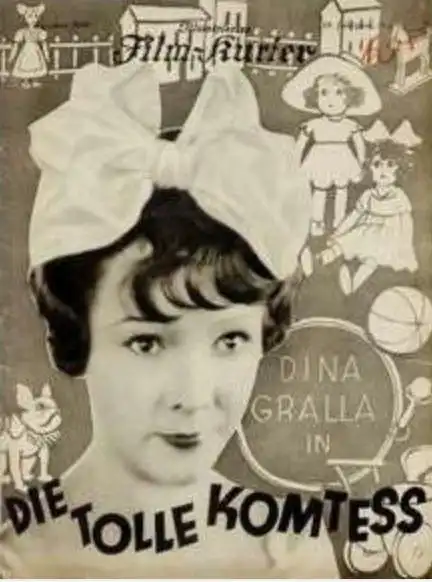
If you have a soft spot for late silent-era German comedies where everyone seems to be vibrating at a slightly higher frequency than necessary, The Crazy Countess is worth your time. It’s not a masterpiece, and it’s certainly not going to change your life, but it has this frantic, lived-in energy that makes the ninety minutes fly by. However, if you’re looking for the moody, shadow-drenched expressionism people usually associate with 1920s Germany, you’re going to be disappointed. This is much closer to the DNA of something like A Girl in Every Port—it’s light, a bit silly, and deeply concerned with how people look in expensive clothes.
Hanni Weisse plays the titular countess, and she spends a good chunk of the film looking like she’s just been told a very confusing joke. She has this way of widening her eyes that feels less like "silent movie acting" and more like genuine bewilderment. There’s a specific scene about twenty minutes in where she has to navigate a crowded dinner table, and the way she handles a stray piece of silverware is genuinely funny. It’s a small, physical moment that feels improvised, or at least less rehearsed than the rest of the slapstick.
The movie gets noticeably better once it stops trying to explain the family lineage and just lets the characters run into each other in hallways. The plot—something about inheritance and social standing—is mostly just an excuse to get Paul Hörbiger into a room with Ralph Arthur Roberts. Speaking of Hörbiger, he’s fascinating to watch here. He hasn’t quite settled into the persona he’d become famous for in the sound era, so there’s a weird stiffness to his movements. He looks like he’s trying very hard not to knock over the furniture.
One thing that really stuck out to me was the set design. Most of these Weimar comedies have these sprawling, cavernous rooms, but the sets here feel oddly cramped. There’s a scene in a library where the actors are practically on top of each other, and the camera doesn’t seem to know where to go. It results in some very strange, tight framing that makes the whole thing feel more like a stage play that someone decided to film at the last minute. It’s not necessarily bad, but it gives the movie a claustrophobic vibe that clashes with the lighthearted tone.
The editing is where things get a bit messy. There’s a sequence involving a car chase—or what passed for a chase in 1928—that is cut so abruptly it’s hard to tell who is in which vehicle. One shot lingers on a stationary wheel for about five seconds too long, and then suddenly we’re at the destination. It’s the kind of technical hiccup that reminds you this was a commercial product churned out for a hungry audience, not a precious work of art. It lacks the rhythmic precision of something like The Master Mystery, which, for all its faults, at least knew how to build tension through a cut.
I have to mention the hats. Tilla Garden wears a series of headpieces that are so large they actually seem to affect her peripheral vision. In one scene, she turns her head and nearly takes out a background extra with a feather. It’s the kind of unintentional comedy that makes these old silents so endearing. You can almost feel the costume department having a mid-film crisis as the outfits get progressively more absurd.
There is a subplot involving a character played by Max Ehrlich that feels like it belongs in a completely different movie. He’s doing a very broad, almost vaudevillian routine that grinds the pacing to a halt. Every time he’s on screen, the movie stops being a social comedy and becomes a series of disjointed gags. It’s a strange tonal shift that never quite resolves itself.
The middle of the film drags. There’s a long stretch where characters just sit around and exchange intertitles that don’t really move the story forward. You can tell they were trying to pad the runtime. It’s a bit like The Trap in that sense—a great premise that runs out of steam halfway through and has to rely on the actors' charisma to pull it across the finish line.
Is it a great film? No. But there’s a shot near the end where the countess is looking out a window, and the lighting finally softens, and for a second, you see a glimpse of a much more serious, much better movie. It’s a fleeting moment, but it’s enough to make the whole experience feel worthwhile. It’s a messy, imperfect slice of 1920s entertainment that works best if you don’t think too hard about why anyone is doing anything. Just watch the hats and enjoy the chaos.
IMDb 6.4
1936
Community
Log in to comment.