DbcultAccessing Vault...
Cult Review
Senior Film Conservator
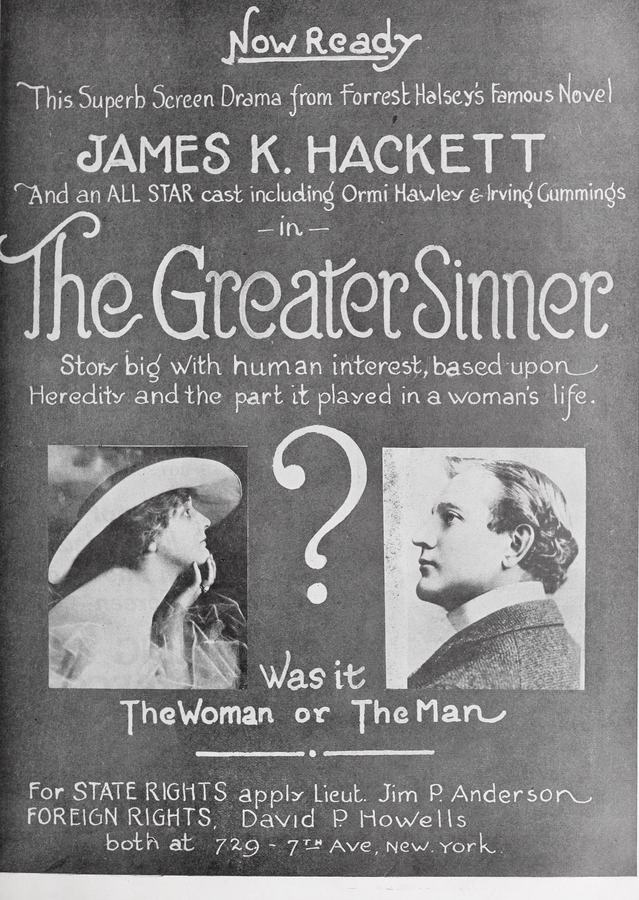
Stepping back into the hallowed halls of early cinema, one occasionally unearths a gem that, despite the passage of decades and the absence of spoken dialogue, resonates with an astonishing contemporary relevance. Such is the case with The Greater Sinner, a cinematic exploration of human frailty, societal pressures, and the relentless pursuit of both power and personal redemption. Directed with a keen eye for dramatic tension, this film, penned by Tom Bret and Forrest Halsey, plunges viewers into a world where ambition clashes with inherited vulnerability, and the dazzling lights of the metropolis threaten to extinguish the delicate flame of a Southern spirit.
At its core, The Greater Sinner presents a compelling dichotomy: the ruthless, almost predatory world of a Wall Street speculator and the serene, yet subtly troubled, existence of a Southern beauty. James K. Hackett, in a portrayal that likely defined the era's archetype of the aggressive businessman, embodies the unscrupulous promoter. His character isn't merely ambitious; he's a force of nature, driven by an insatiable desire to conquer, whether it be financial markets or the heart of a woman. This very intensity, however, sets the stage for a dramatic conflict that feels both grand and intimately personal. His world is one of high stakes, quick decisions, and a moral compass often skewed by the allure of gain. One could draw parallels to the financial machinations portrayed in films like Easy Money, though The Greater Sinner imbues its speculator with a more direct, almost romantic, form of conquest.
Opposing this urban titan is Ormi Hawley's character, the Southern beauty. Her allure is not just physical; it's steeped in a quiet dignity, a grace born of a more pastoral existence. Yet, beneath this placid exterior lies a profound, inherited susceptibility – a predisposition to alcoholism that serves as the film's central psychological battleground. This isn't merely a character flaw; it's a genetic shadow, a generational burden that she carries with her. The promoter, blinded by his desire and perhaps by a naive belief in his own transformative power, plucks her from her peaceful country home. This act, seemingly one of love and elevation, becomes the catalyst for her profound struggle, an unwitting experiment in nature versus nurture.
The transition to New York City is depicted as a jarring immersion into a vortex of frenetic energy and superficial glamour. The 'fast life of the younger set' is not just a change of scenery; it's an assault on her senses and her delicate constitution. The city, with its glittering distractions and relentless pace, becomes a testing ground for her resolve, a place where her inherited tendency is relentlessly provoked. The film masterfully portrays this clash of worlds, highlighting the moral ambiguities and intoxicating perils that lay beneath the city's dazzling facade. It's a stark contrast to the more innocent, though perhaps equally challenging, personal dilemmas explored in films like Little Miss Optimist, where the struggles are often less existential and more circumstantial.
The narrative arc of The Greater Sinner is fundamentally one of suffering and eventual triumph. Both protagonists endure their own forms of torment. The Southern beauty's battle against her inherited tendency is a harrowing, internal conflict, rendered all the more potent by the silent medium, which relies on nuanced facial expressions and body language to convey the depths of her anguish. Her journey isn't a linear progression but a series of relapses and desperate attempts at sobriety, a testament to the insidious nature of addiction. This portrayal, even in its early cinematic form, feels remarkably prescient in its understanding of the disease, moving beyond simple moral judgment to hint at deeper, more complex origins.
Concurrently, the promoter, initially the architect of her new, tumultuous life, is not immune to suffering. His ruthlessness, once a source of strength, becomes a burden, his ambition curdling into regret as he witnesses the devastating impact of his choices. This reciprocal suffering adds layers to the narrative, transforming a simple tale of seduction into a profound exploration of cause and effect, responsibility, and the potential for remorse. It's a journey that diverges sharply from the often clear-cut moralities of contemporary melodramas like Cinderella, where good and evil are more distinctly delineated.
In the absence of dialogue, the success of a film like The Greater Sinner hinges almost entirely on the expressive capabilities of its cast. James K. Hackett, a prominent stage actor of his time, brings a theatrical intensity to the speculator. His gestures, his gaze, and his overall physical presence must convey the character's relentless drive, his moments of tenderness, and ultimately, his despair. It's a performance that demands a certain grandiosity, typical of the era, yet must also hint at an underlying humanity.
Ormi Hawley, as the Southern beauty, shoulders the film's emotional weight. Her portrayal of a woman battling an internal demon requires a delicate balance of vulnerability and nascent strength. The subtle tremors of her hands, the shifting expressions in her eyes, the way she carries herself – these are the tools through which her struggle is communicated. Her journey from quiet grace to the throes of addiction and back to a hard-won sobriety must be believable through gesture alone. One can imagine her performance drawing comparisons to the emotive power seen in films like Il fuoco (la favilla - la vampa - la cenere), where intense emotional states are conveyed through visceral, non-verbal means.
Supporting players like Irving Cummings, Eric Mayne, and John L. Shine would have contributed to the tapestry of New York society, each bringing their own distinct energy to the 'younger set' or the more staid elements of the financial world. Their collective performances are crucial in establishing the vibrant, yet potentially destructive, environment that engulfs the protagonist.
The central thematic thrust of The Greater Sinner – the interplay between inherited traits and environmental influences – remains a topic of enduring fascination. The film grapples with the question of whether one's destiny is predetermined by one's lineage or if personal will and changed circumstances can alter its course. For the Southern beauty, her 'inherited desire to drink' is a formidable adversary, a force that she must actively and consciously combat. This isn't just about a moral failing; it's about a biological predisposition, a concept that early 20th-century audiences were grappling with as scientific understanding evolved.
The transformation of setting from a 'peaceful country home' to the 'fast life of the younger set in New York City' is more than a mere backdrop change; it's a critical environmental shift. The city, with its endless temptations and lack of traditional societal constraints, acts as a crucible, intensifying her struggle. This urban-rural dichotomy was a popular motif in early cinema, often used to highlight the perceived moral decay of the city versus the purity of the countryside. However, The Greater Sinner complicates this by showing that even in peaceful settings, internal demons can lurk. This exploration of challenging societal environments for women is echoed in films like Lu, a kokott, which often depicted women navigating complex social landscapes.
Ultimately, the film culminates in the girl's 'battle against her inherited tendency is won.' This resolution, while perhaps offering a hopeful message, doesn't diminish the arduousness of her journey. It suggests that while predispositions may exist, they are not insurmountable. It's a testament to resilience, a powerful message of self-overcoming that would have resonated deeply with audiences seeking narratives of moral uplift. This hard-won victory distinguishes it from films where societal judgment might be the ultimate arbiter, such as in Should a Woman Divorce?, where external pressures often dictate internal outcomes.
The screenwriters, Tom Bret and Forrest Halsey, crafted a narrative that, despite its relatively straightforward premise, manages to explore complex psychological territory. Their ability to structure a story around an internal struggle, particularly in an era where external action often dominated, is commendable. They understood the dramatic potential of a character battling herself, making the 'sinner' of the title perhaps less about moral transgression and more about the struggle against an inherited fate. Their work here lays groundwork for the character-driven dramas that would define later cinematic periods, offering a nuanced perspective on human fallibility and triumph.
The pacing, a crucial element in silent film, would have been carefully managed to build tension during the protagonist's struggles and provide moments of emotional release. The interplay between the promoter's aggressive actions and the beauty's reactive suffering forms a dynamic core, ensuring that the audience remains invested in their intertwined fates. This kind of tight narrative focus on a central dilemma is evident in other character-centric dramas of the period, like Lydia Gilmore, where individual choices drive the entire plot.
The Greater Sinner is undeniably a product of its time, reflecting early 20th-century sensibilities regarding morality, social class, and the burgeoning understanding of heredity. The portrayal of Wall Street, even then, as a place of ruthless ambition, speaks to a perennial skepticism about unchecked capitalism. The struggles of women, particularly those navigating societal expectations and personal vulnerabilities, were also a common theme, explored in various forms across contemporary cinema, from the domestic challenges in The Family Cupboard to more adventurous tales like Wagon Tracks or Out of the West, though those often focused on external rather than internal conflicts.
Yet, the film's core themes remain remarkably resonant. The struggle against addiction, the corrupting influence of unchecked ambition, and the quest for personal redemption are timeless human experiences. The contrast between rural tranquility and urban tumult, and the psychological toll of adapting to new, demanding environments, continue to be relevant in our increasingly globalized and fast-paced world. While the visual language and acting styles may feel dated to a modern viewer, the emotional truth at the heart of The Greater Sinner endures. It’s a testament to the power of storytelling that even without a spoken word, a film from over a century ago can still speak volumes about the human condition. It reminds us that the 'greater sinner' might not be the one who transgresses outwardly, but perhaps the one who struggles most intensely with their own inherited demons, or the one who, through their actions, inadvertently leads another down a perilous path. The film stands as a fascinating artifact, not just for its historical value, but for its continued capacity to provoke thought on enduring moral and psychological quandaries, much like other thoughtful narratives of the period such as When We Were Twenty-One, which also delved into coming-of-age and moral choices. It's a journey into the past that illuminates the present, proving that some stories, like some struggles, are truly universal.

IMDb —
1927
Community
Log in to comment.