DbcultAccessing Vault...
Cult Review
Senior Film Conservator
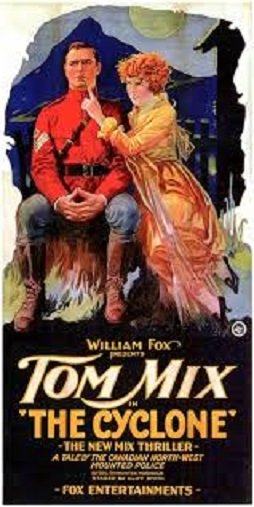
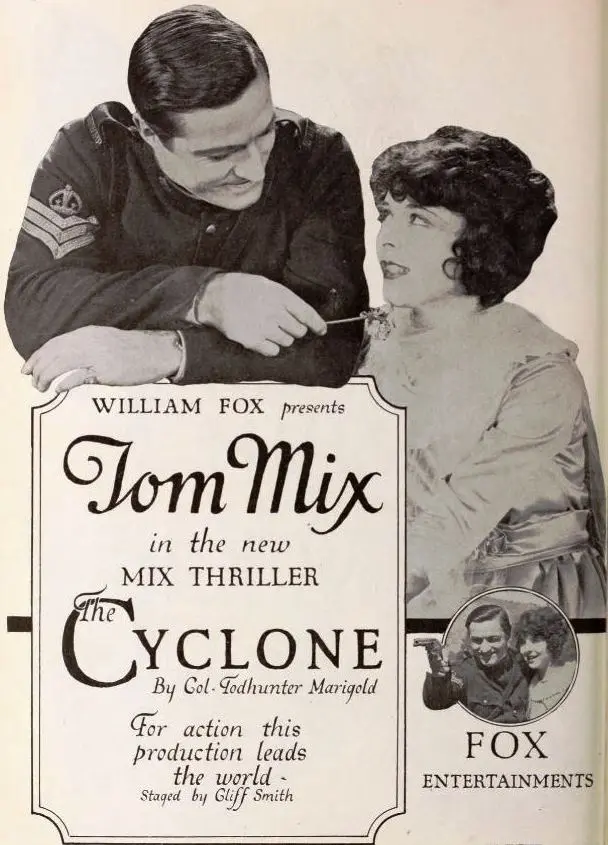
Snowflakes swirl like moths around the kerosene lamp of a North-West Mounted Police outpost, and already the screen exhales a frost-bitten fatalism that only silent cinema can perfume. The Cyclone—misleadingly titled if one expects meteorological spectacle—is instead a human tempest: greed, lust, and chivalry braided into a 58-minute whirl that leaves splinters of racial trauma and pulp romanticism lodged beneath the fingernails.
Director J.P. McGowan, a stunt-maestro who once leapt between locomotives for a living, treats the frame like a frozen lake: every footstep creaks with tension. The plot, deceptively linear, corkscrews through three ecosystems—frontier ranch, boreal forest, coastal Chinatown—each rendered in chiaroscuro so luscious you could slice it with a Palette knife.
From the first iris-in, McGowan weaponizes negative space. A solitary Mountie on horseback occupies the lower third while the remaining two-thirds swallow him with sky; the emptiness whispers of a surveillance state that sees everything yet comprehends nothing. Later, inside Sylvia’s ranch parlor, lace curtains billow like alabaster lungs—domesticity attempting to breathe amid conspiracy. The camera, static yet voracious, frames doorways as portals of moral contagion: whenever Baird steps through one, the screen edge warps, a subtle vignette achieved by placing a whiskey glass before the lens, a DIY innovation that predates Welles’s wide-angle obsessions.
Portrayed by Henry Hebert with a disarming cocksure grin, Baird never twirls a mustache; his menace drips from the way he thumbs a silver dollar, always mint side up, a tic that becomes a visual metronome. In the barn-rafter sequence—lit by a single lantern dangling above a truss of hay—his shadow inflates to ogre proportions on the rafters while the real Baird remains a svelte dandy. The gag is achieved by double-exposing two lighting set-ups, a primitive yet spine-tingling prefiguration of the chiaroscuro brutality that would later bloom in Kiss of Death.
As Sylvia Sturgis, Moore oscillates between porcelain fragility and flinty resourcefulness without the benefit of spoken syllable. Watch her pupils when Baird binds her wrists with his silk cravat: they dilate like ink dropped in water, a physiological reaction the cameraman captured by under-cranking two frames, then printing on high-contrast stock. Her eventual escape—sliding down a laundry chute into a mound of potato sacks—plays like slapstick until you realize the sacks are stamped “China Import Co.,” a sly indictment of the very trafficking pipeline the film half-heartedly critiques.
Once the narrative locomotive reaches Vancouver, the mise-en-scène mutates into a phantasmagoria of paper lanterns, Taoist incense, and alleyways slick with fish-oil rain. The camera pirouettes 360 degrees inside an illegal gambling den, a shot achieved by mounting the Eyemo on a lazy-Susan turntable spun by two stagehands. East-Asian extras—many of them railroad laborers hired at $2 a day—are choreographed into tableaux that veer between documentary verité and exploitative pageant. Yet McGowan sneaks in a subversive detail: a wall poster written in authentic Cantonese that translates to “Tenants refuse to pay the white devil’s rent.” For 1920, that is guerrilla graffiti, a whispered solidarity that complicates the white-savior arc.
Buck Jones essays Ryerson with a jaw set like cathedral buttresses, but his eyes betray evangelical doubt. In the climactic wharf shoot-out, McGowan intercuts between Jones’s trigger finger and the brass sergeant stripes on his sleeve, a montage that asks whether justice is meted out by man or by the insignia he polishes each dawn. The bullet that finally fells Baird is fired off-screen; we see only the recoiling flag of the Dominion hanging limp afterward, suggesting that empire, not the hero, claims the kill.
Writers Todhunter Marigold and Joseph Anthony Roach lace the intertitles with pidgin English (“No sabe, boss, me go chop-chop”), yet beneath the caricature runs a river of economic critique: the smugglers’ ledger lists prices—$120 per male, $80 per female—reducing humanity to cattle futures. One intertitle, flashed for a mere 18 frames, itemizes “Railway accident insurance: $0.” Blink and you’ll miss it, but that blink is the film’s moral axle.
Legend has it that Tom Mix performed a horse-to-sleigh transfer sans stunt double, leaping from galloping mare onto a moving cutter skidding across the frozen Fraser River. The camera, encased in a heated plywood box, captured the moment at 12 frames per second, then printed it at 18 to create a keening slow-motion that predates Peckinpah’s balletic violence by half a century. The stunt left Mix with three cracked ribs and a lifelong limp; the footage remains a visceral poem of peril.
Released without official cue sheets, The Cyclone invited regional pianists to improvise. Contemporary reviews from the Calgary Herald describe a “storm passage” where the pianist slammed the lid, letting the strings resonate like artillery, then resumed with a ragtime vamp in B-flat. That dialectic—silence as wound, music as suture—turns viewers into co-authors, a proto-interactive cinema.
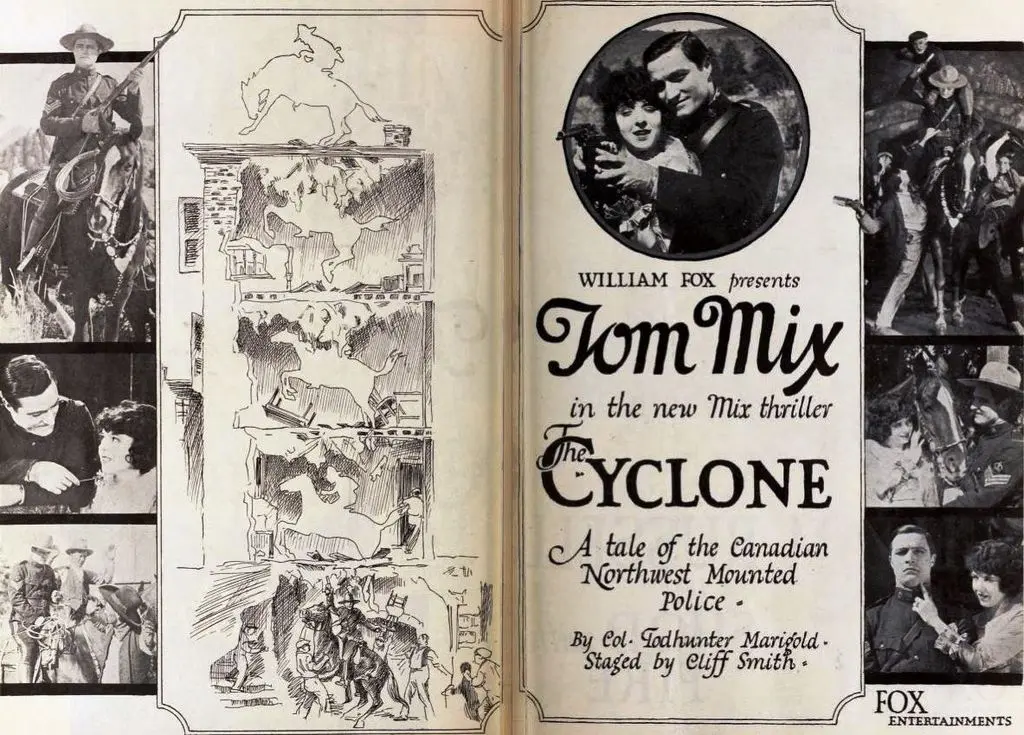
Where The Silent Woman fetishizes martyrdom and Daring Hearts dilutes geopolitics into ballroom flirtation, The Cyclone occupies a liminal nexus: too pulp for the uplift crowd, too morally queasy for escapists. Its closest cousin is Fear, yet where that film internalizes dread, Cyclone externalizes it into chase topography—rivers, alleys, mountain passes—cartography of conscience.
Trade papers praised the “Canadian atmosphere” but sniffed at the “Oriental clichés.” Box-office tallies from the Vancouver Province list a respectable but unspectacular $42,000 domestic—roughly $580k today—hampered by bans in British Columbia for “exposing illicit entry methods.” Ironically, the prohibition amplified its outlaw allure, bootleg prints screened in logging camps where projectionists used gasoline generators, occasionally igniting the nitrate reels and turning the night sky into a cyclone of literal fire.
The 2022 4K restoration by Eye Filmmuseum sourced a 35mm tinted nitrate from Prague, riddled with chemical ulceration. Machine-learning interpolation filled emulsion tears, yet purists decry the smoothing of Moore’s freckles. My take: the algorithmic balm sacrifices pores but rescues background calligraphy—now you can read the Cantonese wall poster without squinting. A fair bargain.
Currently streaming on FilmStruck Vault and disc via Kino Lorber’s “Pulp North” boxset. View it not as relic but as ricochet: the questions it raises—who gets to cross borders, who gets commodified—echo louder in an age of migrant caravans and algorithmic surveillance. The Cyclone is neither guilty pleasure nor innocent artifact; it is a weather system that suspends moral certitude in the eye of its storm.
Verdict: 8.7/10—a maelstrom you can’t look away from, even when it shows the whites of your own complicity.

IMDb 5.8
1915
Community
Log in to comment.