DbcultAccessing Vault...
Cult Review
Senior Film Conservator
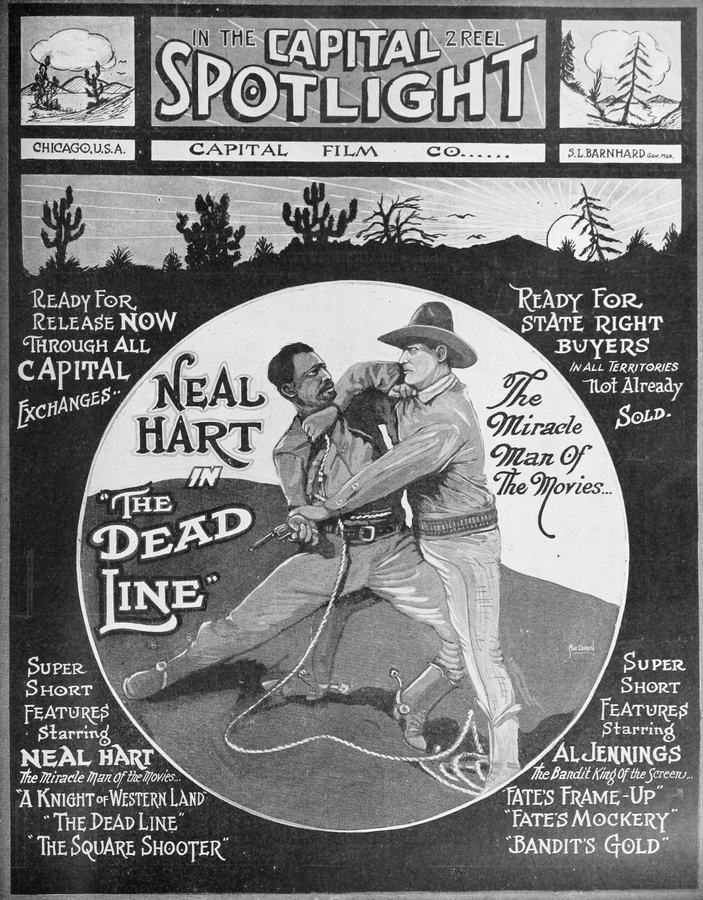
To witness The Dead Line (1920) is to observe the foundational bedrock upon which the entire edifice of the American Western was constructed. In an era where cinema was still grappling with its own technical limitations, Neal Hart emerged not merely as an actor, but as a visceral force of nature. This film, often overshadowed by the high-gloss productions of the later decades, possesses a raw, granular authenticity that modern digital artifice fails to replicate. The narrative doesn't merely tell a story; it captures a vanishing world through the flickering light of a hand-cranked camera.
The 1920s represented a pivotal juncture for the genre. While The Perils of Pauline focused on the episodic thrill of the damsel in distress, Hart’s work in The Dead Line veers toward a more grounded, masculine stoicism. There is a palpable weight to the atmosphere here—a sense of impending doom that mirrors the title itself. The 'dead line' isn't just a geographic marker; it is a psychological precipice. Hart’s performance is characterized by a rugged minimalism, a rejection of the theatrical overacting that plagued many of his contemporaries. He moves with the economy of a man who knows that a single wasted gesture in the desert could be his last.
Technically, the film utilizes the stark chiaroscuro of natural sunlight and harsh shadows to frame its moral dilemmas. The cinematography lacks the fluid pans of the modern era, yet it compensates with a static, almost religious framing of the horizon. When compared to the more European sensibilities of Il buon Samaritano, Hart’s film feels distinctly utilitarian and American. It eschews the ornate for the functional. The editing rhythm is dictated by the pulse of the chase, creating a tension that is surprisingly modern in its execution.
"In the silence of the 1920 screen, Neal Hart spoke through the grit of his teeth and the speed of his draw, defining a hero who was as much a part of the landscape as the sagebrush and the stone."
The use of space in The Dead Line is masterful. The director understands that the vastness of the West is its own character. This isn't the claustrophobic social drama found in A Factory Magdalen; this is a film about the terrifying freedom of the wild. The characters are frequently dwarfed by their surroundings, a visual metaphor for the insignificance of human squabbles against the backdrop of eternity. This sense of scale provides a gravity to the plot that keeps the viewer anchored even when the silent-era intertitles feel brief.
Neal Hart’s presence is the gravitational center of the film. Unlike the flamboyant showmanship of Buffalo Bill or the polished heroism of later stars, Hart brings a blue-collar sensibility to the saddle. There is a weariness in his eyes that suggests a backstory far more complex than the simple plot allows. In this regard, he shares a certain kinship with the protagonists of The Unknown, where the external action is merely a shadow of internal turmoil. Hart’s physicality is his primary tool; he performs his own stunts with a reckless abandon that makes the heart skip.
The supporting cast provides the necessary friction to Hart’s steady flame. The villains are not mere caricatures of evil but are presented as products of a harsh environment where resources are scarce and empathy is a luxury few can afford. This nuanced approach to antagonism is a far cry from the more binary morality of The Mystery Girl. In The Dead Line, the conflict arises from a clash of wills and the desperate need for territory, a theme that resonates through the history of the frontier.
When analyzing The Dead Line, one must consider its position relative to the broader cinematic output of the time. While Solser en Hesse was capturing the comedic antics of a different culture, and The Dancer's Peril was exploring the fragility of the arts, Hart was cementing the 'Western' as the quintessential American myth. The film lacks the whimsicality of The Pinch Hitter, opting instead for a somber tonality that anticipates the noir-Westerns of the 1940s.
Interestingly, the film’s pacing shares more with the suspenseful serials like The New Exploits of Elaine than with the slow-burn dramas of the era. There is a relentless forward momentum. Each scene serves to tighten the noose around the protagonist, leading to a climax that feels both inevitable and earned. The film avoids the melodramatic pitfalls of Civilization's Child, choosing instead a path of stoic resolution. It is this refusal to pander to the audience's desire for easy sentimentality that gives The Dead Line its enduring power.
What remains most striking about this 1920 production is its exploration of justice. In the world of Neal Hart, the law is often an abstract concept, far removed from the daily realities of survival. The protagonist must often operate outside the system to achieve a result that resembles fairness. This moral ambiguity is also explored in films like Hole in the Wall, but where that film uses mystery and the supernatural, The Dead Line uses the cold reality of the gun. There is a 'true nobility' in Hart’s character—not the inherited status found in True Nobility, but a nobility forged in the furnace of conflict and sacrifice.
The film also touches upon the themes of legacy and the return of the prodigal son, echoing the narrative beats of The Return of O'Garry. However, Hart’s 'return' is fraught with more immediate danger. He is not just coming home; he is reclaiming a soul that the wilderness has tried to strip away. The 'dead line' serves as the ultimate test of his character. Will he cross it and lose his humanity, or can he stand his ground and redefine what it means to be a man of the West?
Looking back from a century's distance, the influence of The Dead Line on the genre is undeniable. It established a visual shorthand for the Western that would be refined by John Ford and Howard Hawks. The rugged terrain, the high-stakes stare-down, and the horse as an extension of the hero’s own body are all present here in their nascent forms. Even the more exotic adventures like Queen of the Forty Thieves owe a debt to the structural integrity of these early action films. They taught filmmakers how to communicate movement and peril without the aid of dialogue, relying on the audience’s ability to read the landscape and the actor’s visage.
Furthermore, the film’s depiction of struggle—the 'Küzdelem a Létért' or struggle for life—is universal. While the setting is specific to the American West, the themes of protecting one's own and standing against overwhelming odds are global. Hart’s performance transcends the silent medium, offering a masterclass in screen presence that remains instructive for actors today. He doesn't need to shout to be heard; his silence is deafening.
In the final analysis, The Dead Line is more than just a historical curiosity. It is a vibrant, breathing piece of cinema that demands to be viewed with a modern eye. It challenges our perceptions of the 'simple' silent film, revealing a layer of sophisticated visual storytelling that is often missed. The film’s ability to evoke such strong emotion and tension through primitive means is a testament to the power of the medium. It reminds us that at its core, cinema is about light, shadow, and the human face.
As we navigate the hyper-kinetic, CGI-saturated landscape of contemporary film, returning to the works of Neal Hart provides a necessary grounding. It is a reminder of where we came from and the enduring power of the Western myth. The Dead Line is a stark, beautiful, and uncompromising vision of the past—a film that crossed its own line into immortality long ago. It stands as a monument to the pioneers of the screen who, with little more than a camera and a dream, mapped the territory of the human heart against the backdrop of the wild frontier.
IMDb 5.6
1934
Community
Log in to comment.