DbcultAccessing Vault...
Cult Review
Senior Film Conservator
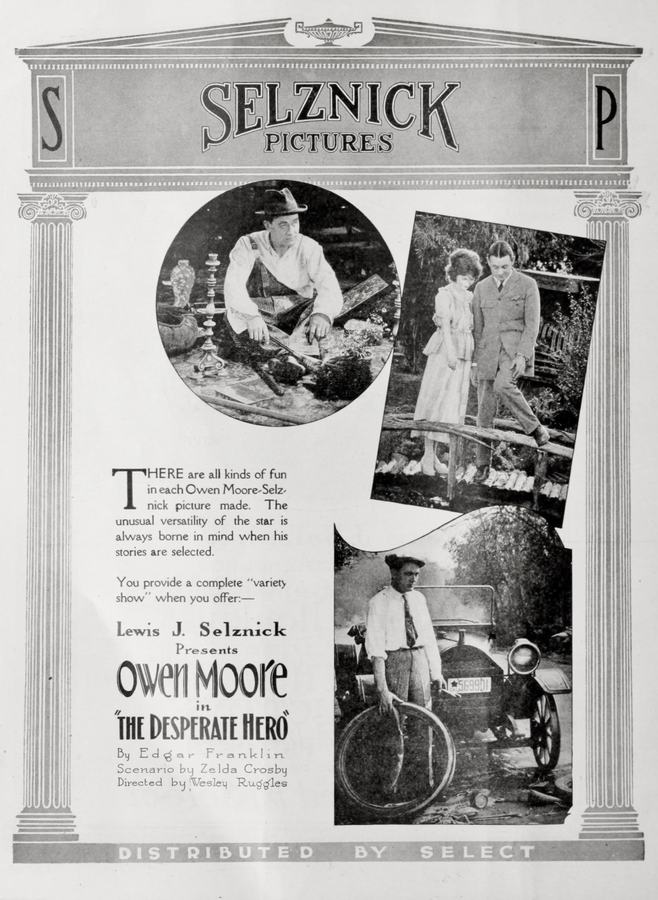
The Desperate Hero is a Molotov cocktail hurled into the rose-tinted garden party of early 1920s romantic comedy: a film that smells of gasoline, newsprint, and the ozone that crackles just before hearts break.
Picture the county picnic as a Bruegel canvas—barrels of lemonade, brass bands bleating Sousa, and in the epicenter Henry Baird, played by Owen Moore with that bruised-knuckle charm he later sanded down for more urbane roles. Moore’s Henry doesn’t stride; he ricochets, a human headline in want of a better font. His pockets are as empty as tomorrow’s edition before the presses roll, yet he stakes everything on a raffle, gambling that fortune will be his copy editor for once.
Enter the jalopy—an anthropomorphic heap of rust and optimism whose headlights wink like a soused uncle. The camera (courtesy of veteran lensman Tom Ricketts, who also cameos as the frazzled ticket-seller) lingers on the vehicle’s sagging fenders as if they were the drooping moustache of a tragic clown. When the kids torch it, the flames are shot through a lavender filter, turning catastrophe into a pagan ballet. Seldom has the destruction of private property felt so carnivalesquely cathartic.
Joseph Plant—Emmett King channeling a mid-level predator in a linen suit—claims his burnt prize with the icy relish of a man who collects debts the way lepidopterists collect moths. King’s performance is calibrated a hair’s breadth from outright villainy; he’s less Snidely Whiplash than a ledger with a pulse, and that makes his jealousy deliciously toxic.
The two-week servitude contract is where the screenplay (Edgar Franklin’s plotting colliding with Zelda Crosby’s epigrammatic intertitles) morphs into a domestic Marquis de Sade for the Keystone crowd. Henry peels potatoes, scrubs flagstones, and endures a thousand tiny paper cuts to dignity—all while framed through windows and keyholes, the visual grammar of surveillance before Hitchcock made it fashionable. Notice how cinematographer Charles Arling racks focus from foreground scrub-brush to background parlor, where Evelyn, Gloria Hope in cloche hat and moral vertigo, sips tea like Lady Macbeth on a budget.
Which brings us to the film’s most subversive engine: the love quadrangle that dares not speak its name. Henry’s residual torch for Evelyn flickers in reaction shots—Moore’s left eyebrow arches a millimeter, a silent confession that lands harder than pages of dialogue. Meanwhile, Mabel (Virginia Caldwell, equal parts porcelain and steel) watches from her family’s veranda, binoculars in hand, a suburban sentinel. Caldwell excels at the slow erosion of trust; her eyes calcify from affection to suspicion without a single tear, a masterclass in genteel paranoia.
Dorothy Kind’s arrival detonates the narrative like a stink bomb in a cathedral. Nell Craig plays the vamp with flapper flamboyance—bee-stung grin, cigarette trailing ectoplasmic curls—yet beneath the clownish guise there’s a Method-esque commitment. When she declares herself the mother of Henry’s nonexistent quadruplets, the intertitle卡片 explodes in oversized, jittery font, as though even the typography is mortified. The sequence is cut like a Soviet montage: children hoisted aloft, scandalized matrons, a parson clutching his collar—all scored by a theater organist’s wildest improvisation, though on home viewing you’ll supply your own riotous soundtrack.
One cannot discuss The Desperate Hero without bowing to its clockwork construction. Every setup—raffle ticket, debt, fire—pays off in a different register. The tailor who demands payment reappears at the altar, now tailor to the groom, a sly class commentary that wealth sews its own garments. Even the name Plant is a weed growing beside the manicured Darrow estate: horticultural wordplay that would make Dickens nod.
Compare it to Her Purchase Price (1919), where marriage functions as chattel; here, marriage is the escape clause from indentured labor, a critique of capitalism wrapped in confetti. Or align it with The Misfit Wife (1920), another silent that toys with reputation; yet where that film wallows in penance, Desperate Hero pirouettes toward absolution, suggesting honor is not inherited but hammered out on the anvil of farce.
Visually, the picture revels in chiaroscuro. Interiors are pools of umber shadow, exteriors over-exposed until whites glare like interrogation lamps. Arling’s camera pushes in on a kerosene lantern just before Henry confronts Joe, the flame trembling between them—a duel of phallic symbolism worthy of academic papers. The tinting strategy is equally eloquent: amber for daylight farce, cyan for nocturnal scheming, rose for the final clinch, a chromatic arc that makes the 65-minute runtime feel like four movements.
Performances oscillate between macro and micro. Arthur Hoyt, as Mabel’s father, delivers apoplexy with a single neck-jerk—watch how he adjusts his cravat as though strangling his own dynastic expectations. Rube Miller, the comic deputy, has a drunk scene that predates the stateroom gag in Duck Soup, stuffing his mouth with eviction notices while tap-dancing; the speed ramps ever so slightly, a proto-fast-motion that anticipates sound-era slapstick.
Yet the film’s true marvel is its tempo. Director Tom Ricketts (pulling double duty behind the lens) toggles from frenetic Keystone chase—Henry catapulting over hedges, a dog nipping his coattails—to Ozu-like pillow shots of laundry snapping in wind, allowing the audience to metabolize the anxiety. Compare this ebb-and-flow to the relentless crescendo of Quo Vadis? (1924) spectacles; here, the quiet is not filler but solvent, dissolving the hero’s bravado until raw decency shows through.
Some cavil that the resolution hinges on coincidence—Dorothy’s sudden confession, the rival’s forged deeds—but coincidence is the lingua franca of screwball, and Ricketts lands it with a moral ledger balanced. Henry’s final act isn’t triumph over poverty but over calumny; he buys back his name with labor, proving that dignity, unlike stocks, can’t be cornered.
Preservationists among you will lament: only two 35mm prints survive, one at MoMA (missing Reel 3) and a dupe at EYE Filmmuseum. Yet even fragmentary, the film pulses. The Dutch print’s intertitles are translated back into English via subtitles, creating a palimpsest that somehow amplifies the comedy—“You are the father of my children!” becomes “Gij zijt de vader van mijn kroost!”—the guttural consonants lending an unintended operatic glee.
For home viewing, pair it with Daddy-Long-Legs for a double bill about benevolent deception, or program it beside The Reclamation to trace how 1920s cinema negotiates masculine self-worth through sacrifice and scheming. Your theater organ playlist should toggle between “Ain’t We Got Fun” for the picnic scenes and something Satie-esque for the nocturnal guilt; the tonal whiplash is the point.
Bottom line: The Desperate Hero is a pocket symphony of social anxiety, a cautionary fable that laughs at its own moral, a celluloid firework whose embers still warm the contemporary viewer. It argues, with breezy irreverence, that honor is not the absence of scandal but the stubborn refusal to let scandal finish the sentence. Stream it if you can hunt it down; project it if you have the print; but above all, talk about it—because films this giddily profound deserve resurrection from the ash-heap of footnotes into the blazing marquee of now.
Verdict: 9.2/10—a blazing jalopy of satire you’ll want to ride straight into your next cine-club discussion.
IMDb —
1923
Community
Log in to comment.