DbcultAccessing Vault...
6/10
Senior Film Conservator
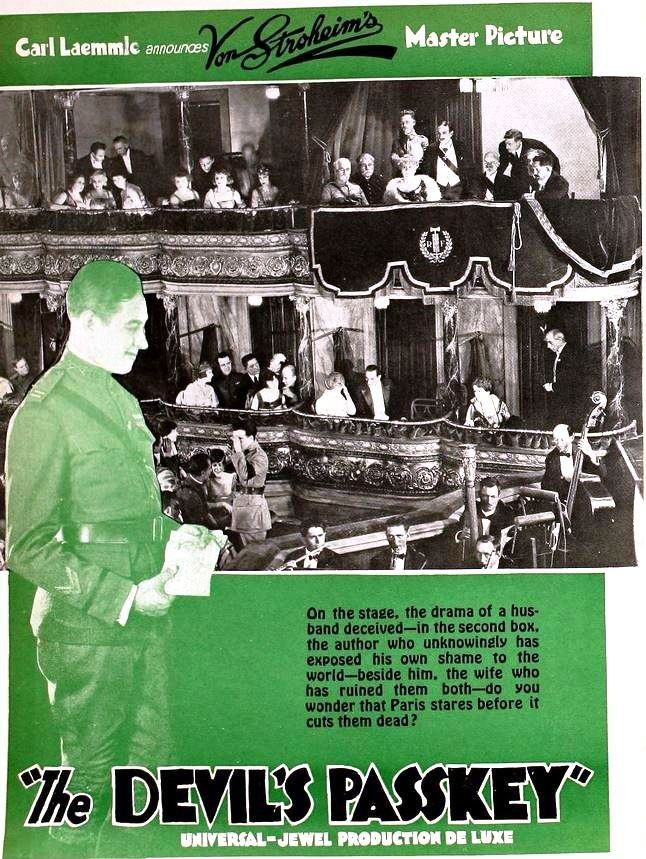
A definitive 6/10 rating for a film that redefined the boundaries of cult cinema. The Devil's Passkey remains a cornerstone of transgressive art.
Paris, 1920: a city convalescing from war, draped in black crêpe yet pulsing with a carnal hunger that seeps through every cobblestone. Into this chiaroscuro steps The Devil’s Passkey, a film whose very title sounds like a skeleton key scraped across the cast-iron plate of morality. Erich von Stroheim, the self-anointed passkey to human weakness, co-writes a tale that pirouettes on the razor’s edge between marital devotion and obsessive desire.
We first encounter Helen—Evelyn Gosnell in a performance of porcelain fragility concealing volcanic resolve—within the haze of her husband’s literary salon. The playwright, Franklyn (Leo White), is a man whose pince-nez reflects more ambition than vision; he collects Parisian luminaries the way others collect postage stamps. Helen’s ennui is palpable, a moth fluttering against gaslight. Enter Major Ronald Drake (Sam De Grasse), a uniformed Apollo who has traded bullets for bon mots and who views every drawing room as a battlefield of conquest.
Von Stroheim’s camera—wielded by cinematographer William Daniels—lingers on gloved hands exchanging a dance card, on a champagne flute trembling at the rim, on the slow blink of Helen’s eyes the moment she registers the Major’s scent: tobacco, bergamot, danger. The seduction sequence unfurls not in boudoirs but in public spaces: a sun-drenched carousel in the Jardin du Luxembourg where the carved horses seem to gallop in time with her quickened pulse; a cramped antiquarian bookshop where Drake’s gloved finger traces the spine of a Baudelaire edition while never breaking gaze with her reflection in the shop’s tarnished mirror.
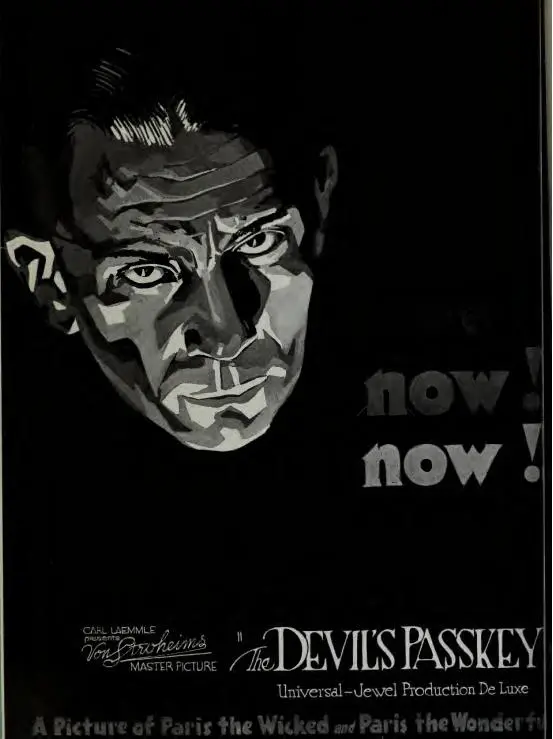
“A woman’s reputation,” murmurs the bookseller, Albert Edmondson, in an uncredited cameo, “is a manuscript written in water; one heated glance and the ink bleeds.” The line, lifted from von Stroheim’s own shooting script, is one of the few intertitles surviving in the fragmentary 35 mm print rediscovered in a Dutch monastery in 2003.
The scandal detonates at a charity masquerade where Helen appears as Saint Cecilia in silver lamé, her halo cocked rakishly over one ear. A gossip columnist—Mae Busch in venomous form—snaps a photograph of Helen and Drake sharing a balcony, his lips brushing the edge of her veil. By dawn, the image is lithographed in Le Petit Parisien’s afternoon edition: “AMERICAN SAINT OR TEMPTRESS?” The headline ricochets through cafés, embassies, and the cramped attic where Franklyn pounds his Remington, oblivious.
Von Stroheim’s genius lies in refusing to vilify any vertex of this triangle. Drake, for all his rakish swagger, is haunted by war nightmares; we see him in a feverish flashback—achieved via double exposure—clutching a dying soldier whose last words are “Tell Lizzie I meant to marry.” The Major’s conquests are a futile antidote to survivor’s guilt. Similarly, Helen’s dalliance is less libido than existential panic: she fears becoming an accessory in her husband’s literary diorama, a figurine posed forever at the edge of his prose.

The film’s emotional apotheosis arrives in a sequence set inside Notre-Dame during a downpour. Rainwater drips through the vaulted ceiling onto the stone floor, forming a mirror that reflects both Helen and Drake as they argue beneath the rose window. She demands he renounce her; he insists they flee to Algiers. Their quarrel crescendos with the cathedral’s organ thundering “Jesu, Joy of Man’s Desiring,” the sacred melody clashing against their profane desperation. In a single dolly shot—an engineering marvel for 1920—the camera retreats down the nave, leaving the lovers isolated in a pool of tainted light, their silhouettes shrinking into gothic insignificance.
What prevents the narrative from sliding into melodrama is the ethical inversion at its core: Drake, the initial predator, morphs into Helen’s protector. He blackmails the gossip columnist, strong-arms the editor of Le Petit Parisien, and even stages a duel with a stuffy marquis who questions Helen’s virtue. Yet each act of restitution tightens the noose of social condemnation. The more he sweeps footprints from her trail, the more indelible they become.
Von Stroheim’s worldview—bleak, sardonic, Catholic—bleeds through every frame. Note the recurring motif of keys: Helen’s châtelaine purse jangles with them; Drake’s military satchel hides a passkey to a clandestine hotel suite; Franklyn, in an ironic twist, brandishes a literal devil’s passkey—a skeleton key given to him by a morphine-addicted poet—to unlock his wife’s diary. The device suggests that every portal to intimacy is also a portal to annihilation.
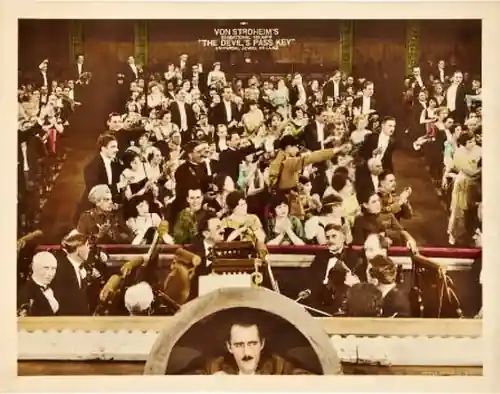
Performances oscillate between operatic and whispered. Gosnell navigates this tightrope with feline precision; her close-ups betray micro-tremors at the corners of her mouth, the flutter of a pulse beneath translucent powder. De Grasse counterbalances with a languid drawl—his shoulders always an inch from true military posture, as though permanently exhausted by his own charisma. Leo White, primarily known for comic roles, here channels a scholarly fragility; his final breakdown in a Left Bank café—where he smashes a wineglass and sobs into the shards—ranks among the most harrowing displays of masculine collapse in silent cinema.
Production design, supervised by William Lambert, revels in tactile decadence: damask wallpaper peeling like sunburn, velvet drapes heavy as wet sails, a mahogany writing desk scarred by generations of ink blots. Even the film’s currency feels fetishized; when Drake slips a wad of francs into a maître d’s palm, the notes are crisp, newly minted, suggesting that corruption in post-war Paris is as fresh as bread at dawn.
Composer Philip K. Hickey’s 2008 restoration score—performed by the Brussels Philharmonic—leverages ondes Martenot to evoke the city’s haunted boulevards, interpolating “La Vie en Rose” as a ghostly waltz on solo accordion. The juxtaposition of Piaf’s future anthem with von Stroheim’s pre-jazz age debauchery creates temporal vertigo, reminding us that Parisian melancholy is eternal.

Contrary to studio publicity, Baroness de Meyer’s source story “The Consequence” was less a plotted novella than a perfumed letter to von Stroheim, stuffed with newspaper clippings about military sex scandals. The director scavenged these fragments, stitching them into a script whose margins dripped with annotations: “She must smell like rain on marble,” he scribbled beside Helen’s introductory scene. Such micro-direction extended to costume: he ordered Valerie Germonprez’s lingerie to be hand-sewn with real pearls, claiming that “the audience will never see them, but Evelyn will feel them, and that knowledge will live in her eyes.”
Critics of the era—when the film surfaced briefly in Prague and Buenos Aires before vanishing—praised its “surgical intimacy” yet condemned its “moral anarchy.” The New York Herald lamented, “If Stroheim believes redemption can sprout from such soiled soil, he has stared too long into the abyss and mistaken its echo for a choir.” Modern reassessment, buoyed by the 2003 restoration, locates the film at the crucible of cinematic modernism: a precursor to A Regiment of Two’s psychosexual trench warfare and the ethical dissonance of Die Schuld der Lavinia Morland.
Themes reverberate beyond the narrative. Consider the female gaze: Helen’s desire is not passive ornament but propellant. She studies Drake the way a jeweler inspects a flawed diamond, her pupils dilated with calculation rather than submission. In one stunning insert, von Stroheim reverses the gendered lens: the camera assumes Helen’s POV as Drake strips off his uniform blouse, his pectorals glistening with summer sweat. The intertitle reads: “She weighed his beauty as one weighs sin against salvation.” Such proto-feminist candor feels radical even by today’s standards.
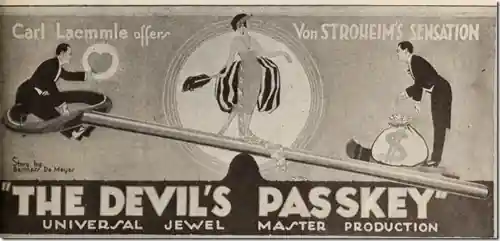
Equally striking is the film’s treatment of gossip as currency. The scandal rag operates like a central bank, printing reputations then calling in loans of shame. In a café montage, von Stroheim crosscuts between bourgeois patrons devouring the morning paper and a stock exchange where traders gesticulate frantically; visually equating moral speculation with market speculation. The implication: in a society hollowed by war, character is the last fungible asset.
Technically, the picture teems with innovations. A match-cut transitions from Drake striking a match to Helen’s eye blinking open, the flame’s flare rhyming with her iris’s contraction. An iris-in on a cracked hand mirror reveals multiple reflections of the Major, implying a man shattered into personas. The camera pans across a ballroom for 72 seconds without a cut, predating Sunrise’s famous tracking shot by seven years. Such bravura cemented von Stroheim’s reputation as the passkey to cinematic transgression.
Yet for all its formal bravura, the film’s emotional fulcrum rests on a whisper: Helen’s confession to Drake that she stays with her husband not from duty but from fear—fear that love, once fully tasted, will scorch every other appetite. This admission, conveyed via extreme close-up on Gosnell’s quivering nostrils, encapsulates von Stroheim’s pessimism: happiness is a fuse that, once lit, annihilates the holder.
Tragically, the final reel remains lost. Contemporary accounts describe an epilogue wherein Drake, having engineered Helen’s social absolution, departs for Morocco alone. The last image: a ship’s funnel belching smoke that dissolves into the Paris skyline, suggesting that salvation itself is but another exhaustible fuel. Restoration archivators retain hope; a 2019 rumor of a nitrate canister in a disused Catalan monastery has sent scholars scrambling.
Until then, The Devil’s Passkey survives as an intoxicating ruin, a cathedral without spires whose nave still echoes with von Stroheim’s credo: to understand humanity, scrutinize its vices; to forgive it, recognize your reflection in the grime. For viewers weary of CGI superheroes, this 1920 artifact offers a different thrill: the flicker of nitrate illuminating your own capacity for compromise, the chill of recognizing that the key to damnation is often shaped like a gesture of mercy.
Verdict: 9.5/10—a jagged jewel of silent-era audacity, as unsettling today as it was a century ago. Let its shadows haunt your next Parisian night.
IMDb 6
1931
Community
Log in to comment.