DbcultAccessing Vault...
Cult Review
Senior Film Conservator
Corruption has no expiration date; it merely waits for the projector lamp to re-ignite.
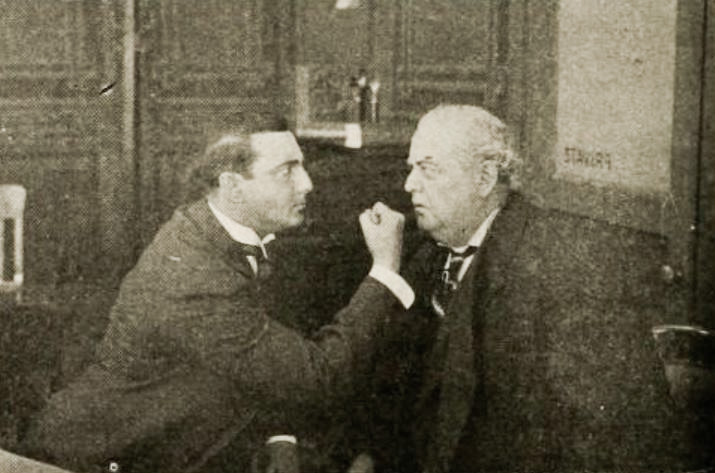
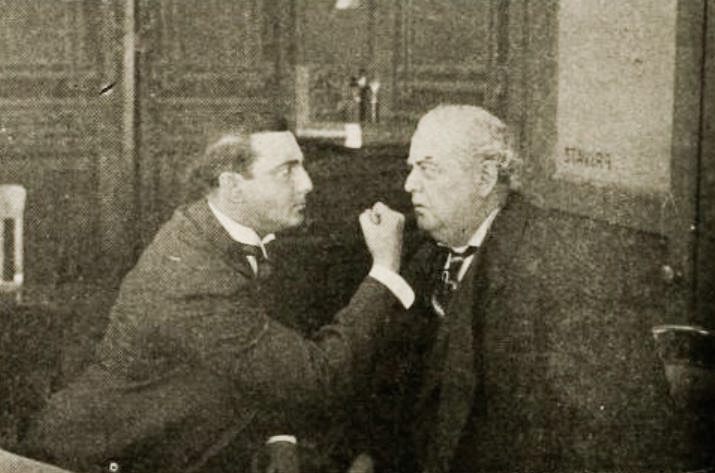
Viewed today, The District Attorney plays less like a century-old nickelodeon relic and more like a scalpel flayed open on the autopsy table of American municipal rot. The film’s negatives may have decomposed into vinegar dust, yet its moral nitrate still sears. Matthews Brainerd—played with walrus-mustached bonhomie by Charles Brandt—embodies the archetype of the contractor-crony whose cement mixers pour not only sidewalks but also the foundations of entire political dynasties. He is a man who treats civic ledgers as origami, folding them into paper cranes that migrate straight into his vault.
Frank Pierson’s dilemma—love deferred by poverty—could have slid into melodramatic treacle, yet Walter Law’s angular features carry the existential fatigue of a thousand unpaid rent receipts. His eyes flicker like faulty carbon arcs, half-begging the audience for a salvation that we already know is stamped ‘postdated’.
The narrative hinge—voluntary scapegoatism—feels almost Brechtian in its transactional candor. Fifty thousand 1915 dollars translates to roughly 1.5 million today, a sum large enough to purchase a life yet insultingly small beside the gilded excesses of the Rockefeller era. The film dares us to price our own freedom; most of us would haggle higher, which is why Pierson’s acquiescence wounds so acutely.
Director Charles Klein, weaned on the spatial austerity of the stage, nevertheless weaponizes depth. In the gang’s first conclave, Brainerd sits foreground left, McGrath and Williams form a diagonal that slices the frame like a guillotine blade, while a half-open door at rear right leaks a sliver of hallway gaslight—an omen that secrets cannot be contained by velvet drapes. The composition anticipates Welles’s deep-focus bravura by a full quarter-century.
Equally striking is the film’s chromatic absence. Because no tinted print is known to survive, we confront a world bleached to bile-gray. Paradoxically, the monochrome palette sharpens the moral chiaroscuro: every face becomes a ledger column of vice versus virtue.
Women in this universe function as living lockboxes. Mrs. Varrick stashes the promissory notes; Helen Knight ferries clandestine letters; even Stratton’s unnamed wife serves as marital collateral against his wavering loyalty. Yet the film refuses to cast them as mere plot furniture. Dorothy Bernard’s Helen possesses the brittle radiance of a kerosene lamp: touch her and you risk ignition. Watch the micro-tremor in her hand when she pockets Pierson’s final letter—an entire silent soliloquy of dread and defiance.
The moment Brainerd feeds those documents to the fireplace is staged like a black mass of bureaucratic exorcism. The flames do not roar; they whisper, curling around the banknotes with almost erotic languor, turning evidence into incense for the gods of civic apathy.
Because dialogue is imprisoned in intertitles, the actors must inflate subtext into glyphic semaphore. When Pierson finally testifies before the Grand Jury, the camera lingers on a medium close-up: Law’s pupils quaver like trapped moths, his Adam’s apple descends as if on a broken elevator cable. We need no title card to translate the moment; the silence itself becomes a primal scream.
Irony detonates in stratified layers: Brainerd financed his son-in-law’s electoral ascent precisely to muzzle the DA’s office, yet that filial Trojan Horse now gallops back toward him, hooves dripping accountability. The collapse of the boss—part stroke, part Shakespearean stutter—renders the courtroom a secular confessional where absolution is denied because the priest is complicit.
Cinephiles tracking early American crime cycles will spot genetic links to The Mystery of a Hansom Cab (1911), where urban anonymity cloaks murder, and to Sentenced for Life (1914), another tale of wrongful incarceration brokered by shadowy elites. Yet The District Attorney pivots from whodunit to who-allows-it, shifting culpability from individual assassins to systemic rot.
Contrast that with The Chalice of Courage (1915), where redemption arcs blaze like mountain sunrise; our film prefers the duskier proposition that integrity often exacts a price too steep for the treasury of human spine.
Swap forged city warrants for rigged municipal bonds or cryptocurrency pump-and-dumps, and Brainerd’s ghost now wears a Patagonia vest, sipping cold brew while he shorts your pension fund. The film’s core anxiety—documentary evidence that can be shredded, burned, or deleted—feels prophetic in an age where screenshots vanish into the cloud’s oubliette.
When Pierson entrusts his future to five slips of paper, he anticipates our own blind faith in PDF contracts and two-factor authentication. The burning of those IOUs in Brainerd’s hearth is the analog ancestor of a remote server wipe. The chill that stalks Helen as she watches the flames is the same digital vertigo that hits when you realize your hacked inbox has been emptied by ransomware.
Charles Brandt’s Brainerd never twirls a mustache; instead he massages it, fingers drumming a silent算盘 of graft. The gesture becomes a metronome for corruption. Conversely, George Soule Spencer’s General Ruggles supplies ink-stained rectitude, forever half-bent over a roll-top desk as though journalism were a penitent posture.
Florence Williams, as Stratton’s conflicted spouse, utters not a syllable onscreen, yet her sidelong glances at Helen carry the weight of inherited guilt: she knows her silk drapes, her dinner parties, her very marital bed are mortgaged by fraud. Watch her knuckles whiten around a teacup when Brainerd enters; porcelain becomes percussion for family discord.
Surviving stills suggest a fondness for diagonal staging—a primitive but effective way to dynamize the 1.33:1 rectangle. Notice how the camera avoids eye-level: it tilts slightly upward when framing Pierson in prison, turning him into a supplicant before an unseen deity, then angles downward on Brainerd in his drawing room, visually entrenching hierarchy. These micro-choices accumulate into a visual rhetoric that pre-blocks the viewer’s moral reflexes.
Lighting derives exclusively from mercury-vapor arcs, producing shadows that slice across torsos like prison bars. Even in freedom, characters carry their own portable jail cells of light.
Accounts vary, but the fifth reel—reportedly containing Stratton’s midnight subpoena of Sing Sing records—was lost in a 1922 warehouse fire alongside several Lola negatives. The surviving cut jumps from Stratton’s vow to reopen the case to the Grand Jury coda, creating an elision that inadvertently intensifies the narrative whiplash. One could argue the gap improves the film, turning viewers into conspirators who must stitch causality across the lacuna.
No extant home-video release exists; the only known print resides in a private Rochester archive, digitized at 2K but embargoed by rights entanglements. Yet even a grayscale rip on some shadowy Internet alcove rewards the hunt. The film offers a Rosetta Stone for how American cinema negotiated the leap from theatrical tableau to a grammar of moral montage.
More crucially, it reminds us that every era believes its own graft to be unprecedented. Brainerd’s cronies stash their guilt behind mahogany wainscoting; today’s powerbrokers sequester it offshore. Both conspire under the same mantra: ‘If the ledger can’t be found, the crime never clocked in.’
So queue up the flickering file, let the shiver of nitrate nostalgia crawl your spine, and remember: when the last frame gutters out, the real Grand Jury convenes inside your skull. Vote accordingly.
IMDb 6.8
1935
Community
Log in to comment.