DbcultAccessing Vault...
Cult Review
Senior Film Conservator
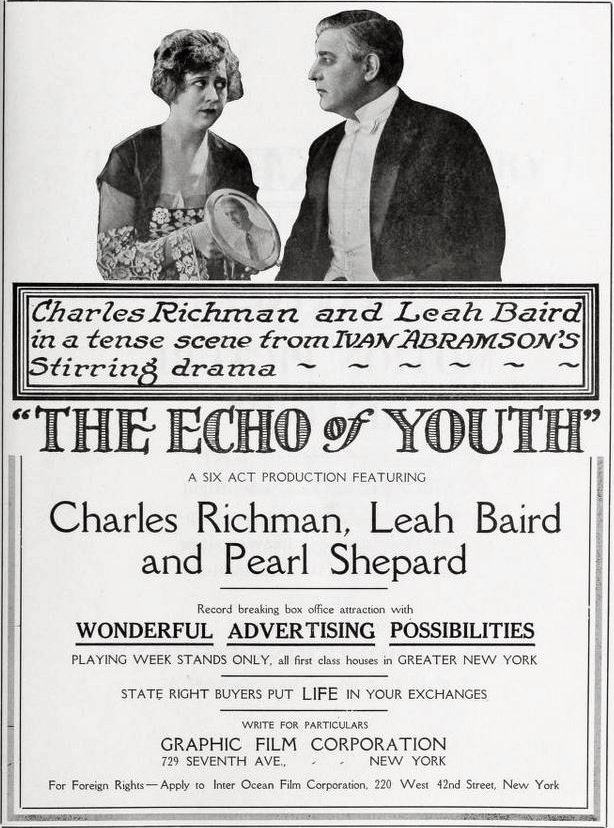
Step into the early 20th century, a time when cinema was finding its voice, and narratives, often melodramatic, grappled with the profound moral and social dilemmas of an evolving society. Among these compelling productions stands Ivan Abramson’s The Echo of Youth (1917), a film that, even a century later, resonates with a potent blend of scandal, societal expectation, and the intricate web of human relationships. This isn't just a story; it's a window into the anxieties and moral compass of an era, delivered with a theatricality that was both groundbreaking and deeply ingrained in the popular entertainment of its day. Abramson, a director known for his sensationalist yet often thought-provoking dramas, crafts a narrative here that twists and turns with the precision of a master puppeteer, pulling at the heartstrings and challenging the viewer's perceptions of justice, love, and the insidious nature of secrets.
The film plunges us headfirst into the seemingly unassailable world of Peter Graham, a man who has ascended to the pinnacle of American jurisprudence as a Supreme Court Justice. His life, from all outward appearances, is a testament to integrity, diligence, and societal respect. Yet, beneath this polished veneer lies a festering wound—a youthful dalliance with Olive Martin, a singer from the vibrant, often unforgiving streets of New Orleans. This past affair, a moment of fleeting passion, has become a lifelong burden, manifesting as a continuous stream of hush money meant to silence Olive and, ostensibly, support their son. It’s a classic Faustian bargain, where a man’s future is held hostage by a ghost of his past, a theme that has been explored in countless dramas, from the stage to the silver screen, because it taps into a universal fear: the immutable power of prior choices.
However, Olive Martin, portrayed with a compelling mix of desperation and ambition by Pearl Shepard, is no mere victim. She is a woman of agency, albeit one operating within the constrained societal roles afforded to her. Her reappearance in Peter’s life is not just a plea for continued support but a brazen demand for an entirely new existence. She envisions a life of high society, a place far removed from her New Orleans origins, and she sees Peter’s established position as her ticket. Her ultimatum is stark: divorce his wife, marry her, and legitimize her place in the upper echelons. This audacious demand sets the central conflict ablaze, pitting Peter’s carefully constructed reputation against Olive’s ruthless ambition. It’s a collision of worlds – the austere halls of justice against the raw, unvarnished desires of a woman fighting for a better life, however morally compromised her methods may be. One cannot help but draw parallels to the societal critiques embedded in films like Woman, Woman!, where the harsh realities faced by women outside conventional norms often drove them to desperate measures.
As Peter grapples with this existential threat, the narrative skillfully introduces a devastating parallel storyline. In Boston, far removed from Olive’s immediate machinations, Peter’s innocent daughter, Anita (Leah Baird), falls deeply in love with Harold (Howard Hall), a young man of considerable charm and promise. Their romance blossoms with the purity and idealism characteristic of young love, culminating in an engagement that promises a bright, untroubled future. The dramatic irony here is palpable, almost excruciating. We, the audience, are privy to Peter’s secret, understanding the looming shadow that threatens to engulf not just him, but now, his unsuspecting daughter. The joy of their engagement is short-lived, however, as the cruel hand of fate, or rather, the intricate design of Abramson’s plot, delivers a gut-wrenchwrenching blow: the revelation that Harold is, in fact, Peter’s son, making him Anita’s half-brother. This discovery plunges the young lovers into an abyss of despair, their idyllic world shattered by the unthinkable specter of incest. The emotional weight of this moment, even without spoken dialogue, must have been immense for audiences of the time, touching upon one of society's deepest taboos. It’s a moment designed for maximum shock and emotional devastation, a testament to the power of early cinematic melodrama.
Just as Peter stands on the precipice of utter ruin, contemplating the ultimate escape from his torment, the film introduces its most pivotal character: Thomas Donald, Olive’s dissolute brother-in-law, played with a nuanced blend of weariness and unexpected honesty by William Bechtel. Thomas, a figure seemingly on the fringes of Olive’s life, emerges as the unlikely harbinger of truth. He confronts Peter, not with further demands or threats, but with a confession that unravels the entire intricate tapestry of deceit: Thomas, not Peter, is Harold’s biological father. Olive, it is revealed, had orchestrated the entire charade, adopting Harold merely as a sophisticated, long-term instrument of blackmail against Peter. This twist, audacious and unexpected, reconfigures every preceding event, transforming Olive from a wronged lover into a calculated manipulator and Peter from a burdened father into a victim of elaborate deception. The brilliance of this revelation lies in its ability to simultaneously resolve the central conflict and redefine the moral landscape of the story. It echoes the kind of intricate plotting found in other early thrillers like The House of a Thousand Candles, where secrets upon secrets are peeled back to reveal a surprising core.
The performances, constrained by the conventions of silent film, rely heavily on exaggerated facial expressions, body language, and intertitles to convey the complex emotional states of the characters. Charles Richman, as Peter Graham, expertly navigates the character's journey from dignified public servant to a man tormented by his past, teetering on the brink of collapse. His internal struggle, a battle between honor and fear, is palpable even in the absence of spoken words. Pearl Shepard's Olive Martin is a fascinating study in moral ambiguity. She is not a one-dimensional villain but a product of her circumstances, driven by a desperate desire for upward mobility, albeit through unscrupulous means. Her transformation from a seemingly aggrieved party to a calculating schemer is handled with a subtlety that belies the overt melodrama of the plot. Howard Hall and Leah Baird, as the star-crossed lovers Harold and Anita, evoke the innocence and subsequent devastation of their characters with an affecting sincerity, making their eventual resolution all the more satisfying. The entire ensemble, under Abramson's direction, manages to convey the high stakes and emotional turmoil with a conviction that captivates, drawing the audience into their world of secrets and revelations.
Thematic resonance in The Echo of Youth is profound. At its core, it's an examination of the destructive power of secrets, particularly those involving class and reputation. Peter's entire public identity is built on a foundation of respectability, which is constantly threatened by the specter of his past affair with a woman from a different social stratum. The film critiques the hypocrisy inherent in a society that demands moral purity from its leaders while often turning a blind eye to the private transgressions of the powerful. It also delves into the nature of love and duty, contrasting the genuine affection between Harold and Anita with the transactional and manipulative 'love' Olive attempts to force upon Peter. The resolution, where truth ultimately prevails, albeit through a rather convenient plot twist, offers a sense of moral order restored. This emphasis on the triumph of truth and the consequences of deception is a recurring motif in early cinema, seen in works like The Root of Evil, where moral transgressions inevitably lead to comeuppance.
Ivan Abramson's directorial style, while firmly rooted in the theatrical conventions of the era, demonstrates a keen understanding of pacing and dramatic tension. He allows scenes to breathe, building suspense through lingering shots and the careful staging of confrontations. The use of intertitles is effective, not just in conveying dialogue but in providing crucial narrative exposition and emotional commentary, guiding the audience through the labyrinthine plot. The visual storytelling, while lacking the sophisticated camerawork of later decades, is clear and purposeful, ensuring that the complex storyline remains comprehensible. For a film of its time, it’s a remarkably intricate narrative, managing multiple character arcs and a significant plot twist without losing its dramatic momentum. One could argue it shares a certain narrative ambition with other large-scale dramas of the era, though perhaps not the epic scope of something like The Battle of Gettysburg, it focuses its intensity on the personal instead of the historical.
The denouement of The Echo of Youth provides a satisfying, if somewhat tidily resolved, conclusion to its tumultuous journey. With the revelation of Thomas Donald as Harold’s true father, the shadow of incest is lifted, allowing Harold and Anita to marry without moral impediment. Peter, freed from Olive’s blackmail and the weight of a fabricated paternity, finds redemption in confessing his past indiscretion to his wife, signifying a return to honesty and integrity. Olive, her schemes exposed and her leverage gone, quietly exits the narrative, a figure defeated by her own ambition and deception. This resolution, while perhaps a convenient narrative escape, nonetheless reinforces the film's underlying message: that truth, however painful its emergence, ultimately leads to freedom and authentic connection. It’s a testament to the era's preference for clear moral outcomes, even in the face of immense dramatic complexity.
In conclusion, The Echo of Youth stands as a fascinating artifact of early American cinema, a testament to the enduring power of melodrama to explore universal themes. It’s a film that speaks to the anxieties of reputation, the corrosive nature of secrets, and the intricate dance between personal desire and societal expectation. While its narrative twists might seem overtly theatrical to a contemporary audience, they were, for their time, powerful devices for exploring the moral ambiguities of human existence. The performances, the intricate plot, and Abramson's direction coalesce to create a compelling drama that, despite its age, still manages to captivate and provoke thought. It reminds us that the echoes of our youth, whether of love or transgression, often reverberate through our lives in profound and unexpected ways, shaping our destinies long after the initial sound has faded. It's a journey into the moral landscape of a bygone era, yet one that holds up a mirror to the timeless struggles of the human heart. For those interested in the foundational narratives of film, this is a compelling watch, offering more than just a plot, but a glimpse into the evolving art of storytelling itself. It makes you wonder how differently such a story would be told today, but appreciate the bold strokes with which it was painted then. The film, like its title suggests, has an enduring quality, allowing its themes to resonate through the passage of time, an echo that refuses to be silenced.
IMDb 5.6
1934
Community
Log in to comment.