DbcultAccessing Vault...
5.8/10
Senior Film Conservator
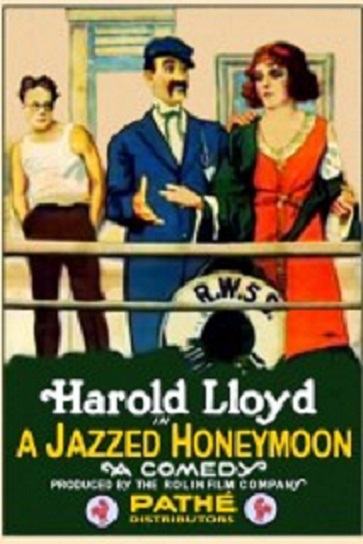
A definitive 5.8/10 rating for a film that redefined the boundaries of cult cinema. A Jazzed Honeymoon remains a cornerstone of transgressive art.
There is a specific brand of frantic energy that only the year 1919 could produce—a post-war exuberance clashing with the burgeoning sophistication of cinematic grammar. A Jazzed Honeymoon is a quintessential artifact of this era, capturing Harold Lloyd at a pivotal juncture in his meteoric ascent. While many look to his later features for the definitive 'Glasses Character' experience, this short subject provides a raw, unadulterated glimpse into the mechanics of his comedic timing before it was polished for the feature-length audiences of the mid-twenties.
The film opens with the deceptive simplicity of a wedding. We see Harold and Bebe Daniels—a pairing that possessed a screen chemistry rivaling any of the great romantic duos of the silent era—embarking on what should be a serene voyage. However, in the world of Hal Roach, serenity is merely a setup for an impending collapse. The sequence where Harold is left behind is a masterclass in spatial awareness. Unlike the more static compositions found in A Son of Erin, Lloyd and his director utilize the entire frame to convey a sense of mounting panic. The pier becomes a site of existential dread, albeit one painted in the bright strokes of slapstick.
When Harold finally infiltrates the ship, the narrative takes a sharp turn into the industrial. The engine room, with its hissing valves and rhythmic pistons, serves as more than just a backdrop; it is a character in its own right. The contrast between the pristine deck where Bebe resides and the grimy, hellish depths where Harold is forced to toil as a stoker provides a sharp, if unintentional, commentary on the social strata of the time. It reminds one of the darker undertones found in The Great Problem, though Lloyd keeps the atmosphere firmly rooted in the absurd.
"Harold Lloyd’s genius lay not in his ability to take a fall, but in the frantic logic he applied to avoiding one. In 'A Jazzed Honeymoon', we see the early blueprints of the 'Boy'—a character who is perpetually outclassed by his environment but never outmatched by it."
The performance of Harold Lloyd here is a fascinating study in transition. He had recently shed the 'Lonesome Luke' persona, a Chaplin-esque derivative that relied on baggy clothes and exaggerated movements. In this film, the 'Glasses Character' is fully realized—a go-getter, an everyman, a figure of relentless optimism in the face of certain catastrophe. This optimism is tested repeatedly as he navigates the maritime machinery. His interactions with the crew, particularly the formidable Noah Young and the eccentric 'Snub' Pollard, create a friction that drives the comedy forward. Unlike the more whimsical tone of The Habit of Happiness, the stakes in A Jazzed Honeymoon feel strangely tactile. You can almost smell the coal dust and the salt spray.
Bebe Daniels, often relegated to the role of the 'girl' in these early shorts, brings a remarkable amount of agency to her performance. Her reaction to Harold’s absence is not merely one of distress, but of a specific, high-society frustration that heightens the comedy. The ensemble cast, featuring stalwarts like Bud Jamison and James Parrott, functions like a well-oiled machine. There is a rhythmic quality to their movements that mirrors the ship’s engines. The way they move in and out of the frame suggests a level of rehearsal that was often overlooked in the 'sausage factory' production style of early silent comedy.
Compare this to the ensemble work in Soldiers of Chance, and you begin to see the superiority of the Roach studio’s pacing. Every gesture in A Jazzed Honeymoon is calculated for maximum impact. When Harold is mistaken for a worker and shoved into the engine room, the physical comedy is not just about the soot on his face; it is about the frantic subversion of his expectations as a newlywed. He expected a silk-sheeted honeymoon; he received a coal-shoveling nightmare.
From a technical standpoint, the film is surprisingly ambitious. The use of the ship as a multi-level set allows for verticality in the comedy—a precursor to the legendary skyscraper stunts Lloyd would later perform. The cinematography captures the claustrophobia of the lower decks with a gritty realism that stands in stark contrast to the breezy, sun-drenched pier sequences. This visual dichotomy reinforces the theme of the honeymoon 'gone wrong'. It’s a descent into a mechanical underworld, a trope that would be explored in different contexts in films like The Chattel or the much later Trompe-la-Mort, though rarely with such a commitment to the laugh.
The writing, credited to the legendary H.M. Walker, is sharp and economical. The intertitles don't just provide dialogue; they add a layer of wit that complements the physical action. Walker knew exactly when to let the image speak and when to punctuate it with a dry observation. This synergy between the visual and the textual is what makes the Roach-Lloyd-Walker trifecta so formidable. It’s a level of craft that makes contemporary viewers realize just how much 'talkies' lost in terms of pure visual storytelling.
As we look back at A Jazzed Honeymoon, it is easy to dismiss it as a mere stepping stone. Yet, there is a purity here that is often lost in the more complex narratives of the 1920s. It is a film about a man who simply wants to be with his wife and the universe’s hilarious refusal to allow it. The resolution, while predictable in the sense that our hero must prevail, is earned through sheer physical exertion. Harold’s eventual reunion with Bebe is not a moment of quiet romance, but a triumphant survival of a mechanical gauntlet.
In the broader context of silent cinema, this film sits comfortably alongside the works of Keaton and Chaplin, offering a more grounded, relatable form of comedy. While Chaplin was the poet and Keaton the mathematician, Lloyd was the athlete of the heart. He represented the American spirit of the time—resilient, slightly overwhelmed, but ultimately unstoppable. Whether he was battling the elements or a disgruntled ship’s captain, Lloyd’s Harold was the surrogate for every man who had ever felt left behind by the ship of life.
Final Critical Verdict:
A Jazzed Honeymoon is a breathless, beautifully choreographed romp that showcases the nascent genius of Harold Lloyd. It is a vital watch for anyone interested in the evolution of comedy, the history of the Hal Roach studios, or simply the joy of watching a man in glasses try to outrun his own bad luck. It lacks the polish of Safety Last!, but it possesses a raw, infectious energy that is impossible to ignore. A true gem of the 1919 cinematic landscape.
***
IMDb 5.8
1931
Community
Log in to comment.