DbcultAccessing Vault...
Cult Review
Senior Film Conservator
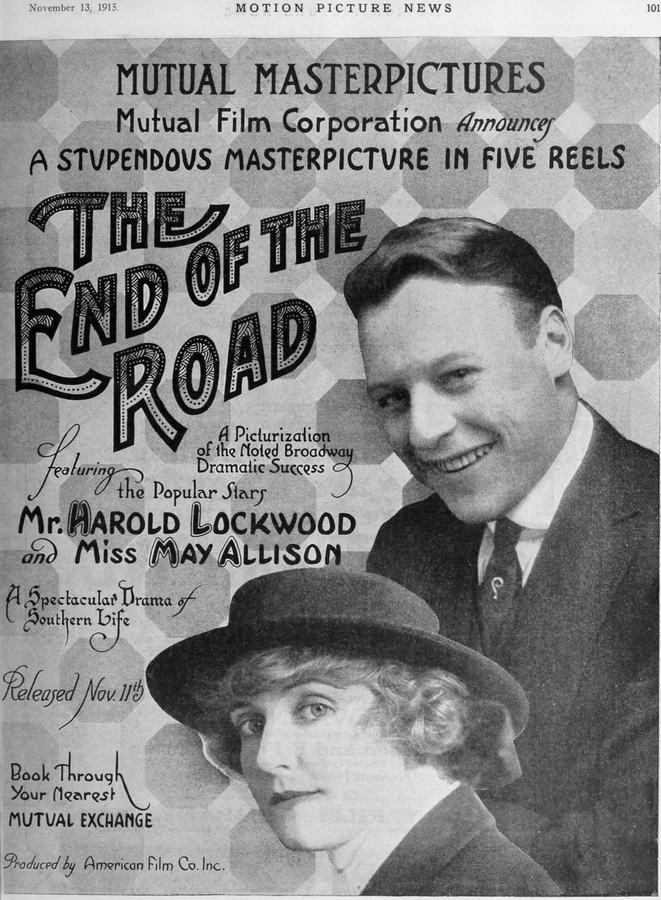
Lightning never strikes the same film twice, yet The End of the Road keeps luring me back like a jug of contraband that improves with each uncorking. What sounds on paper like a stock melodrama—city boy rescues belle from mustache-twirling villain—reveals itself, frame by nitrate frame, as a fever dream of post-Reconstruction entropy: land-rich but cash-poor, honor-bloated yet morally porous.
Visual Patois of the Pines
Director W. J. Lincoln shot on location in the Blue Ridge foothills during the dog days of 1915, and the celluloid perspires pine resin. Note the tableau where Harold Lockwood’s Paul Harvard first glimpses Magnolia Hall: the mansion is framed through a lattice of kudzu, its Corinthian capitals eroded like molars in a moonshiner’s mouth. The image forecasts the decay of an entire social order more eloquently than any intertitle.
The Amber Morality of Moonshine
Forged currency and bootleg liquor circulate here as twin sacraments. Counterfeit bills—crude Benjamin facsimiles—pass from palm to palm with the same furtive velocity as the mason jars of corn whiskey. Lincoln literalizes this equivalence in the cross-cutting montage where Quigg’s printing press thumps in off-beat synchrony with the gurgling still. Both machines exhale vapor: one of alcohol, the other of illusion. The moral? Value itself has become fungible, a mere question of ink viscosity.
Performance as Appalachian Cipher
Harold Lockwood, usually a genial matinée idol, here plays Harvard with the tight-lipped fatalism of a man who suspects his own pedigree is counterfeit. Watch the micro-gesture when Grace confesses the mortgage crisis: Lockwood’s pupils skate left, the camera inching closer as though to catch the moment ancestral guilt metastasizes into erotic obligation. It’s silent-era Stanislavski via Appalachia.
Nan Christy’s Grace: Belle as Battlefield
Grace Wilson could have been another swooning magnolia; instead Nan Christy inflects her with steel-wool resilience. Her refusal to wed Quigg is filmed in a single sustained take—no cutaways to swooning damsels here. The camera lingers on her clenched knuckles whitening around a parasol handle, the gesture evoking both sexual revulsion and economic terror. In that moment she is every indebted farmer’s daughter turned into a last bulwark against the predations of capital.
Hal Clements’ Agent Grant: Method in Moonlight
Federal agent Wilbur Grant’s faux inebriation predates by a decade the undercover shtick of late-20s gangster pics. Clements studied actual revenue men, borrowing their repertoire of tics: the too-careful footfall, the way eyelids droop while ears stay radar-sharp. When Grant finally flashes his badge, the gesture is undercut by a bead of sweat that slips from temple to jaw—an intimation that even the law is moonshine-drunk on its own theatrics.
The Dam Burst: Deus ex Machina or Folk Eschatology?
Some scholars deride the climax—flash flood, shack swept away, lightning like Jehovah’s flashbulb—as Victorian contrivance. I read it as Lincoln’s concession to mountain eschatology. Appalachian oral culture is soaked in deluge myths: Noah’s variants where the ark is a still-house. The bursting dam externalizes generations of repressed guilt; the shack’s obliteration is communal absolution rendered in hydraulics. When Harvard rescues Jack Tolliver, the rescue feels less like individual heroism than a ritual exchange: life for honor, water for fire.
Race, Credit, and the Itinerant Jew
One cannot ignore the cringe-inducing subplot of the “itinerant Jew” peddler whose appearance occasions Caroline’s coveted frock. The stereotype is as threadbare as the coat he carries, yet Lincoln frames him in chiaroscuro that complicates the caricature: backlit against pine needles, his silhouette is indistinguishable from that of the bootleggers. The visual rhyme suggests that otherness, not ethnicity, is the true mark of Cain in this economy of liquidity. Still, the film never grants him agency, a silence that clangs louder than any counterfeit press.
Restoration Rumors and Nitrate Ghosts
For decades the only known print languished in a Sao Paulo archive, beset by vinegar syndrome. A 4K restoration premiered last year at Pordenone, accompanied by a new score fusing banjo with analog synth—think Dock Boggs meets Kraftwerk. The tinting schema—amber for interior lamplight, viridian for nocturnal exteriors—reinstates Lincoln’s original chromatic symbolism. Blu-ray release rumored for 2025 via Kino; extras promise an essay on Appalachian currency crises post-1890.
Comparative Lattice: From Becky to Kilmeny
If The Case of Becky probes split-personality as feminine curse, and Kilmeny mythologizes pastoral innocence, The End of the Road hybridizes both: Grace is Becky’s will splintered by Kilmeny’s economic fragility. Meanwhile the counterfeit motif rhymes with The Merchant of Venice—yet where Shakespeare interrogates the ethics of collateral, Lincoln merely punishes the forger, restoring moral legibility via federal handcuffs.
Final Pour: Why It Still Steeps
We keep returning because the film distills a national neurosis: the terror that our wealth—land, blood, identity—might prove counterfeit under black-light scrutiny. The road ends not in marriage but in mortgage, the nuptial kiss sealed by a deed transfer. Magnolia Hall stands, but its foundation is Yankee capital, its white columns propped by federal muscle. The last shot—Harvard and Grace silhouetted against the portico—feels less like closure than a freeze-frame on a Ponzi scheme about to unravel in 1929. Drink deep, but know the aftertaste is pure fusel oil.
IMDb —
1926
Community
Log in to comment.