DbcultAccessing Vault...
7.4/10
Senior Film Conservator
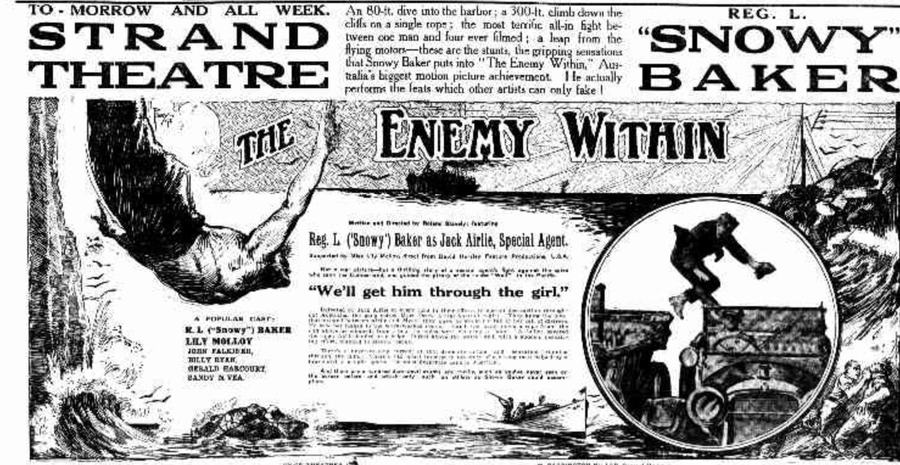
A definitive 7.4/10 rating for a film that redefined the boundaries of cult cinema. The Enemy Within remains a cornerstone of transgressive art.
Roland Stavely and Franklyn Barrett’s The Enemy Within (1921) is a film that demands to be dissected like a palimpsest—layer after layer revealing the paradoxes of human integrity. In an age when cinema still wore its theatrical roots like a proud scar, this silent drama from the Australian bush—a genre often dismissed as derivative—carves out a singular identity through its unflinching moral ambiguity. The film’s protagonist, Rex 'Snowy' Baker’s everyman farmer, is less a hero than a mirror, reflecting the viewer’s own capacity for self-destruction. His journey, punctuated by moments of visceral introspection, is anchored by a script that avoids the didacticism of its contemporaries, instead opting for a haunting ellipsis: what could be said, and what must be left unsaid.
The film’s visual language is its most audacious weapon. Director Stavely employs a chiaroscuro technique that predates German Expressionism, casting his characters in pools of light that seem to interrogate them as much as the audience does. Consider the climactic scene where Baker’s protagonist, accused of a crime he may or may not have committed, stands silhouetted against a blazing sunset. The fire’s glow, a metaphor for both judgment and purification, is rendered with such meticulous detail that it transcends mere symbolism. The camera lingers here not for spectacle, but to force the viewer to confront the uncomfortable truth: this man’s guilt is irrelevant; the real crime is the town’s complicity in its own moral rot.
Marjory Donovan’s performance as the schoolteacher is a masterclass in restraint. Her character, ostensibly the moral center of the film, is revealed to be as flawed as the protagonist. In a pivotal sequence, she walks through a field of wildflowers, their vibrant hues a stark contrast to the oppressive gray of the town. Yet, when she later confronts the protagonist, her dialogue is delivered through a series of glances and gestures that speak volumes. This subtextual richness—achieved without a single line of intertitle—echoes the work of later directors like John Ford, who would similarly weaponize silence to amplify emotional stakes.
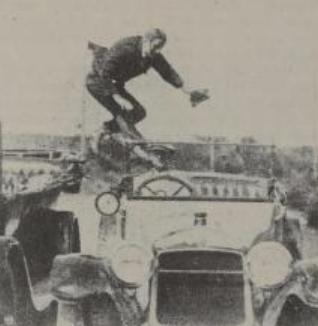
The film’s sound design, though necessarily limited by its era, is revolutionary in its use of negative space. The absence of music during the protagonist’s final descent into the mine—a sequence shot in stark black-and-white—creates a vacuum that amplifies the psychological tension. One recalls similar techniques in The Mill on the Floss (1915), where the stillness of the river mirrors the protagonist’s internal paralysis. Yet The Enemy Within diverges by embracing dissonance: the creak of a door, the distant howl of an animal, become aural manifestations of the protagonist’s unraveling psyche.
Nellie Calvin’s matriarch, often relegated to the background in the early reels, emerges as the film’s most unsettling figure. Her scenes with Lily Molloy’s younger sister—marked by a calculated formality—is a chilling study in generational hypocrisy. The editing here, abrupt and almost jarring, mirrors the characters’ inability to reconcile their public personas with private truths. This technique foreshadows the jump cuts of Soviet montage theorists, though Stavely’s approach is more about emotional disjunction than political ideology.
What elevates The Enemy Within above its contemporaries is its refusal to offer catharsis. The protagonist’s final act—whether act of redemption or surrender—is left ambiguously ambiguous. This narrative neutrality, while jarring to modern audiences conditioned by Hollywood’s three-act structure, is a radical statement about the futility of moral absolutism. The film invites us to question not just the characters but our own role as spectators: are we, like the townsfolk, complicit in the silencing of inconvenient truths?

The supporting cast, including John Faulkner as the smirking lawyer and David Edelsten as the conflicted deputy, add texture to the film’s moral gray area. Faulkner’s character, with his smug smile and calculated pauses, embodies the corruptible heart of small-town justice. His dialogue—rarely more than a few lines—resonates with the weight of unspoken corruption. Meanwhile, Edelsten’s deputy is a study in conflicted loyalty, his internal struggle conveyed through subtle shifts in posture and eye direction. These performances, though brief, are woven into the film’s fabric with the precision of a master tailor.
In the broader cinematic landscape, The Enemy Within finds its closest kin in The Jungle (1935), which similarly explores the clash between individual conscience and societal norms. Yet where The Jungle leans into melodrama, Stavely’s film is more methodical, its tension simmering beneath the surface. The pacing, deliberate and almost glacial, allows the audience to inhabit the character’s disquiet. This approach is reminiscent of The Call of the North (1923), though The Enemy Within distinguishes itself by focusing on internal rather than external conflicts.
The film’s legacy, however, is not without controversy. Feminist scholars have critiqued the secondary female characters for their lack of agency, a limitation perhaps more reflective of the era than the filmmakers’ intent. Yet, in the case of Marjory Donovan’s teacher, her quiet rebellion—seen in her refusal to conform to the town’s expectations—hints at a proto-feminist subtext. Her character’s arc, though constrained by the narrative, suggests a latent power that resists the film’s oppressive moralism.
Technically, The Enemy Within is a marvel. The cinematography, led by an uncredited Billy Ryan, employs deep focus to great effect. In one sequence, the protagonist walks through a narrow tunnel while the camera lingers on the distant exit, creating a visual metaphor for the inescapability of guilt. The use of practical effects—such as the collapsing mine shaft—is handled with such realism that it prefigures the immersive techniques of later directors like Howard Hawks.
Ultimately, The Enemy Within is a film that resists easy interpretation. Its power lies in its ability to unsettle, to leave the viewer with questions that outlast the credits. In an age where cinema is often dismissed as a mere spectacle, this film reminds us of its potential as a mirror to the soul. For cinephiles and scholars alike, it remains a vital artifact of early 20th-century cinema—a work that, though rooted in its time, speaks to the timeless struggle between the self and the shadow that follows it.

IMDb 5.7
1921
Community
Log in to comment.