DbcultAccessing Vault...
Cult Review
Senior Film Conservator
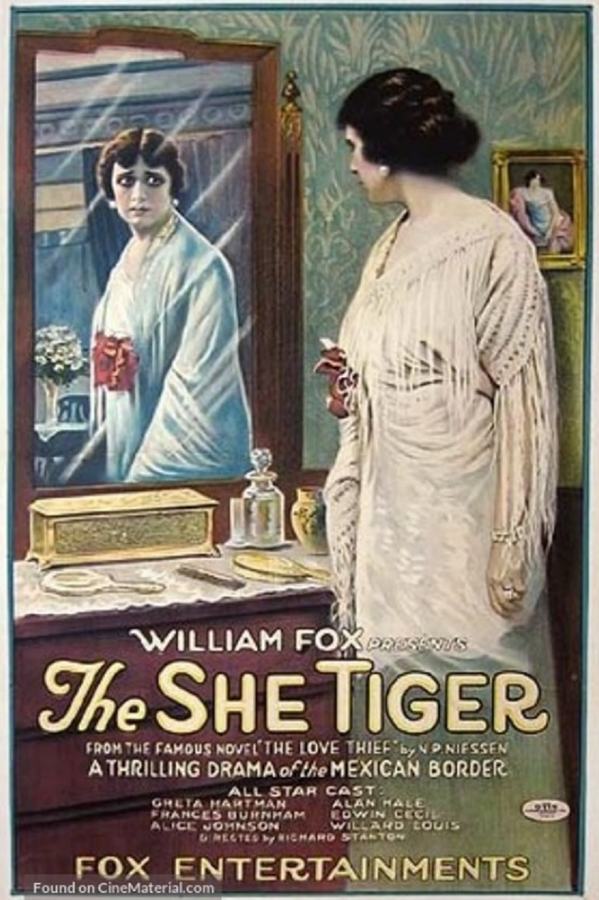
A fever dream shot through with alkali dust and rosary beads, The Love Thief is less a story than a tango performed on the edge of a canyon—one misstep and everyone plummets into myth.
Picture 1926: sound stages still smell of varnish, intertitles flicker like semaphore, and the border between the United States and Mexico is a wound that keeps being stitched with silver nitrate. Into this gash rides director M.P. Niessen, armed with Bennett Cohen’s scenario and a cast willing to emote as if their lives, not merely their careers, depend on it. What emerges is a western only in geography; at its marrow it is a baroque study of covetousness, a pre-Code morality play that dares to suggest love can corrode faster than any rifle bore.
The film’s negative was rumored dumped into the Pacific to reclaim silver, yet surviving prints—scuffed, nitrated, ghosted—reveal cinematographer Charles E. Kaufman chasing grandeur with nothing but sunrise and reflectors. Observe the early cantina tableau: Juanita’s lace mantilla backlit so that every thread becomes a spider’s filament, while Boyce’s brass buttons catch fire like miniature suns. It’s chiaroscuro lifted straight from Goya, but sped up to 22 fps so the dread becomes kinetic. Compare this relentless luminosity to La Salome where light caresses decadence; here it accuses, burns, brands.
Frances Burnham’s Clare is no wilting lily but a woman whose trust erodes in real time; watch her pupils dilate when the forged love letter is pressed into her palm—an entire breakup registers in the twitch of a nostril. Conversely, Alan Hale—years before his jovial Robin Hood sidekick status—plays Boyce as a man whose spine is slowly soldered with shame. Note the courtroom sequence: Hale stands erect, yet his eyes ricochet like trapped swallows, silently testifying that innocence can be heavier than chains.
Gretchen Hartman’s Juanita, meanwhile, is the film’s blazing core. She refuses the vamp cliché, opting instead for wounded Machiavellian grandeur. Every gesture is flamenco: the arc of a wrist, the stamp of a heel, the sudden hush when obsession flips to contempt. In close-up her nostrils flare as if scenting her own decaying dreams. She dies not with a whimper but a hex, and the frame lingers on her fallen form until the dust settles like a shroud—an image as indelible as any in The Marked Woman.
Cohen’s scenario courts the risqué: a woman weaponizing rumor, the state eager to lynch without corpus delicti, munitions smuggled by an avuncular Quixote who quotes Jefferson while peddling death. Yet the narrative also indicts Boyce’s emotional illiteracy; he never once declares his innocence to Clare with the fervor he reserves for battlefield commands. The resulting vacuum is filled by Juanita’s machinations, suggesting that silence can be as culpable as perjury.
Compare the plot’s moral quicksand to The Convict Hero, where the protagonist’s guilt is ironclad yet valor redeems him. Here redemption is porous, contingent upon a murderer’s pang of conscience—an eleventh-hour deus ex machina that feels both Catholic and cruelly arbitrary.
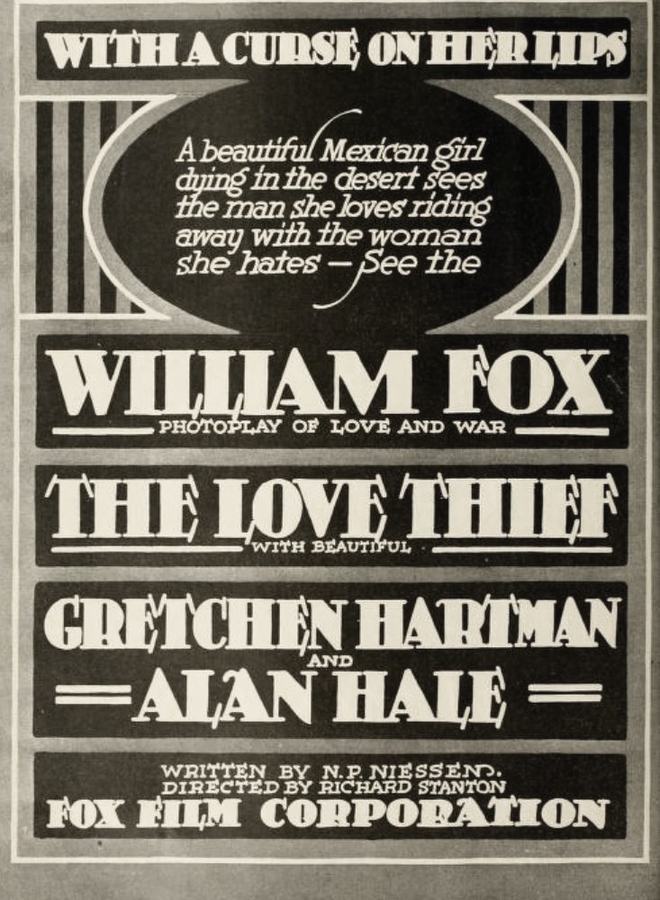
Editors in ’26 often cut on movement; Niessen cuts on breath. Witness the jail-cell dissolve: Boyce exhales, smoke curls, match-cut to Juanita inhaling cigarillo on a moonlit bluff—two lungs across a divide, sharing poison. Later, the escape sequence crosshatches three parallel actions across twelve shots: Clare unpicking rawhide, Lopez rolling dice with a dead man’s knucklebones, distant cavalry trumpets reverberating through canvas. The tempo accelerates until the montage collapses into a single frame: Juanita’s horse rearing, its silhouette eclipsing the moon—a visual palindrome to open the film—announcing that fate, too, loves symmetry.
Silent cinema trafficked in maidens tied to tracks; The Love Thief ties the hero’s reputation to the tracks and lets a woman drive the locomotive. Juanita’s downfall isn’t failed seduction but failed patriarchal bargain: she believes that by engineering Boyce’s disgrace she can purchase his dependence, only to discover masculinity’s fragility curdles into violence, not gratitude. Clare’s final act—picking the lock with a hairpin—reclaims the damsel trope, but the film refuses applause; her freedom is offset by Juanita’s corpse, reminding us that every emancipation in this universe is financed by another woman’s annihilation.
Though the original score is lost, modern restorations often pair the film with nuevo tango ensembles—bandoneón sighs, violin staccato mimicking hoofbeats. The synergy is uncanny: each pluck underscores the social precarity, each legato bow stretches the lovers’ agony. If you screen this at home, cue Astor Piazzolla’s Milonga del Ángel when Juanita first spies Boyce; swap to Ennio Morricone’s Man with a Harmonica during the shack standoff—watch how the past and future of border cinema collapse into one electric continuum.
Rumors claim studio accountants weighed the silver content higher than cultural memory; thus the original negative allegedly sank off Santa Monica. What circulates today is a 9.5 mm condensation, speckled like measles, missing two reels. Yet fragments—lobby cards, a continuity script at UCLA—hint at deleted scenes: a cantarito toast between Juanita and Costa that foreshadows betrayal, a midnight mass where Clare clutches a scapular soaked in tears. These lacunae only heighten the myth, transforming The Love Thief into a ghost that flickers at the periphery of western scholarship, waving from the shadows of Mexico and Ivanhoe alike.
Is the film imperfect? Unquestionably. Its racial politics wear the casual imperialism of the era; Mexicans oscillate between saintly victims and lecherous bandits with the predictability of a metronome. Its pacing sags mid-reel when Niessen lingers on Clare’s moonlit lament. Yet these flaws feel like cracks in cathedral glass—blemishes that admit shards of brutal honesty.
Watch The Love Thief not for tidy closure but for the way Juanita’s final curse ricochets through your skull long after the projector’s whirr fades. In an age that franchises every superhero, here is a 63-minute silent relic that proclaims love can be grand larceny, justice a roulette wheel, and redemption a door that opens only to slam on someone else’s fingers. That searing recognition, white-hot against the cool tintype of history, is why this forgotten artifact deserves resurrection on 4K, on Blu, on whatever byte-sized immortality we invent next.
Stream it with the lights off, volume of your own heartbeat cranked high. Let Juanita’s shadow stretch across your wall—an ars amatoria written in gunpowder and moonlight.
IMDb —
1921
Community
Log in to comment.