DbcultAccessing Vault...
Cult Review
Senior Film Conservator
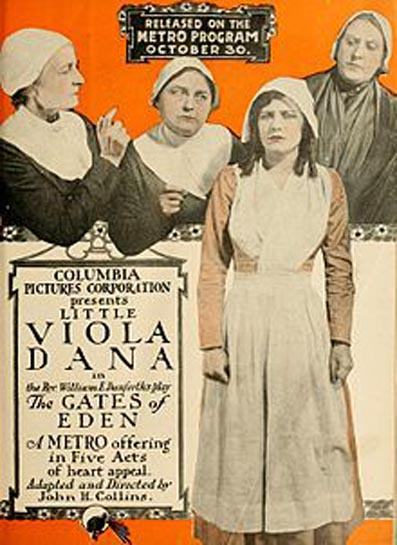
In the monochrome hush of 1916, when the world outside movie-palaces reeked of trench mud and cordite, The Gates of Eden arrives like a shard of stained glass hurled against the whitewash of American utopias. Director John H. Collins, a name now entombed in the catacombs of lost film lore, wagers everything on a single heresy: that the most corrosive violence is not war between nations but war between the body and the soul.
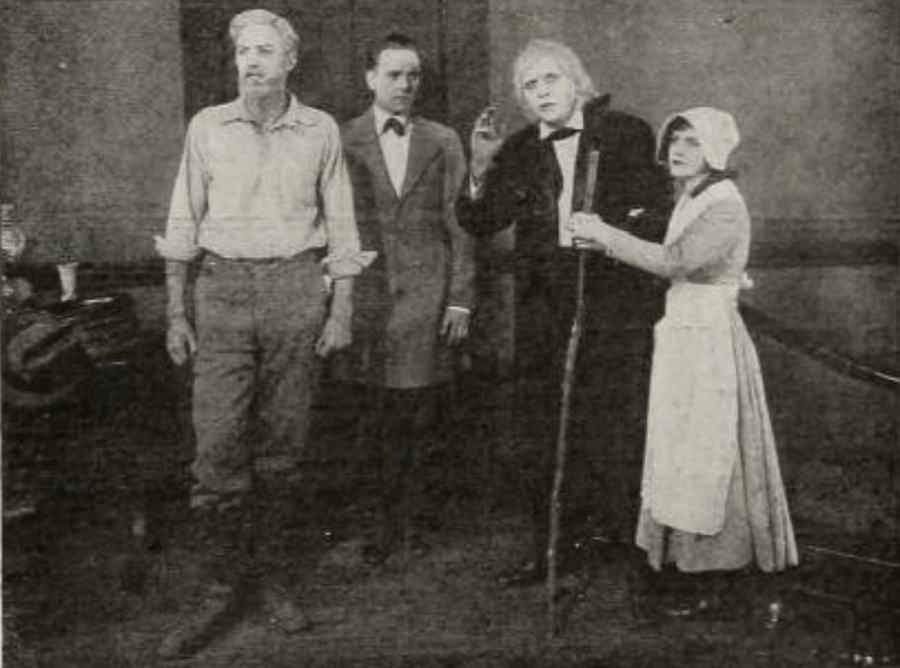
Viola Dana’s Evelyn enters the frame hair scraped beneath a linen cap, yet the camera—sniffing scandal like a bloodhound—keeps tilting toward the pulse fluttering at her clavicle. That pulse is the film’s true protagonist; every subsequent rupture, whether of community or of celluloid, syncopates with it. Dana, barely twenty during production, had the kind of face the silent era adored: eyes that could suggest both beatitude and burglary in the same glance. Watch the sequence where she kneels in the Shaker meetinghouse while the sisters whirl in their choreographed ecstasy: the lens holds on her profile, the shutters of her eyelids beating out a Morse code of panic. No intertitle is needed; the body has already confessed.
Augustus Phillips’s William is less a flesh-and-blood spouse than a walking dialectic: beard trimmed to the modesty of a Pietist patriarch, yet palms blistered by the plow of outright insurgence. Their joint announcement of impending parenthood detonates the commune’s equilibrium like a stink bomb lobbed into a prayer meeting. Collins stages the expulsion as a fever dream of silhouettes: pitchforks pricking the dusk sky, lanterns swinging like censers of damnation, children—yes, the Shakers’ adopted progeny—chanting “Mother Ann, Mother Ann” in eerie two-part harmony. The moment feels pilfered from some lost Puritan opera, yet its throb is unmistakably modern: cancel culture in bonnets and buckles.
Once the lovers cross the titular gates—nothing more than rough-hewn cedar posts strung with a rope that might as well be a hangman’s noose—the film’s palette (or its sepia surrogate) grows colder. Cinematographer William E. Danforth, writing with light the way other men wrote with ink, lets the horizons sag under the weight of nothingness. We sense space not by vistas but by what cruelly withholds them: a barn wall here, a leafless copse there, the sky clamped down like a pewter lid. This is the American interior as antiparadise, a place where Manifest Destiny runs into its own emaciated shadow.
Evelyn’s death in childbirth is filmed with an austerity that would make Carl Dreyer blink. No midwife, only a calico curtain snapping in the wind like a flag of surrender. The infant Eve’s first wail arrives simultaneous with her mother’s last exhalation; Collins superimposes the two events in a single frame, a visual pun on the biblical curse: “in sorrow thou shalt bring forth children.” The Shaker elders, arriving too late to save yet punctual enough to snatch, pronounce the child stillborn. William, delirious with grief, never sees the corpse. Viewers attuned to melodrama’s sleights will arch an eyebrow—did the infant die?—but the film refuses the cheap comfort of a switched-at-birth twist. Its tragedy is existential, not procedural.
What follows is a structural gambit that modern screenwriting manuals would flag as suicidal: the protagonist disappears for a reel and a half. Collins instead tours the Shaker settlement as it attempts to repress the memory of the scandal. We see the sisters quilting a “mourning” blanket into which they stitch the very pattern Evelyn once proposed for her hope-chest—an act of textile gaslighting. Meanwhile the brethren harvest apples with the methodical silence of automata, each thud of fruit on wagon bed echoing like a muffled heartbeat. The community’s denial is so absolute it becomes spectral; their hymns, drained of joy, now drone like incantations to exorcise history itself.
When William resurfaces—beard unkempt, eyes cavernous—he carries no rifle, no blazing torch. His weapon is memory. In one of the film’s most haunting set-pieces he stands outside the gates at dusk, reciting the names of every Sister who ever offered him cider, every Brother who taught him joinery. The litany, delivered in intertitles, scrolls upward like the credits of a reverse Genesis: “Sister Abigail, Brother Seth, Sister Hope…” The act is both benediction and blacklist. We realize vengeance can be passive, a mere refusal to let the past settle into anecdote.
Cinephiles schooled in the late-silent resurrection of Memoria dell’altro will recognize a kinship: both films stage the return of the repressed as a moral reckoning rather than a thriller mechanism. Where Memoria weaponizes amnesia, Gates weaponizes perfect recall. Conversely, The Money Master treats capital as the solvent of sectarian bonds; Collins locates the solvent in sexual continence, that most intimate of currencies. If you double-bill Gates with I Accuse, you’ll notice shared DNA: both pivot on a child presumed dead, yet whereas I Accuse externalizes guilt into courtroom spectacle, Collins keeps the courtroom internal, a silent tribunal where conscience cross-examines itself.
Viewers who thrilled to the pastoral fatalism of The Mill on the Floss will find a more austere sibling here. Eliot’s flood becomes Collins’s winter; both are acts of nature complicit with patriarchal cruelty. And anyone who endured the slaughterhouse horror of The Jungle will appreciate how Gates locates its abattoir not in Chicago stockyards but in the human heart.
Dana’s reputation has languished in the penumbra of better-known muses like Lillian Gish or Louise Brooks, yet her craft is no less formidable. She modulates between beatitude and terror with the precision of a Swiss watch—no small feat when your only gears are eyebrow, shoulder, and diaphragm. Note the instant she feels the first labor pang: her knees buckle, yet her fingers fly to her abdomen as if to hush the scandal within. The gesture lasts perhaps two seconds but etches itself into the viewer’s nervous system.
Augustus Phillips, saddled with the thankless role of “the man left behind,” avoids the ham-fisted clutches of contemporaries who’d twist grief into Grand-Guignol gesticulation. His stooped shoulders become a landscape of bereavement; the way he fingers the empty sleeve of Evelyn’s abandoned dress is a poem of bereavement more eloquent than pages of intertitles.
Among the supporting cast, Grace Stevens as Sister Mercy deserves special mention. Her face, round and bland as a biscuit, becomes a canvas upon which the camera projects our own dawning horror. Watch her in the scene where she rocks an invisible cradle while humming a lullaby to the “dead” infant: the performance is so bereft of actorly vanity it achieves the uncanny valley of documentary.
Collins, himself the lapsed son of a Methodist minister, fills the mise-en-scène with iconography that quietly blasphemes. The Shaker chairs, famous for their utilitarian elegance, are filmed from below so they resemble torture racks. The communal dining table, stretched like an altar, becomes the stage for a last supper of ostracism. Even the famed Shaker drawers-within-drawers, symbols of orderly inwardness, are shown yawning open, revealing not secrets but vacancy.
Color, though absent, is implied with a chromatic wit that belies the medium: the sisters’ white bonnets gleam with such intensity they seem to emit their own lunar glow, while William’s drab coat absorbs light like a black hole. When the final conflagration arrives—yes, there is fire, though not the sort you expect—it is preceded by a single shot of a yellow apple rolling across the floor, a sun eclipsed by gravity.
Original exhibitors would have accompanied the film with whatever sentimental parlor tune the house pianist could sight-read. Modern revivals often slap on a pastiche of Shaker hymns, all “'Tis the Gift to Be Simple.” Both approaches miss the film’s tonal dissonance. A more honest score would juxtapose the Shakers’ rigorous shaker melodies with the syncopated heartbeat of early jazz—an aural reminder that while the community polices bodies, the century is learning to dance on its own pulse.
Upon its April 1916 release, the film was picketed by reform leagues who objected not to its anti-Shaker stance but to its implication that celibacy might be impossible rather than merely undesirable. The New York Evening Mail dismissed it as “a preachment for pandemonium,” while Motion Picture Magazine praised Dana’s “virginal luminosity”—a phrase that today reads like a euphemism for the male gaze. Regional exchanges trimmed anywhere from 200 to 600 feet, depending on the superintendent’s threshold for heresy. The Library of Congress holds a 28mm print riddled with emulsion rot; most of what survives today comes from a 1950s acetate duplication struck for the Shaker museum at Sabbathday Lake, ironically preserved by the very sect it indicts.
Stream the film on your laptop and you’ll feel a twitch of recognition: communes rebranded as “intentional communities,” influencers touting dopamine fasts, tech bros chasing monk-mode productivity. The Shakers’ celibate utopia was the 19th-century equivalent of today’s algorithmic purity diets—both promise transcendence through denial, both collapse under the weight of basic biology. Collins’s camera, unblinking, asks: what do we do with the human residue when the system spits it out?
There is a moral hazard in deriving aesthetic pleasure from depictions of sectarian cruelty. Yet to look away is to replicate the elders’ denial. Collins offers no moral bridge; he leaves us stranded on the roadside with William, clutching a memory that may or may not be true. Perhaps that is the film’s most radical gesture: it refuses to resolve whether revenge, or forgiveness, or forgetfulness is the antidote to trauma. It simply insists that the wound remain visible, like the empty sleeve William carries through the final shot, flapping in the wind like a flag whose nation has ceased to exist.
Shot on Eastman 28mm stock at an aperture that rarely exceeds f/4, the film exhibits a shallow depth of field that turns every background into watercolor. The aspect ratio, when projected at the correct 1.33:1, reveals feet and hats otherwise lopped off in 16mm dupes. Runtime varies: 68 minutes at 18 fps, 54 at 24 fps. The surviving print lacks the final intertitle; rumors persist that it read: “The gates of Eden open only outward.”
Great art does not comfort; it returns you to the world with your nerves scraped raw. The Gates of Eden does exactly that, minus the comfort blanket of nostalgia. It reminds us that every utopia carries a built-in ejector seat, and that the expelled, not the dwellers, inherit the burden of storytelling. Watch it, then go outside at dusk and listen for the echo of William’s recitation. Somewhere in the hush between sirens and cicadas, you might hear your own name—proof that the gates, despite rust and ruin, never quite swing shut.
If this review sent you spiraling, consider circling back to Aftermath or the maternal gothic of The Sins of the Mothers for complementary lacerations. For a palate cleanser of communal hope gone right—well, you’ll have to look beyond Collins; perhaps Common Ground will lend salve, though I make no promises.
IMDb 5.4
1935
Community
Log in to comment.