DbcultAccessing Vault...
Cult Review
Senior Film Conservator
The nascent years of cinema, a period often mischaracterized by casual viewers as merely a precursor to sound, were in fact a vibrant epoch of narrative experimentation and profound emotional resonance. Within this fertile ground emerged films like The Evil Eye (1917), a powerful melodrama that transcends its era, offering a poignant exploration of human nature, societal conflict, and the enduring power of love. Penned by Hector Turnbull and George DuBois Proctor, this cinematic artifact serves as a compelling reminder of the silent film's capacity to communicate complex ideas and evoke deep sentiment without a single spoken word. It's a testament to the universal themes that captivated audiences then and continue to resonate today.
The narrative unfurls in the sun-drenched, yet tragically afflicted, vineyards managed by Leonard Sheldon (William Dale). A virulent epidemic has gripped the isolated Mexican settlement, prompting a desperate plea for medical intervention. In response, a most unexpected savior arrives: Katherine Torrance (Blanche Sweet), a young, beautiful, and remarkably resolute physician. Her very presence, a woman in a traditionally male profession, immediately sets the stage for a clash of cultures and expectations. Accompanying her is her younger brother, Clifford (Webster Campbell), whose weak-willed and dissipated nature initially serves as a stark counterpoint to Katherine's unwavering resolve. This initial setup immediately establishes a multi-layered conflict: the external battle against disease, the internal struggle for acceptance, and the personal journey of redemption for Clifford.
Upon Katherine's arrival, Sheldon, thunderstruck by the audacity of a woman tackling such a formidable task, attempts to dissuade her, urging her to retreat from the daunting circumstances. His skepticism, born of societal norms and perhaps a protective instinct, is a familiar trope, yet Katherine's steadfast refusal to yield defines her character from the outset. She is not merely a doctor; she is a pioneer, a symbol of burgeoning modernity confronting entrenched tradition. This defiance immediately endears her to the audience, establishing her as a formidable protagonist whose intelligence and compassion are matched only by her courage. Her dedication to faithfully caring for the afflicted underscores her professional integrity and deep empathy, qualities that will be severely tested by the community she seeks to heal.
The true antagonist, beyond the disease itself, emerges in the form of deep-seated ignorance and superstition prevalent among the village inhabitants. Katherine's innovative medical tools, particularly the diagnostic light she wears on her forehead to illuminate the throats of her patients, become the focal point of their suspicion. This practical, scientific instrument is tragically misinterpreted as an ominous 'evil eye,' a malevolent force rather than a beacon of healing. As the epidemic inexorably spreads, the escalating fear and misunderstanding are accredited to this 'evil eye,' leading the benighted Mexicans to reject her medicine, often discarding it rather than utilizing its curative properties. This rejection highlights a profound cultural chasm, a struggle between empirical evidence and ancient folklore, a theme that resonates even in contemporary society. The film masterfully uses this conflict to explore the dangers of prejudice and the difficulty of introducing new ideas into a closed community. The visual metaphor of the 'evil eye' is particularly potent in a silent film, relying on the audience's understanding of visual cues and the power of suggestion.
This central conflict, pitting modern medicine against deeply ingrained cultural beliefs, draws interesting parallels with other cinematic narratives of struggle and societal friction. One might consider the resilience against overwhelming environmental or social forces found in films like The Squatter's Son, where characters battle for survival and acceptance, or the human spirit's endurance against natural calamities depicted in An Alpine Tragedy. Katherine's solitary fight against both disease and prejudice positions her as a heroic figure, embodying the relentless pursuit of progress in the face of archaic resistance. The film, through its stark portrayal of this clash, implicitly champions enlightenment over ignorance, a timeless message conveyed with remarkable clarity for its era.
Amidst the relentless demands of their strenuous duties, a profound, yet largely unacknowledged, affection begins to ripen between Leonard and Katherine. Both are so deeply absorbed in their respective responsibilities that the burgeoning romance remains an unconscious undercurrent, a subtle emotional bond forged in the crucible of shared crisis. This 'slow burn' romance, devoid of overt declarations for much of the film, speaks volumes about the power of shared purpose and mutual respect to foster genuine connection. William Dale's portrayal of Sheldon captures his evolving perspective, moving from initial skepticism to profound admiration and, ultimately, love. Blanche Sweet, as Katherine, subtly conveys her growing regard for Sheldon, her expressive eyes and nuanced gestures hinting at emotions she dare not voice. Their relationship is not one of instant infatuation but of a deep, abiding respect that gradually transforms into something more profound.
The escalating danger further intertwines their fates. When Sheldon falls gravely ill, rendering him unable to transfer the vital payroll to the bank, Katherine, with characteristic selflessness, volunteers for the perilous task. This act of courage is not only a testament to her character but also a pivotal moment in their unspoken narrative. It demonstrates a trust and reliance that transcends professional boundaries, pushing their bond deeper into the realm of personal commitment. The ensuing hold-up, meticulously planned by Mexican Joe (Walter Long), the leader of the disgruntled employees, is thwarted, showcasing Katherine's quick thinking and adding a thrilling dimension to the plot. This sequence, executed with the dramatic flair characteristic of silent era action, serves to further solidify Katherine's heroic status and deepen Sheldon's admiration.
Beyond the central romance and the medical crisis, The Evil Eye skillfully weaves in compelling subplots that enrich the narrative tapestry. Clifford, Katherine's initially weak-willed brother, undergoes a significant transformation. Witnessing his sister's unwavering dedication and facing the harsh realities of the epidemic, he 'braces up,' shedding his dissipated habits to become an invaluable assistant to Katherine. Webster Campbell's performance effectively conveys this journey from fecklessness to responsibility, adding a powerful arc of personal redemption to the film. This transformation not only provides emotional satisfaction but also reinforces the film's broader message about the potential for human growth even in the most challenging circumstances. His newfound strength and loyalty become crucial to Katherine's ability to continue her work.
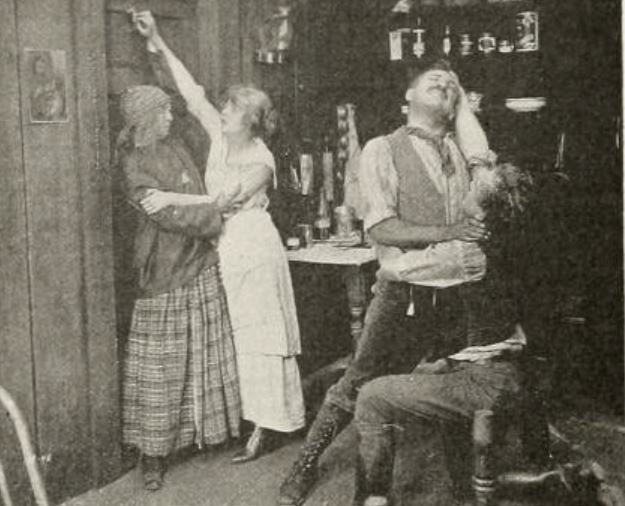
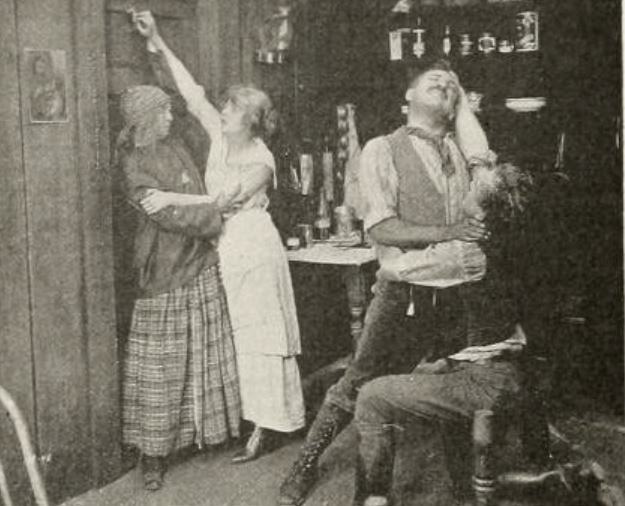
Another poignant subplot involves Rosa (Ruth King), Sheldon's servant, who harbors unrequited love for Frank King (Tom Forman), Sheldon's assistant, whose affection for her has noticeably cooled. This emotional entanglement adds a layer of human frailty and social commentary. Rosa's 'unfortunate condition'—implying an unplanned pregnancy, a significant social stigma in that era—becomes a catalyst for a dramatic confrontation. Her parents desperately try to wring from her the name of the man responsible, setting the stage for a climactic reveal. Leonard, mistakenly believing Clifford to be the culprit, is about to announce himself as the guilty party, prepared to sacrifice his own reputation to protect Katherine's brother. This act of intended chivalry underscores his noble character and his deepening affection for Katherine. However, Frank King's belated confession and his subsequent call for a priest dramatically alter the course of events, exposing the truth and resolving this emotional tangle. This kind of moral complexity and dramatic confession finds echoes in films like John Needham's Double, where characters grapple with difficult truths and their consequences.
As sentiment against Katherine reaches a crescendo, fueled by superstition and the continued spread of the disease, she decides to leave, her spirit wearied by the relentless resistance. This moment of despair is critical, highlighting the immense toll her pioneering work has taken. However, the film is poised for its triumphant resolution. Leonard, witnessing Katherine's tears in the aftermath of Frank's confession, misinterprets her distress as grief for Frank's wrongdoing. This classic melodramatic misunderstanding is swiftly corrected by Clifford, who, having found his own strength and clarity, urges Leonard to 'take her in his arms.' This intervention is the pivotal moment, a simple yet powerful directive that cuts through the emotional fog. Leonard, finally awakened to Katherine's true affection for him, promptly embraces her, a gesture that is both a personal declaration and a public defiance. In front of the assembled crowd, he announces that they may send for a 'man doctor,' for Katherine is to be his wife. This powerful declaration not only resolves the romantic tension but also serves as a definitive rejection of the villagers' superstitious demands, affirming Katherine's worth and Sheldon's commitment to her, both professionally and personally.
The emotional arc of the romance, marked by misunderstanding, sacrifice, and eventual clarity, resonates with the intricate romantic narratives found in other classic films. One might draw parallels to the complex emotional landscapes of The Voice of Love or The Rosary, where love is tested by societal pressures and personal doubts. The dramatic intensity and eventual triumph over adversity recall the passionate, often star-crossed, relationships explored in Her Beloved Enemy, or even the grand romantic gestures of Romeo and Juliet, albeit in a vastly different context. The Evil Eye, through its nuanced portrayal of love blossoming under duress, solidifies its place as a compelling romantic drama of the silent era.
As a product of its time, The Evil Eye showcases the distinctive cinematic techniques prevalent in early Hollywood. The acting, characterized by broad gestures and exaggerated facial expressions, was designed to convey emotion in the absence of dialogue. Blanche Sweet, a prominent star of the era, delivers a performance that is both commanding and empathetic, her expressive eyes conveying Katherine's internal struggles and steadfast determination. William Dale's Leonard Sheldon is a compelling figure, embodying the patriarchal attitudes of the time while gradually succumbing to Katherine's intelligence and charm. The film's pacing, typical of melodramas, builds tension through a series of dramatic incidents, punctuated by intertitles that provide essential dialogue and narrative progression. The use of light and shadow, though perhaps not as overtly expressionistic as later films, effectively highlights key moments, particularly the 'evil eye' itself, which is visually emphasized to underscore its symbolic power.
The film also offers intriguing cultural commentary. Its portrayal of the Mexican villagers, while perhaps reflecting certain stereotypical views common in early 20th-century American cinema, also serves to highlight the universal struggle between progress and tradition. The 'outsider' narrative, where a protagonist from a different cultural background attempts to bring change to an insular community, is a theme explored in various forms throughout cinematic history. One might draw a parallel to the challenges faced by characters in films like Northern Lights, where new ideas or individuals confront established ways of life in remote settings. The Evil Eye, through its depiction of this cultural clash, invites viewers to consider the complexities of cross-cultural interaction and the enduring power of belief systems.
In conclusion, The Evil Eye stands as more than just a historical curiosity; it is a compelling piece of silent cinema that deftly blends medical drama, romance, and social commentary. Its narrative, though rooted in a specific historical context, explores universal themes that continue to resonate: the courage required to challenge ignorance, the transformative power of love, and the journey towards personal redemption. The film's ability to communicate such a rich tapestry of emotion and ideas without spoken dialogue is a testament to the artistry of the silent era. It reminds us that storytelling, at its core, transcends technological limitations, relying instead on compelling characters, engaging plots, and universal human experiences. For those willing to delve into the depths of early cinema, The Evil Eye offers a powerful and rewarding viewing experience, a silent masterpiece whose gaze continues to captivate and provoke thought long after its initial release.
Its enduring relevance lies not only in its historical significance but also in its timeless exploration of human nature's complexities. It's a film that speaks to the heart of what it means to be human: to struggle, to love, to err, and to ultimately find triumph in the face of overwhelming odds. A true classic that deserves wider recognition and appreciation.
IMDb 5.3
1928
Community
Log in to comment.