DbcultAccessing Vault...
7.6/10
Senior Film Conservator
A definitive 7.6/10 rating for a film that redefined the boundaries of cult cinema. La fille bien gardée remains a cornerstone of transgressive art.
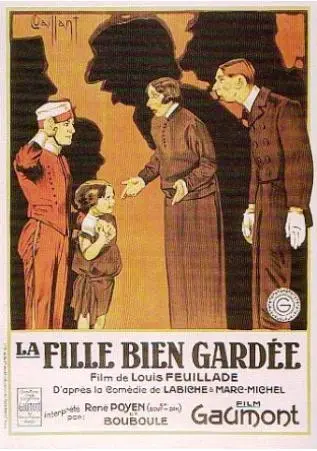
In the annals of early cinema, where narratives were often painted with broad strokes and emotions conveyed through exaggerated gestures, Louis Feuillade stands as a towering figure. Renowned for his sprawling serials like Fantômas and Les Vampires, which captivated audiences with their intricate plots and shadowy intrigue, it is sometimes easy to overlook his more concise, poignant works. Among these lesser-discussed gems is La fille bien gardée (The Well-Guarded Daughter), a 1912 drama that, despite its brevity and seemingly simple premise, offers a surprisingly potent commentary on societal anxieties, class dynamics, and the fragile nature of youthful innocence. This film, emerging from the vibrant crucible of Gaumont's early production, predates the grander scale of his later masterpieces but nevertheless carries the unmistakable imprint of Feuillade's meticulous direction and keen observational eye.
The premise is deceptively straightforward: a baroness, a figure of aristocratic leisure and implied detachment, entrusts the care of her daughter to her domestic staff, specifically Germain and Marie. This act of delegation, seemingly born of convenience, sets in motion a chain of events that exposes the chasm between social expectations and human fallibility. The daughter, sheltered and perhaps naïve, represents a purity that the baroness, through her delegated guardianship, attempts to preserve. Yet, Marie, one of the designated protectors, ultimately leads the young charge into a setting fraught with peril: a dance hall. This seemingly innocuous decision, a moment of perhaps misguided revelry or even a yearning for the forbidden thrill, culminates in the daughter being 'taken' by a man. The narrative’s power lies precisely in this understated yet devastating conclusion, a stark punctuation mark on the perils of the era. The ambiguity surrounding the term 'taken' is particularly striking; in 1912, it would have immediately conjured notions of lost honor, abduction, or sexual transgression, leaving the audience to fill in the tragic blanks with their own societal fears and moral interpretations.
Feuillade, alongside his co-writers Eugène Labiche and Marc Michel, distills a complex societal drama into a concise visual narrative. The absence of spoken dialogue, characteristic of the silent era, compels the filmmakers to rely heavily on visual storytelling, a skill Feuillade mastered. The careful arrangement of bodies within the frame, the subtle shifts in facial expression, and the strategic use of intertitles become the primary conduits for emotion and plot advancement. The contrast between the presumed sanctity of the baroness's home and the chaotic energy of the dance hall is rendered with an almost ethnographic precision. The dance hall itself functions as a character, a vibrant, dangerous siren call to the sheltered, embodying the burgeoning urban temptations that threatened traditional moral frameworks. This visual juxtaposition is a hallmark of Feuillade’s ability to imbue everyday settings with symbolic weight, transforming them into stages for human drama.
The ensemble cast, featuring René Donnio, Émile André, Lise Jaux, René Poyen, Alice Tissot, and Bouboule, delivers performances that are both era-appropriate and surprisingly nuanced. In silent cinema, the actor’s body is the primary instrument of expression. Facial contortions, often deemed exaggerated by modern standards, were essential for conveying internal states to an audience accustomed to theatrical conventions. Lise Jaux, as the titular 'fille,' likely portrays a spectrum of emotions from innocent curiosity to eventual distress, her vulnerability palpable through her gestures and gaze. Alice Tissot, as the baroness, would convey her aristocratic bearing through posture and demeanor, while the servants Germain and Marie (perhaps René Donnio and Émile André or René Poyen, given the limited information on specific roles) would communicate their respective senses of duty, negligence, or perhaps even a touch of envy for their charge's freedom. Bouboule, a character actor often seen in Feuillade's works, would have added a layer of realism or comic relief, though in this particular drama, his presence likely contributes to the atmosphere of the dance hall or the household's dynamic. The power of their acting lies in their ability to articulate complex feelings without a single uttered word, relying instead on the universal language of human emotion, filtered through the specific stylistic grammar of early film.
While La fille bien gardée might not share direct narrative parallels with many contemporary American productions, its thematic core of vulnerability, societal expectations, and the harsh consequences of moral lapses resonates across the silent film landscape. One could draw a thematic line to films like The Price They Pay (1914), which, though dealing with different social strata and specific moral choices, similarly explores the irreversible repercussions that individuals face when their actions deviate from established norms. The silent era was rife with narratives exploring the fragility of reputation and the societal pressures placed upon women, a theme powerfully present here. Similarly, the exploitation or objectification of women, albeit in a different context, is a central concern in films such as The Auction Block (1917), where women are presented as commodities. While Feuillade's film handles the 'taking' with a more immediate and less metaphorical sense of violation, both films speak to the precarious position of women in a patriarchal society.
Even a film like The Law Decides (1916) touches upon the weight of moral choices and their legal or social ramifications, albeit from a more explicit justice-system perspective. La fille bien gardée, by contrast, focuses on the immediate, personal tragedy rather than a broader legal framework. The cultural context of a dance hall, a place of both allure and potential danger, finds a parallel in the 'Fasching' (carnival) setting of the German film Fasching (1917), where anonymity and revelry can lead to moral ambiguity and unforeseen consequences. Both settings serve as microcosms where social rules are temporarily relaxed, often with devastating results for the unsuspecting or the vulnerable. These comparisons, though not direct narrative siblings, illuminate the pervasive anxieties that permeated early 20th-century societies across different national cinemas, anxieties about modernity, morality, and the preservation of innocence.
Feuillade's directorial prowess is evident in his masterful use of the tableau shot, a common technique in early cinema where scenes are presented as static, theatrical compositions. Rather than rapid cuts, the camera often remains fixed, allowing the audience to absorb the entire scene, much like observing a stage play. Within this frame, however, Feuillade carefully orchestrates movement, gesture, and the interplay of light and shadow to guide the viewer's eye and convey narrative information. The interior of the baroness's home, presumably opulent but perhaps stifling, contrasts sharply with the dynamic, less controlled environment of the dance hall. This meticulous attention to mise-en-scène, the arrangement of everything that appears in the frame, underscores the narrative’s thematic concerns. The costumes, though simple by today's standards, would have been carefully chosen to denote class and character, from the refined attire of the baroness and her daughter to the more utilitarian uniforms of the servants and the fashionable, perhaps daring, outfits of the dance hall patrons. These visual cues were paramount in an age devoid of spoken exposition, acting as silent signifiers of character, status, and intent.
Beyond the immediate tragedy, La fille bien gardée functions as a potent social critique. It subtly questions the efficacy of aristocratic parenting, where responsibility is outsourced, and the potential dangers that lie just beyond the gilded cage of privilege. The servants, particularly Marie, are caught between their duty and perhaps their own desires for a momentary escape from servitude. Her decision to take the daughter to the dance hall, while disastrous, could be interpreted as a fleeting act of agency or a momentary lapse in judgment brought on by the allure of the forbidden. The film, therefore, doesn't merely present a plot; it invites contemplation on the systemic issues of class, trust, and the societal mechanisms that both protect and endanger the vulnerable. It’s a snapshot of a society grappling with changing mores, where the traditional boundaries of protection were increasingly permeable, and the modern world presented new, unforeseen challenges to established norms.
While not as widely celebrated as Feuillade's more sensational serials, La fille bien gardée remains a significant artifact of early French cinema. It demonstrates Feuillade's range as a filmmaker, capable of crafting intimate dramas alongside epic adventures. Its power lies in its ability to evoke profound emotion and social commentary through purely visual means, a testament to the universal language of cinema before the advent of sound. The film serves as a reminder of the foundational principles of cinematic storytelling, where every gesture, every set piece, and every intertitle had to carry the weight of the narrative. For contemporary audiences, it offers a fascinating window into the moral landscape of a bygone era, revealing the timeless anxieties about youthful vulnerability and the consequences of negligence that continue to resonate, albeit in different forms, today.
In conclusion, La fille bien gardée is more than just a historical curiosity; it is a meticulously crafted piece of early cinematic art that, in its quiet intensity, speaks volumes. It forces us to consider the often-unseen vulnerabilities of the seemingly protected and the ripple effects of seemingly small decisions. Feuillade, with his characteristic blend of realism and dramatic flair, manages to distill a complex social dilemma into a concise and unforgettable moving picture, proving that even in the nascent days of film, profound stories could be told with breathtaking simplicity and devastating impact. Its enduring relevance lies not just in its historical context but in its timeless exploration of trust, responsibility, and the perilous journey from innocence to experience.
IMDb —
1926
Community
Log in to comment.