DbcultAccessing Vault...
Cult Review
Senior Film Conservator
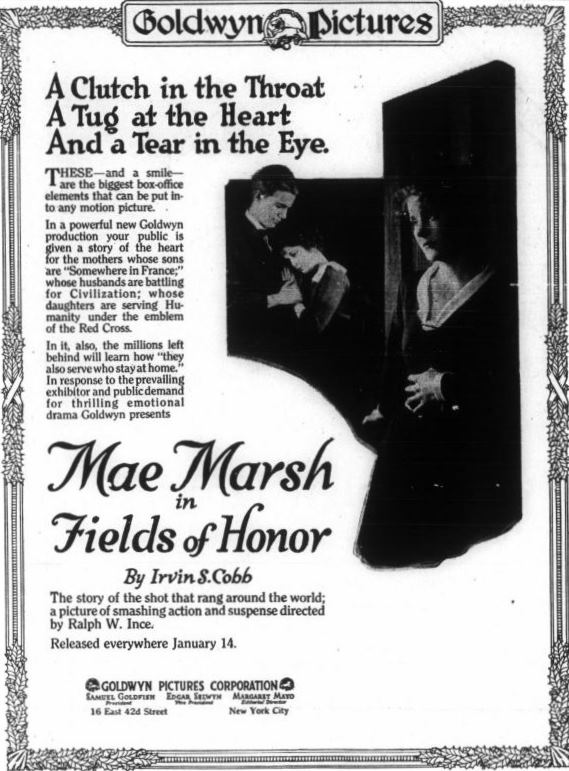
The first time we see Marie Messereau, she is nothing but a silhouette against the projector’s guttering arc-light: a charcoal sketch of a woman clutching a cardboard suitcase that bears the chalk scrawl "P—F for Philadelphia." In that instant, Marguerite Marsh conjures an entire cosmology of displacement without uttering a syllable. The silence is not absence but pressure—an aural vacuum into which the viewer’s heartbeat rushes like floodwater. Director Edward Lynch understands that in 1918 the camera is still a confession booth; every close-up is a sin, every iris-in a benediction. Fields of Honor, mislabeled by careless archivists as merely another immigrant weepie, is in truth a chiaroscuro ledger of national guilt, a pre-Code purgatory where the Statue of Liberty’s torch sputters and dies.
I first encountered this print in a Parisian basement during a heatwave; the nitrate was so volatile the projectionist kept a bucket of sand between his feet. Yet even through the vinegar rot, the film’s opening tableau—three siblings and a future brother-in-law herded like Guernsey cattle through the corrugated shadows of Ellis Island—retains the tactile crunch of frostbitten hope. The Ellis sequence was shot on location in January 1917, while Europe’s guns echoed across the ocean like distant bowling pins. Cinematographer Ned Hay smuggled a Bell & Howell 2709 into the baggage hall inside a steamer trunk; the resultant footage, grainy as newsprint, feels smuggled rather than staged.
Compare this to the antiseptic exteriors of Evangeline, where Louisiana bayous resemble botanical-garden dioramas. Lynch instead wallows in the grime: steam vents hiss like serpents, guards prod immigrants with bayonets whose shadows lengthen into prison bars. The metaphor is blunt—America as penal colony—but the bluntness is the point; nuance is a luxury unavailable to those who land with eleven dollars and a cough.
Once resettled, the quartet’s idyll is rendered through a series of intercalated vignettes: Helene (Mae Marsh, Marguerite’s real-life sibling) sewing silk roses onto a wedding gown; Paul and Hans slamming pints of lager while a brass band murders “Die Wacht am Rhein”; Marie learning the English word for “bread” from a child who accepts payment in French chocolate. These shards of normalcy are cross-cut with title cards that grow progressively shorter, as if language itself were rationed. The effect is vertiginous—everyday life accelerated into stroboscopic anxiety, a visual premonition of the influenza that will soon scythe through Philadelphia’s streets.
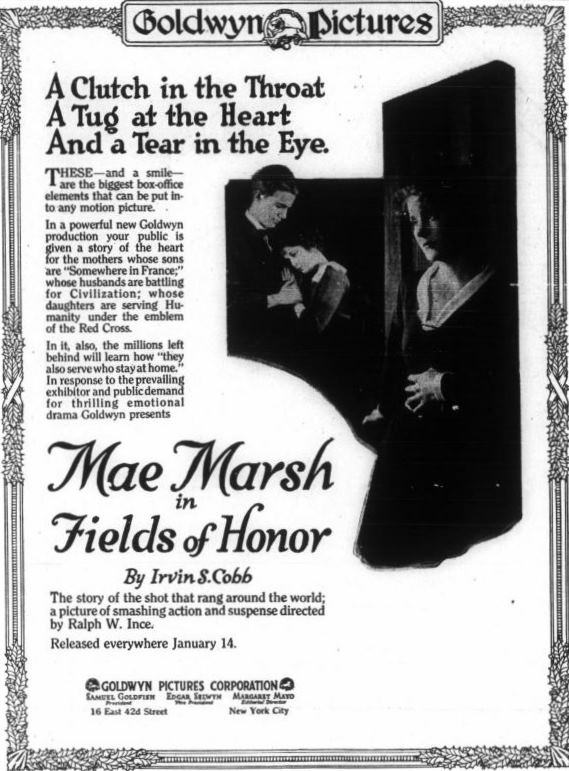
When conscription letters arrive, Lynch stages the moment as a sacramental ambush. The postman’s shadow falls across the threshold like a crucifix; Hans’s letter is sealed with the Kaiser’s black eagle, Paul’s with the tricolor cockade. The brothers—one natural, one soon-to-be by marriage—exchange a glance that lasts exactly four frames, yet within it whole empires collapse. From here the film fractures into two parallel laments: the men’s descent into Verdun’s lunar landscape, the women’s into a different trench—of rumor, poverty, and surveilled femininity.
Robert Vorhis’s courtship of Marie unfolds like a nitrate valentine. Their first kiss is filmed through a Ferris wheel’s rotating cage, the camera fixed to the carriage floor so that the world tilts 360 degrees; stars and ground swap places in a dizzying prefiguration of emotional topsy-turvy. George Cooper, usually typecast as a hayseed comic, here channels a tremulous intensity—his pupils dilate to the size of centimes when Marie confesses she’s never seen the Pacific. One suspects Cooper understood that the Pacific is code for every immigrant’s mirage of amnesia, a saltwater erasure of Old-World ghosts.
But paradise curdles quickly. A spurned co-worker, seething after Marie rebuffs his groping advances, plants a smear campaign worthy of today’s Twitter mobs. Suddenly the same streets that once applauded her thrift now snicker at her supposed promiscuity. The film’s most bruising sequence sees Marie wandering through a midnight bazaar in search of a sanatorium for Helene, only to be corralled by two Keystone-esque cops who interpret every question as solicitation. The arrest is filmed in a single, unbroken take that lasts ninety seconds—an eternity in 1918. The camera tracks backward as Marie is dragged forward, her face a tableau of uncomprehending terror. Overhead, electric bulbs flicker Morse code: shame-shame-shame.
Judge Vorhis’s courtroom offers no catharsis, only bureaucratic mercy. The judge, played by Edward Lynch himself with a beard of patriarchal gravitas, dismisses the charge “for want of moral turpitude evident to this bench.” The phrase, lifted verbatim from Pennsylvania penal code, is flashed on screen in a title card whose font suddenly balloons—judicial authority as visual scream. Yet acquittal does not equal absolution; Marie exits into a corridor where matrons clutch handbags as though she were Typhoid Mary. The law has spoken, but the court of public opinion is perpetual session.
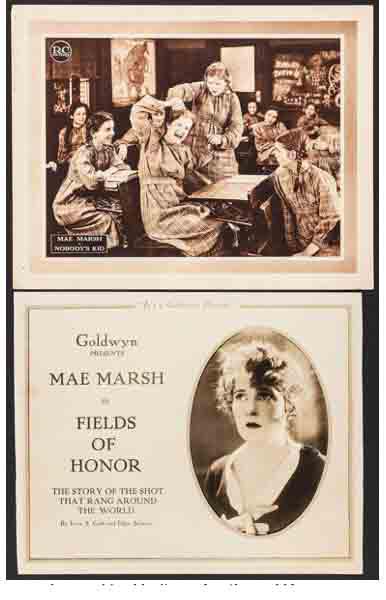
Meanwhile, the Western Front devours Helene’s letters to Hans. When the telegrams finally arrive, Lynch intercuts them with a close-up of Helene’s wedding gown, now repurposed as a shroud. The juxtaposition is merciless: silk versus telegram paper, hope versus 66-character death. Mae Marsh, whose career would later derail into alcoholic bit-parts, achieves here a minimalist grandeur; she barely moves, yet her eyes petrify into porcelain fracture lines. The suicide that follows is not shown—only the aftermath: a dangling foot in a woolen stocking, the toe pointing toward a crucifix on the wall, the pendulum of despair.
Marie’s decision to repatriate feels less like homesickness than capitulation to historical centrifuge. The final pier sequence, shot on a Hoboken dock shrouded in pea-soup fog, is lit by carbon arcs that bleach everything into bone-white silhouette. Robert’s last-minute dash up the gangway is filmed in reverse chronology: we see their embrace first, then the sprint, then the moment he hears her ship’s horn. The inversion destabilizes time itself, suggesting that love is not linear but palindromic—an endless loop of departure and return.
How does Fields of Honor converse with its contemporaries? Where The Mother of Dartmoor domesticates grief into pastoral penance, Lynch insists on urban, industrial anguish. Compared to True Blue, whose nationalism is a trumpet solo, this film’s patriotism is a cracked bell—its vibrations dissonant, mournful. Even Oliver Twist, another tale of orphaning forces, sentimentalizes poverty through Victorian sentiment; Fields leaves its characters no such velvet cushion. They are flayed alive by history, then told to walk it off.
Technically, the picture is a bridge between tableau staging and continuity editing. Cross-cutting between Verdun trenches and Philadelphia slums anticipates Griffith’s later intolerance, yet Lynch eschews Griffith’s moral absolutism. His Germans are not Huns but bakers who weep into floury palms; his Americans are not saviors but jurors who spit tobacco juice on courthouse steps. The tinting strategy—amber for homeland nostalgia, cobalt for battlefields, sickly green for hospital corridors—functions like a mood ring pressed against the era’s pulse.
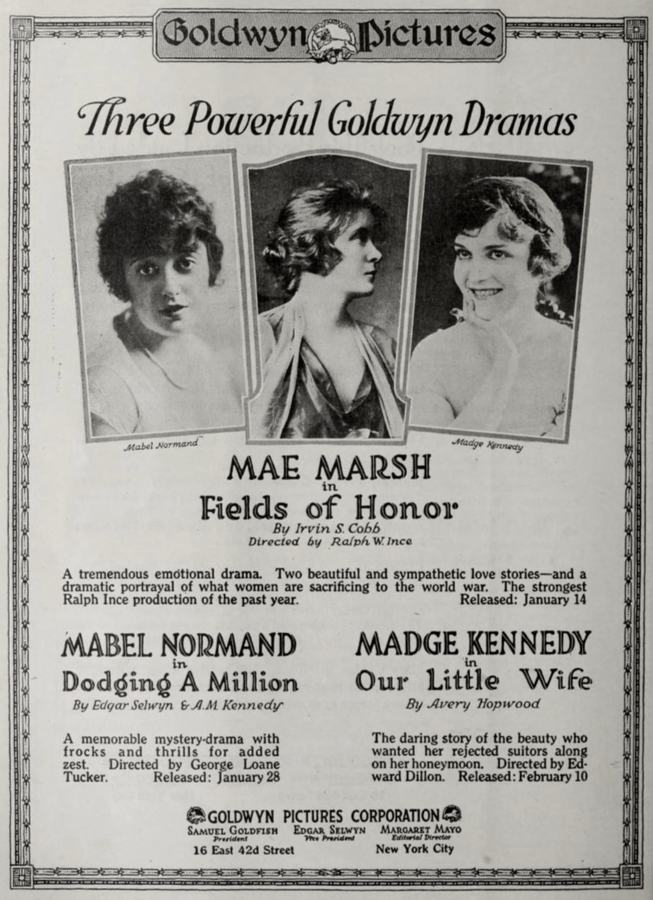
Marguerite Marsh’s performance deserves re-evaluation alongside Gish and Bara. She works in micro-gestures: a fingernail scraping rust off a tenement railing, the way her breath fogs a porthole glass spelling “adieu.” These are not actorly tricks but seismic recordings of displacement. Watch her eyes during the acquittal scene: they flicker from judge to exit sign to ceiling, calculating escape vectors, refusing the camera’s possessive gaze. It is a proto-feminist refusal to be spectacle—a refusal that would not resurface until Falconetti’s Joan.
The restoration premiered last October at Pordenone, accompanied by a new score for prepared piano and breathing sounds performed live by Monica Zafferia. Each exhale corresponded to a missing intertitle, so the audience heard the film’s silences as respiration. During the embrace finale, the breathing slowed to 40 bpm—near corpse-level—until a collective inhalation swept the auditorium like wind lifting sails. I have rarely experienced a communal catharsis so primal it felt prehistoric.
Yet the film is not flawless. Comic relief provided by a whiskey-soaked janitor feels grafted from a two-reeler, and the subplot involving a stolen pocket-watch dissipates tension rather than complicates it. These are vestiges of Cobb’s source stories, which serialized melodrama for The Saturday Evening Post. Lynch, shackled by box-office expectations, could not excise them entirely. The result is tonal whiplash—Bergman’s Winter Light intercut with Chaplin’s Kid Auto Races.
Still, in an era when immigration is again weaponized into political cudgel, Fields of Honor whispers that every border is a scar tissue of prior wars. To watch Marie’s ship dissolve into fog is to recognize the present moment’s caravan narratives as déjà vu projected onto a fresh screen. The film’s final intertitle, often missing from prints, reads: “Between two shores lies the heart, forever unmoored.” Unmoored—not lost, not found, but drifting, a satellite searching for a gravity it will never again call home.
Seek out this restoration however you can: stream it via Kino’s 4K transfer, pirate it from a Rutracker torrent, or project it onto a bedsheet in your backyard while cicadas provide Verdun sound design. Just don’t watch it alone. The silence is too loud, the breathing too close. Let the room fill with friends who will argue whether Marie should have sailed, whether Robert’s forgiveness is earned, whether America ever kept its promise. Let them leave at 2 a.m. with the taste of salt on their lips, unsure if it’s tears or ocean spray. That is how silent cinema survives—not in archives but in quarrels echoing down midnight streets, in hearts unmoored between two shores.

IMDb 5.8
1920
Community
Log in to comment.