DbcultAccessing Vault...
Cult Review
Senior Film Conservator
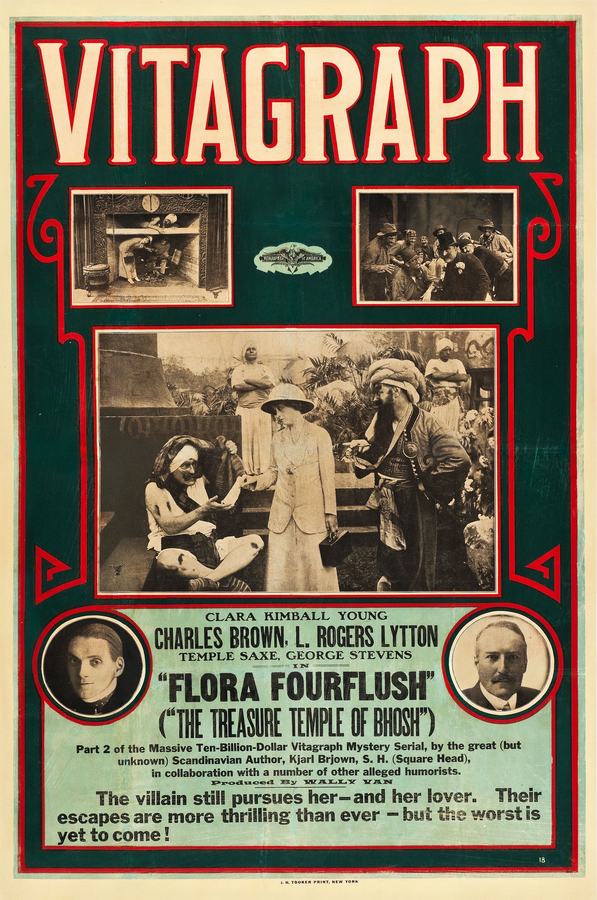
Picture, if you dare, a universe where physics files for bankruptcy and melodrama grabs the throttle with both gauntleted fists. The Fates and Flora Fourflush—shot in the vertiginous summer of 1908 and shipped to nickelodeons like a lit bundle of Chinese firecrackers—doesn’t merely break the rules of believability; it barbecues them over a pyre of nitrate and sends the ashes whirling into the faces of its aghast, delighted audience. Three reels, three continents, three near-deaths per reel: that’s the arithmetic of madness Mark Swan and James Young bring to bear, and the result is a berserk triptych equal parts Jules Verne fever dream and Barnum sideshow.
The first chapter, “Treachery in the Clouds,” opens on a city street where the pavement seems to sweat coal-smoke and possibility. Enter Flora Fourflush—Clara Kimball Young in a hat the size of a small planet—behind the wheel of an 1892 Combustible that wheezes like an asthmatic dragon. One crunch later, Frank Goodheart (Charles Brown, all jawline and jaunty cap) becomes the world's first traffic casualty turned romantic lead. The film’s joke is that resurrection is instant: a sling, a blush, and our penniless protagonist is ready to reject Flora’s marriage proposal because, well, a man needs a nest egg before he can share her gilded tree branch. Cue Sir Simon Blackheart (George Stevens, moustache twirled to Ramonese altitude) whose courtship technique includes kidnapping, explosive parcels, and grand larceny of aircraft engines. The serial’s heartbeat is the moment Frank, peering through binoculars, sees Flora’s biplane falter 3,000 feet aloft and—without parachute, harness, or rational thought—commandeers a carnival balloon. Cinematographer J. Roy Hunt cranks his hand-crank as though winding up the cosmos itself, and the result is a sky-bound waltz that ends with one rifle shot, one deflated silk belly, and two plummeting lovers smashing through the greenhouse glass of Flora’s own solarium. Roll on the intertitle: “Will they survive? Of course they will—tea is served.”
Episode two catapults us to the Indian Ocean, where pirate galleons still roam and every sailor dresses like a Toulouse-Lautrec poster. Sir Simon, now commodore of the Jolly Roger du Jour, slings Frank into the briny blue with a cannon tied “round his honest gullet.” The gag—played for gasps in 1908—is that our hero strolls across the seabed, hoisting the cannon like a diorama Atlas, before strolling ashore. It’s a hallucination worthy of Méliès, minus the Trip to the Moon, plus a full-body baptism in bravado. Meanwhile Flora, draped in chiffon that refuses to crease despite nautical gales, reaches the court of the Rajah of Chutneypore where elephant idols slide on rails to squash intruders. Frank’s bare-knuckled wall demolition predates Indiana Jones by seven decades, yet the film never winks; it races from jeopardy to jeopardy with the attention span of a hummingbird on absinthe.
By the time “A Race for Life” unspools, the filmmakers have exhausted every continent save the human heart. Shackled to railway sleepers, Frank faces an oncoming locomotive commandeered by Blackheart in a diabolical children’s costume. Flora’s cream-colored racer—top speed ten, maybe twelve miles per—barrels to the rescue, gears grinding like iron teeth. The physics may be risible, yet the tension is ferociously real: editors cut between looming wheels and frantic close-ups of Flora’s wind-whipped veil, a montage grammar that would become the lingua franca of Griffith-era suspense. The coup de grâce comes when Sir Simon is trussed beside boxes of dynamite, fuse sizzling, while the heroes retreat to a safe distance. The explosion—double-exposed, orange-tinted—turns villain to confetti, a cathartic fireworks show for the immigrant crowds who’d cheer in Yiddish, Italian, and broken English.
Shot in and around the hilly streets of Fort Lee, New Jersey, the picture disguises East Coast humidity for every latitude on the atlas. Cotton-wool clouds become Himalayan snowdrifts; a painted muslin drape stands in for the Indian Ocean; a condemned ferry stands in for a pirate flagship. The budget is threadbare, yet the illusionism sings—especially in the tinting. Sea-blue dyes ripple across wave sequences, while the Rajah’s treasure chamber glows amber, then blood-orange when the stone elephant slides shut. These dyes were hand-brushed by legions of anonymous women in Manhattan lofts, and their artisanal shimmer lends the film an opulence no CGI sheen could replicate.
Silent-era performance is often caricatured as swoons and moustache twirls, but the quartet at the center of Fourflush operates with athletic precision. Charles Brown’s Frank is all forward momentum: calves flexed, shoulders squared, eyes locked on the next calamity like a magnet seeking metal. Opposite him, Clara Kimball Young tempers Flora’s privilege with a tomboy’s spark—she hikes skirts, clambers into biplane cockpits, pilots her own destiny. George Stevens, meanwhile, weaponizes the pause: he lingers one beat too long in doorways, letting lamplight carve his cheekbones into gargoyle shadows. The result is a trinity of archetypes that feel—within the film’s delirious logic—lived-in.
Each reel ends on a death sentence: mid-air engine theft, elephant-crushing vault, locomotive grill. Exhibitors were instructed to pause the projector, plunge the house lights, and hawk the next week’s ticket. The cliff-hanger is not merely narrative; it is mercantile. Contemporary trade papers crow that one Ohio theater owner hired a barbershop quartet to sing “Will Frank Survive?” between episodes, while kids traded chromo cards of Flora’s balloon rescue. The strategy worked: Fourflush became a proto-blockbuster, out-grossing even Ivanhoe in some markets, though today it languishes in copyright limbo and 16mm anonymity.
Flora’s wealth is no mere plot motor; it is the fulcrum upon which the serial flips Victorian expectation. She bankrolls trans-Atlantic flights, underwrites expeditions, and ultimately gifts the ruby dowry to herself. Frank’s insistence on “earning” her hand reads, to modern eyes, as residual chauvinism, yet the film’s dramatic irony lands on Flora’s smile—she already holds the purse, the plane, and the power. In episode three she commandeers a motorcar, outpaces a steam engine, and drags her fiancé from the tracks. The image of a woman at the wheel—literal and symbolic—must have thrilled the factory girls in the audience chewing Double-Bubble for a penny.
Place it beside Samhällets dom and you see Scandinavian social realism shunning the very cliff-hanger euphoria that Fourflush guzzles. Pair it with In the Python’s Den and notice how both trade on imperial exoticism, though only the American film lets the Rajah become comedic ally rather than racial threat. Contrast it with Robbery Under Arms: Australia’s outback fatalism versus New Jersey’s can-do optimism. Fourflush is less a story than a delivery mechanism for adrenaline, cousin to Louis Feuillade’s crime serials yet scrubbed of noir cynicism. Hope, not dread, is its narcotic.
Original exhibitors accompanied the reels with galloping Rachmaninoff, toy-pistol percussion, and the occasional slide-whistle nosedive. Restored screenings today face the puzzle of scoring a film that never had fixed music. My preference: a small ensemble—clarinet, junk-metal percussion, electric guitar—treating each episode as a punk rhapsody. The cacophony matches the on-screen anarchy, reminding viewers that silence is not absence but invitation. Every clang fills the vacuum where dialogue should sit, turning spectators into co-authors of the soundtrack inside their skulls.
Strip away the pixels from today’s MCU sky-portals and you will find Fourflush’s skeleton: the irreversible mid-credits cliff-hanger, the city-levitating stakes, the hero who survives orbital free-fall unscathed. Christopher Nolan’s The Dark Knight Rises borrows the “broken back equals cardio rehab” timetable; Mad Max: Fury Road owes its desert racer feminism to Flora’s goggles-and-goggles attitude. Even the self-aware parody—think Indiana Jones and the Temple of Doom’s Thuggee carnival—echoes the Rajah’s elephant-crusher. Fourflush proves that American cinema’s superpower was never realism; it was escalation, the promise that next week the danger will be taller, faster, louder.
Yes, the plot is preposterous; yes, the racial caricatures demand contextual critique; yes, the gender politics wobble between proto-feminist and paternalist. Yet the film’s kinetic sincerity—its refusal to let irony corrode wonder—makes it a tonic against algorithmic cool. In an age where every frame is digitally buffed to porcelain gloss, the flicker of hand-cranked celluloid feels almost illicit, like touching history’s pulse. Hunt down the archival print if you can; watch the emulsion bruise and heal as the projector lamp breathes on it. You will leave the theater convinced that cinema’s greatest special effect is still the human heartbeat, hammering away at a hundred and twenty beats per minute, convinced that gravity is optional and next week’s reel will arrive on time.
IMDb 4
1929
Community
Log in to comment.