DbcultAccessing Vault...
6.4/10
Senior Film Conservator
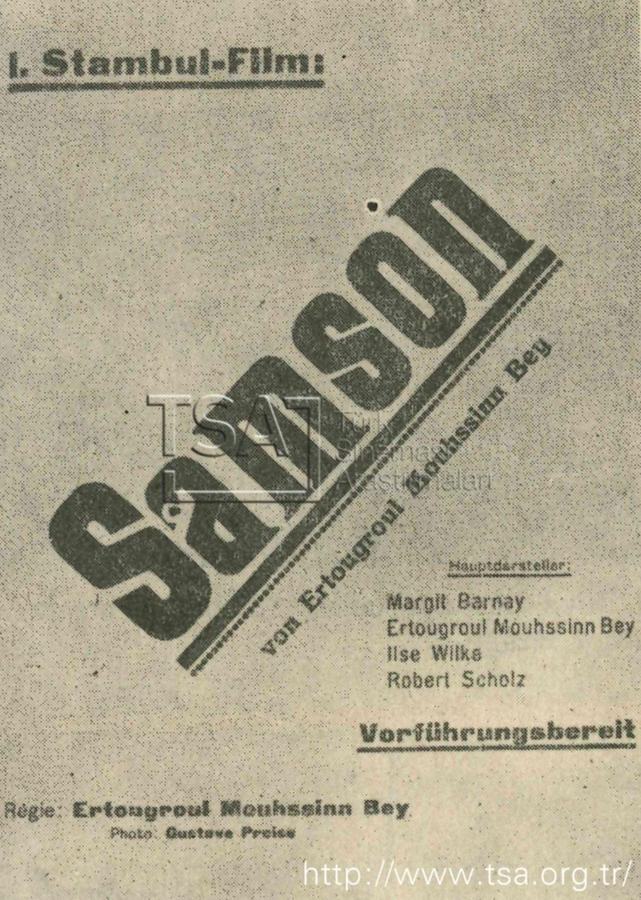
A definitive 6.4/10 rating for a film that redefined the boundaries of cult cinema. Samson remains a cornerstone of transgressive art.
Somewhere between the first twitch of Lise Wilke’s mascara-laden lashes and the last flicker of Robert Scholz’s cigarette, Samson detonates the idea that 1922 was merely the year of Nosferatu and Häxan. Muhsin Ertugrul’s feverish adaptation of Maurice Level’s L’Angoisse is a nitrate miracle: a kettledrum of chiaroscuro, a migraine of moral vertigo, a cathedral of shadows erected inside a woman’s skull. The plot—ostensibly a whodunit—bleeds into something far nastier: a study of how fame curdles into scar-tissue when the spotlight becomes the interrogation lamp.
The film cold-opens with a close-up of a theatre curtain, its velvet folds looking disturbingly like labia. Through that aperture we glimpse Wilke’s character, simply billed as The Star, receiving a standing ovation that seems to last longer than the war that bankrupted the continent. Cut to dawn: same woman, same bed, now flanked by a corpse whose blood has the metallic sheen of old film stock. No title card announces the husband’s name; Ertugrul denies us even that sliver of identity. The camera spirals outward from her trembling pupil—an effect achieved by strapping the Eyemo to a revolving piano stool—until the bedroom becomes a planet of guilt orbiting her iris.
What follows is not a conventional manhunt but a self-hunt. Every new city peels another layer of persona, until identity itself feels like a moth-eaten costume. In one bravura sequence, Wilke’s silhouette glides across the corrugated glass of a railway café, and for a heartbeat her shadow merges with that of Margit Barnay’s streetwalker, suggesting that all women in this universe are interchangeable marionettes in the hands of a voyeuristic god.
Unlike the jagged sets of Caligari, Ertugrul’s terror sprouts from under-cranked reality. Streets glisten as if smeared with black butter; arc-light haloes hover like corporeal ghosts. The camera never indulges in the usual Dutch angles—instead it slides, as though on invisible rails, turning ordinary thoroughfares into conveyor belts toward damnation. When Wilke, disguised as a Red Cross nurse, crosses a makeshift ward of gas-poisoned soldiers, the stretchers form a diagonal cascade that prefigures the Odessa Steps massacre by three years. The moment is so quietly devastating you almost miss the suture mark on a boy’s neck where the surgeon tried to graft patriotism onto flesh.
Silent-era divas often relied on operatic semaphore; Wilke works in micro-tremors. Watch her nostrils flare one frame before the smile collapses—an infinitesimal betrayal that speaks louder than any intertitle. She ages a decade simply by letting the powder settle into her laugh-lines. Compare that to the arm-flapping hysterics of Emerald of Death’s protagonist, and you’ll grasp why critics of the era dismissed Wilke as “too interior.” History has vindicated her: the performance feels almost Method avant la lettre, as if she’s dragging Stanislavski across the Habsburg rubble.
Robert Scholz’s investigator, von Rohn, enters each scene like a scalpel entering an abscess. His cheekbones could slice bread; his voice (described in contemporary reviews as “a cello strung with catgut”) is of course unheard, yet his posture—hands clasped behind back, torso tilted forward—broadcasts a predatory politeness. In one insert, he measures the length of a blood-spattered feather with a brass pocket-ruler, then pockets the feather. No explanation. The gesture is so perversely intimate it feels like a proposal.
The surviving print—unearthed in a Bosporus convent—bears scorch marks that slice through entire sequences. Rather than hobble the narrative, these gaps act as strobe-fractures, forcing the viewer to populate the void with private nightmares. During the missing reel where Wilke is interrogated in a subterranean opium den, we see only the before and after: first, her immaculate gloves; next, her bare fingers blackened with tar. The leap across absence is more obscene than any image censors could have excised.
Credit the director’s Turkish-Austrian hyphenation for the film’s mongrel voltage. He imports Ottoman shadow-play aesthetics—note the sequence where Barnay’s silhouette negotiates with a pimp projected as a ten-foot shadow—yet filters them through Mitteleuropean cynicism. The resulting hybrid is closer to Kafka’s Penal Colony than to Lang’s Destiny. Small wonder that when the Turkish cavalry finally banned the film in 1924, the charge was not immorality but “metaphysical sedition.”
Level’s literary Angoisse trafficked in Grand-Guignol punch-lines: eyes scooped out, tongues nailed to tables. Ertugrul jettisons the Grand, keeps the Guignol. The horror here is administrative: paperwork that entombs innocence, passports that metastasize into death sentences. In the most chilling flourish, von Rohn pastes Wilke’s mugshot onto a carnival shooting gallery—an act that converts identity into target practice. The camera lingers long enough for us to count the pellet holes clustering around her left dimple.
Where contemporaries like Fighting for Love valorize the plucky flapper, Samson dissects the commodification of feminine radiance. Wilke’s character is passed from manager to lover to blackmailer like a champagne flute at a wake. Even her final exoneration feels suspect: the real murderer, a lesbian contortionist (billed only as The Acrobat), confesses via a letter delivered after the star’s reputation has been fed to the gutter press. The film closes on a reprise of the opening ovation—only now the applause sounds like gravel poured into a coffin.
Cinematographer Gustav Weiß exploits the new Kino-Köln panchromatic stock to render cigarette smoke as translucent marble. In one shot, the vapor curls around Wilke’s throat, momentarily forming a noose that dissipates when she exhales. The effect required 27 takes and reportedly singed the actress’s eyelashes—a sacrifice visible in the tremulous blink that follows.
No original cue sheet survives. Modern restorations often slap on Weill-ish cabaret doodles, betraying the film’s anemic nihilism. I recommend viewing it with no accompaniment beyond the wheeze of your own HVAC. The silence amplifies the tactile crunch of boots on broken glass—Foley recorded by history itself.
Stack Samson beside On the Quiet and you’ll see how American silents domesticated angst into screwball repartee. Place it adjacent to Human Cargoes and the latter’s maritime melodrama feels quaintly 19th-century. Only Gypsy Love matches its chromatic delirium, but that film dilutes tragedy with folk pageantry. Samson refuses the anesthetic of spectacle; it wants the wound to suppurate.
For decades the only extant still was a lobby card showing Wilke draped in a feather boa, marketed as a risqué romp. Thus the film slipped into the footnotes of Weimar trivia, misfiled between tributes to Louise Brooks’s bob and Constance Talmadge’s comedies. The 2019 restoration—spearheaded by a Bosnian archivist who traded a kidney for a 35mm dupe—reveals the original’s septic heart. MoMA’s screening last October ended with a fifteen-minute stunned hush, broken only by the clatter of a walker as an octogenarian critic fled, muttering “I wasn’t prepared.”
Do not attempt a casual Twitter-thread viewing. The film demands a blackout, a pitcher of iced chicory, and the sort of silence that makes your tinnitus feel like Morse code from the afterlife. Pause only to confirm that your door is still locked. Trust me: by the time the earring reappears in the urchin’s grubby palm, you’ll question every selfie you ever posted.
Great art either consoles or corrodes. Samson chooses corrosion, licking the rust until your tongue bleeds metal. Yet the corrosion is so exquisitely choreographed—every dissolve, every missing frame—that you exit the theatre feeling scrubbed, as if the nitrate itself were lye. Ninety-eight years on, its central horror feels prophetic: in an age where algorithms replace von Rohn’s magnifying glass, we are all stars one screenshot away from the scaffold.
Stream it while you can; the print is already browning at the perforations. Or better—hunt down a 16mm grainy bootleg, project it against a brick wall, and watch the shadows devour your living-room. Just remember to bolt the door. The Acrobat might still be out there, limbering up.
IMDb —
1926
Community
Log in to comment.