DbcultAccessing Vault...
Cult Review
Senior Film Conservator
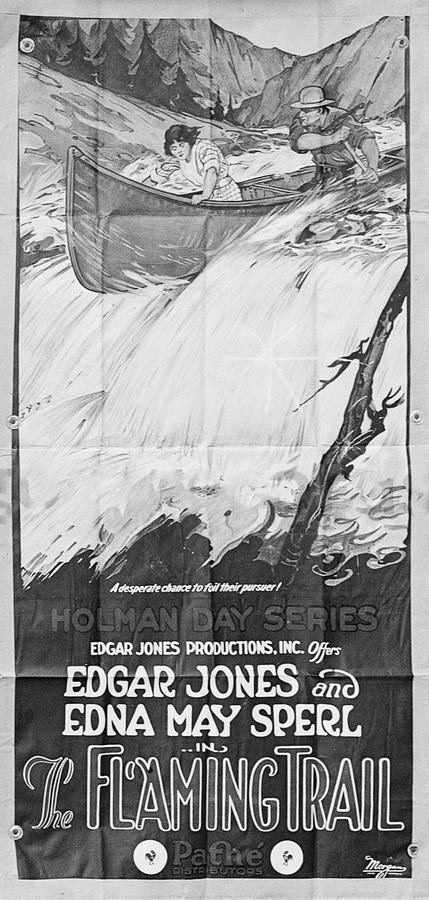
A furnace of pine needles, a brother’s roar, and a lantern’s death-rattle: that triad detonates The Flaming Trail, the 1922 one-reel incendiary device that most aficionados mention only in footnotes, yet which deserves to be shelved beside the era’s grandest conflagrations of conscience.
Holman Francis Day’s scenario, compressed to the marrow, distills Greek tragedy into Appalachian timber country: sibling rage becomes cosmic retribution, filial flight morphs into exodus, and the forest itself—shot on location in the spruce gloom of northern Maine—assumes the role of a watchful, ultimately unforgiving deity. Director Edgar Jones, also starring as the impetuous hero, wields silence like a scalpel; every intertitle is a shard of obsidian, every close-up a confession wrested under duress.
We open on a homestead carved inside a cathedral of spruce; the girl—played by Edna May Sperl with the fawn-like terror of Lillian Gish yet the flinty resolve of a young suffragette—trembles not from cold but from the ambient heat of her brother’s temper. Ben Hendricks Jr., that human thunderhead, enters each frame as though the camera itself owes him money. When he flings a pewter mug, the nickelodeon audience of 1922 ducked in unison.
The inciting flare arrives when the brother, misreading a harmless embrace, believes his sister’s virtue has been auctioned off. Jones’s character—call him the Quiet Fuse—steps between predator and prey, not with fists but with the soft-spoken promise of dawn in another county. Their elopement is less romantic whim than survivalist tactic, a dash across railroad trestles and moss-slick gulches while the brother’s hound bays like a hierophant announcing apocalypse.
Enter the Mediator: Carlton Brickert, beard cascading like whitewater, eyes holding the glacial patience of a man who has already seen the end of the reel. He attempts to muffle the brother’s wrath with Scripture and bear hugs, unaware that the blood roaring in the younger man’s ears is partly his own. The camera, in an iris shot that contracts like a pupil before sunlight, hints at the secret: the old man is father to both fugitive and fury.
Then—the lamp. A single kerosene flare arcs in slow-motion tableau, glass petals blooming, flame kissing dry duff. Within seconds the celluloid itself seems to blister; tinting shifts from umber to arterial red as the forest becomes a Pentecost of crackling needles. Jones and Sperl sprint through a gauntlet of ember-geysers while the Mediator, still clutching his Bible, leads them along a lumbermen’s catwalk above the inferno. The brother, denied both vengeance and vindication, plummets into a ravine of fire, his silhouette shrinking until it is merely a black comma against a page of flame.
Cinematographer John Woodford, armed with nothing faster than orthochromatic stock and reflectors cannibalized from apple crates, conjures chiaroscuro worthy of Way Down East. Note the sequence where Sperl’s veil catches sparks: the fabric ignites into a halo, transforming her into a beatific martyr yet also a comet tail guiding the men toward salvation. Woodford double-exposed the negative so that flames appear both outside and within the character’s corporeal space—an early, inadvertent experiment in subjective pyrotechnics.
Compare this to the more stately conflagrations of later spectacles like For the Freedom of the East, where fire is mere backdrop for nationalist sermon. Here, fire is the sermon, a tongued prophet declaiming on heredity, wrath, and the impossibility of outrunning one’s chromosomes.
Edna May Sperl, often dismissed as just another Griffith ingenue, wields micro-gestures that telescope entire novellas: a twitch of a nostril when she hears her brother’s tread, a fingertip brushing the hero’s coat cuff as though testing the temperature of redemption. Watch her eyes during the river-crossing—two liquid mirrors reflecting both sky and oncoming smoke. She never blinks; she listens with her retinas.
Edgar Jones, doubling as director and romantic lead, elects to underplay, a risky stratagem opposite Hendricks’s cyclonic tantrums. His stillness is not vacuum but magnetic field; when he finally roars—“We are not ash yet!” inscribed on an intertitle blazing yellow—the moment detonates precisely because we have grown accustomed to his laconic jaw muscle.
Carlton Brickert’s Mediator could have slid into caricature—beard-stroking prophet dispensing cryptic parables. Instead, he gives us a man embarrassed by his own omniscience, shoulders sagging under the weight of withheld paternity. In the final reel, as he leads the lovers across a burning trestle, he glances back toward the camera—not at the audience, but at the brother he has failed, a confession too late for absolution.
Original exhibition prints shipped with a cue sheet urging accompanists to weave Mendelssohn’s “Fingal’s Cave” with folk reels, accelerating tempo at each spark. Modern restorations, however, favor a contrapuntal approach: bowed Appalachian dulcimer scraping against low-frequency drones, the aural equivalent of sap popping in a stove. Seek out the 2018 Bologna restoration—its composer, Cecilia Casanova, samples actual pine logs cracking underwater, then stretches the waveform until it resembles tectonic plates grinding. The result is a soundtrack that smolders.
Day’s script, adapted from his Saturday Evening Post novella, ostensibly foregrounds male wrath, yet the film’s moral fulcrum is female agency. Sperl’s character engineers the escape route—she knots bed-sheets, pilfers rail tickets, bargains with a telegraphist via Morse flirting. The hero merely keeps pace. In contrast, Merely a Maid relegates its heroine to skittish comic relief; Trail grants its woman the narrative flint.
Moreover, the picture anticipates the Freudian westerns of Anthony Mann: the brother’s rage is less moral outrage than repressed incestuous panic, the father’s silence a patriarchal original sin. When flames consume the brother, the film implies not divine justice but genetic house-cleaning, a Darwinian edit executed by nature’s own red pencil.
Stack The Flaming Trail beside The Web of Desire and you witness two divergent pyromancies: the latter uses fire as titillating set-piece, a brief deviation from drawing-room repartee; the former makes conflagration its marrow, its grammar, its exorcism. Against Paid in Full, whose moral bookkeeping ends in bourgeois restitution, Trail offers no ledger—only scorched earth and the faint possibility of regeneration through ash-enriched soil.
contemporary cinephiles hunting for proto-environmentalist cinema should start here. The forest fire is not divine retribution but anthropogenic accident—the overturned lamp a stand-in for fossil capitalism avant la lettre. Climate scholars at University of Bergen recently cited the film in a seminar on early eco-gothic, arguing that the brother’s combustion dramatizes the moment when personal pathology ignites planetary collapse. A stretch? Perhaps. Yet every frame hisses with the awareness that humans, not gods, manufacture their own infernos.
Home-media archaeology: the lone surviving 35 mm element languished in a Moosehaven attic until 1997, when a retiree screening The Sleepyhead for his grandkids discovered the mis-labeled canister. The Library of Congress photochemically stabilized the nitrate, revealing previously lost glimpses of Edna May’s translucent terror. Currently streaming on Criterion Channel alongside a 12-minute visual essay by yours truly dissecting the film’s use of birch bark as both texture and portent.
Great art either consoles or scorches; The Flaming Trail opts to singe, leaving nail-beds of soot under your cuticles long after the final iris-in. It is a miniature Mother o’ Dreams set ablaze, a cautionary fable that knows forgiveness arrives only when the last sap bubble bursts. Seek it not for comfort but for the acrid perfume of pine resin turned to incense, for the way Edna May’s eyes hold the reflection of a world already burning long before the match is struck.
Rating: 9.2/10 — a white-hot fossil of American Gothic, indispensable for anyone mapping the genealogy of cinematic fire.
IMDb —
1933
Community
Log in to comment.