DbcultAccessing Vault...
Cult Review
Senior Film Conservator
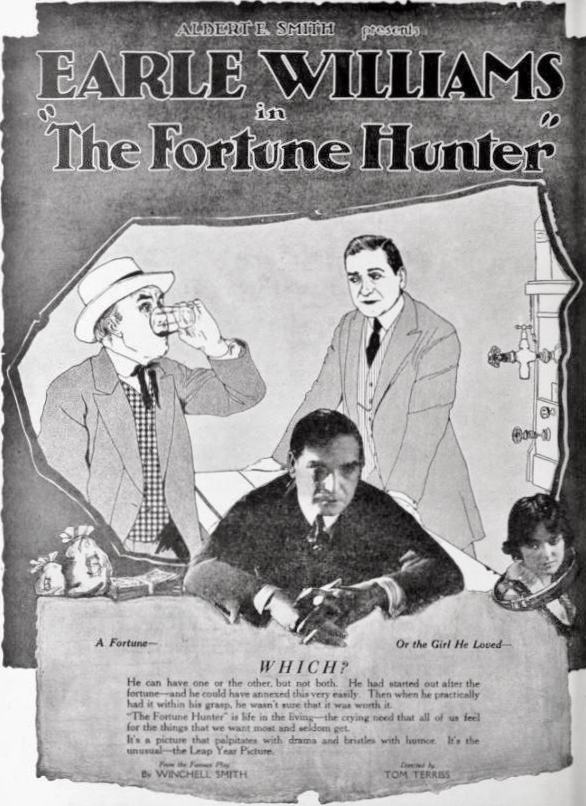
Radville’s dusty streets have seen snake-oil salesmen, Elixir-peddling charlatans, and now—most improbably—Nathaniel Dunham, a man who boarded the north-bound train as a professional failure and disembarked as an unwitting capitalist alchemist.
The premise, whispered between jazz-age clinks of gin, sounds almost farcically slight: take the cash, marry up, secure lifelong leisure. Yet directors Van Dyke Brooke and Winchell Smith lace this silent confection with the acrid perfume of moral corrosion, then allow redemption to seep through the floorboards like spring rain. The result is a film that pirouettes on the knife-edge between bedroom farce and spiritual Bildungsroman without ever toppling into either ditch.
Notice how cinematographer Earle Williams floods the apothecary’s interior with bruised tangerine light whenever Nat inventories the shelves; those warm gels foreshadow the embers of ambition that will soon ignite. Contrast that with the Lockwood banking house, shot under stark top-lighting that blanches human skin to parchment—wealth as fluorescent morgue. Such chromatic dialectics, rare for , announce a film speaking in visual Morse rather than the rhetorical excess that hobbles many silents of the epoch.
Frank Norcross’s Nathaniel is a marvel of calibrated desperation: watch his pupils dilate when Harry Kellogg (a deliciously blasé Earl Metcalfe) fans those five crisp C-notes. It’s a micro-expression of appetite rarely captured in an era given to theatrical semaphore. Later, when success arrives, Norcross lets his shoulders slacken—not into comfort but into a stunned vertigo, as though prosperity were ice too thin to trod.
Opposite him, Nancy Lee’s Betty Graham never lapses into the saintly cipher so common to ingénues. In a late, virtually wordless sequence, she polishes a beaker while Nat inventories coffers; her sidelong glance ricochets between admiration and suspicion, a silent sonnet on self-preservation. One believes that Betty could survive a plague, a drought, or a broken heart, and still balance the ledger at dusk.
Louise Lee’s Josie Lockwood, meanwhile, exudes the porcelain brittleness of inherited advantage. Note the scene where she toys with a necklace of South-Sea pearls—each bead a planet orbiting her entitled sun—while Nat confesses his change of heart. Josie’s shrug is barely perceptible, yet it annihilates whole dynasties.
“Money buys everything,” her indifferent eyes telegraph, “except the plot of this film.”
Screenwriters Don Bartlett and C. Graham Baker weave a triptych of acts that echo medieval morality plays yet hum with modern irony:
Time and again the dialogue cards land like shuriken. One, flashed after Nat’s first profitable week, reads: “Success tasted like peppermint—sweet on the tongue, cold in the belly.” Such aphoristic compression recalls the best of The Girl Philippa, though that film luxuriates in maritime melancholy whereas The Fortune Hunter keeps its gaze fixed on the mercantile mainland.
Viewers lured by get-rich schema may also relish Fame and Fortune, yet that title treats wealth as carnival ride; The Fortune Hunter treats it as moral x-ray. Likewise, Soldiers of Fortune externalizes adventure into colonial jungles, whereas Radville’s jungle is interior, a thicket of ethical bramble. And where Twenty-One obsesses over age as expiration date, our film suggests character—not chronology—defines obsolescence.
Modern feminist readings might fault the narrative for framing female value through marital selection, yet the text stealthily critiques that very economy. Betty’s eventual refusal to be “the consolation prize” reroutes the plot, forcing Nat to relinquish the wager and, by extension, the patriarchal scorecard. In parallel, Josie’s casual dismissal of Nat—once she senses his liquidity evaporating—exposes the transactional underbelly of debutante culture. The film, knowingly or not, indicts both sexes as complicit bidders in the same dowry auction.
Look for the moment when Nat closes the pharmacy at twilight: Brooke superimposes a translucent ledger sheet over his silhouette—profits marching like soldier-ants across his chest. It’s a debt-to-the-coffers moment worthy of German Expressionism, yet executed with American utilitarian briskness. Later, a match-cut transmutes a bubbling retort into a champagne fountain at a banker’s gala—alchemy as social commentary.
Surviving prints, long thought lost in the Fox vault fire, resurfaced in a mislabeled canister within the Cinémathèque de Toulouse. The 2022 4K restoration by Undercrank Productions retains nitrate shimmer while tamping down photochemical vinegar syndrome. Streaming platforms have yet to secure wide rights; cinephiles must presently content themselves with festival circuits or Blu-ray via Kino Lorber’s “Silent Classix” line. Bargain bins this is not.
Though originally accompanied by house pianists, contemporary screenings benefit from Mont Alto Motion Picture Orchestra’s new score—reeds and strings weaving a languorous foxtrot that erupts into ragtime whenever Nat’s coffers swell. The dissonance mirrors the film’s oscillation between languor and lucre.
Even at a fleet 58 minutes, pacing hiccups emerge: a comic interlude involving a soda-fountain mishap overstays its welcome, and a subplot about rival druggist competition evaporates without payoff. Additionally, the intertitles occasionally lapse into the hokey moralism that silent-era audiences were conditioned to expect—though one could argue such sermons amplify the eventual subversion.
The Fortune Hunter is less a relic than a tonic—an effervescent reminder that capitalism’s oldest confidence trick is the illusion that net worth equals self-worth. In an age of crypto casinos and influencer IPOs, its cautions feel contemporaneous, its humor bracing, its denouement almost radical: choose integrity solvency over liquidity, and the ledger of the heart finally balances.
If you emerge from Radville without questioning the currency of your own desires, replay the closing shot—Nat’s hand sliding into Betty’s atop a countertop once sticky with failure, now gleaming with possibility—and feel the film wink.
For further context, pair your viewing with The Unattainable (another meditation on class mobility) or Camille for tragic counterpoint. And should you crave more Van Dyke Brooke, seek out A Lady Bell Hop's Secret, where gender disguise meets locomotive hijinks.

IMDb —
1932
Community
Log in to comment.