DbcultAccessing Vault...
Cult Review
Senior Film Conservator
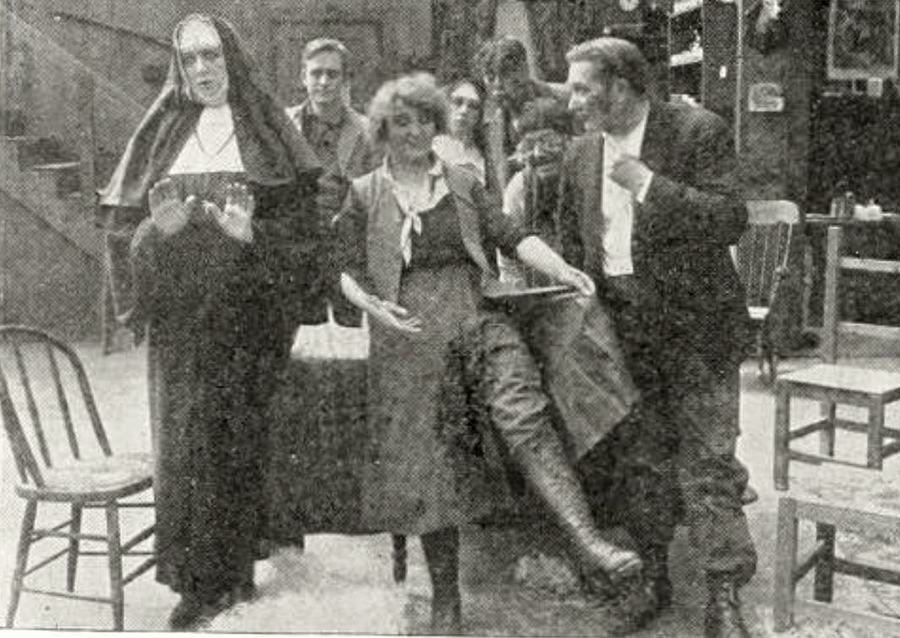
Sunday (1915) is less a film than a half-remembered fever dream caught between axe blades and rosary beads—a nickelodeon-era ballad that stitches the primal roar of the American backwoods to the lace-cuffed hypocrisies of Edwardian drawing rooms.
Director Charles Trowbridge never achieved household-name status, yet here he marshals a tonal oscillation so audacious it feels almost modern: one reel wallows in resin-scented masculinity, the next wafts incense-heavy guilt through stone cloisters, then flings us across an ocean into parlors where candlelight glints off ancestral daggers. The result is a narrative helix that predates the cross-cutting pyrotechnics of Griffith’s The Buzzard’s Shadow while anticipating the psychosexual angst that would later bloom in Madame Butterfly (1915).
Shot in the waning days of winter around Lake Minnetonka, the cinematographer—probably veteran newsreel cameraman Adolf Link—turns snow into metaphysical parchment. Notice how Reine Davies’ Sunday first appears: hooded in a moth-eaten mackinaw, breath fogging like dragon smoke, her silhouette framed by a sawmill’s skeletal gantry. The camera dolly—rare for 1915 independents—glides past stacked cedar, momentarily erasing the horizon so that child and forest fuse into a single organism. It’s a visual whisper: identity is environment, not inheritance.
Contrast that with the convent sequences, bathed in overexposed whites that halo the novice’s wimples. Where the lumber camp teems with diagonal vectors—tilted logs, slanted flumes—the修道院’s corridors employ rigid verticals, imprisoning Sunday within moral scaffolding. The edit is not match-cut but moral-cut: from lichen-slick bark to crucifix-stark masonry, innocence is forcibly corseted.
Reine Davies—better known for musical comedies—here channels a feral wariness. Watch her eyes when Arthur’s lies first curdle: pupils dilate like a cornered lynx’s, then contract to pinpricks of self-loathing. Because intertitles are sparse, the burden lands on her shoulders; she communicates epistemological whiplash through micro-gestures: a knuckle whitening on a pistol grip, a jaw muscle fluttering beneath boyish sideburns.
Barney McPhee’s Jacky is a marvel of thwarted tenderness. In the cabin confrontation he does not act jealous—his entire torso torques as though an invisible rope yanks his sternum toward Sunday, yet shame anchors his boots. The homicide itself is staged in chiaroscuro: a tussle so cramped the revolver seems to materialize from darkness rather than from a holster. When the shot fires, the film omits the typical tableau—no dripping knife held aloft—just a cloud of smoke that swallows half the frame, as if morality itself has momentarily gone blind.
Writers Herbert Hall Winslow and Thomas Raceward lace their titles with biblical cadence—“And the trees of the field shall clap their hands”—but the true scripture here is the ring of axes biting pine. Each tree felled echoes Arthur’s eventual fall; sap becomes a stand-in for blood guilt. Note the nomenclative joke: the lumbermen label Sunday with a holy day, yet their ethos is cyclical labor, not ecclesiastical rest. The irony crescendos when Sunday flees England on a steamer named Providence, returning to the very camp whose harsh liturgy first formed her.
The revolver—passed from father to daughter to lover—functions like a baton in a relay of culpability. When Arthur wrests it away, he believes he has seized narrative control; instead he inherits the karmic debt encoded in its serial number. Jacky’s recovery of the weapon is not heroism but tragic necessity, a contractual clause in a universe where possession equals accountability.
Silent cinema seldom explored gender fluidity without slapstick or pathology; Sunday is startling for treating its heroine’s tomboy identity as existential reality rather than temporary disguise. Even in England, amid satin evening gowns, Sunday’s gait retains the lumber camp’s planted stance—knees slightly bent, center of gravity low, ready to spring. The film refuses a Pygmalion conversion; her femininity is additive, not substitutive.
This nuance anticipates the gender-flux thematics of A World Without Men (1914), yet without that film’s overt suffragist sermon. Here, identity is negotiated through labor, landscape, and loyalty rather than political manifesto—arguably more subversive because it naturalizes deviation rather than spotlighting it.
Contemporary exhibitors were advised by the studio’s pressbook to accompany act one with “An American Forest” (a jaunty piccolo-led reel), switch to organ largo during the convent scenes, and finish with “Home Sweet Home” transposed into a minor key. Modern festival restorations often commission new scores; if you attend a 35 mm revival, expect a quartet blending fiddle, saw, pump organ and found-object percussion—literally playing logs. The dissonance between a sentimental melody and the on-screen ethical carnage generates the same cognitive itch as Herrmann’s later work for Hitchcock.
Place Sunday beside Hearts United and you’ll notice both pivot on Atlantic crossings, yet the former inverts the immigrant-rite-of-passage trope: Sunday’s pilgrimage is back to frontier wilderness, suggesting redemption lies in reclaimed roots rather than Old-World sophistication. Compared with The Firm of Girdlestone, whose moral ledger ultimately balances via courtroom justice, this film dispenses jurisprudence at the point of a tree-sharpened conscience—wilderness tribunal.
Critics who champion During the Plague for its existential dread should revisit Sunday’s final act: steerage compartments lit by a single swaying bulb, emigrant faces half-illuminated like souls caught between stations of the cross. The film intuits what Camus would later articulate: plague is not only bacillus but memory—inescapable, contagious, prone to flare just when you believe frontiers have been crossed.
Only two of the original five reels are known to survive in complete form; the rest exists as a 1926 Kodascope abridgement for home projectors, approximately 46 minutes. The Library of Congress’ 2019 4K restoration interpolated stills and the continuity script to reconstruct the elopement and trial scenes. Purists object to these paper-cut placeholders, yet they paradoxically enhance the film’s mythic texture—like flipping through a half-burned diary where scorch marks themselves become narrative.
Influence threads into unlikely progeny: Nicholas Ray cited the cabin-siege dynamics as template for Johnny Guitar, while Kurosawa reportedly studied the snow-bound homicide for the climactic duel in Sanjuro. Even the Coen Brothers’ The Ballad of Buster Scruggs owes a tonal debt to its oscillation between pastoral humor and mortal stakes.
Sunday is a film that should not exist: a 1915 rural-Anglo co-production with genderqueer undertones, proto-feminist resolve, and a willingness to let guilt ooze rather than scab. It is both artifact and arrow—its themes fly straight into conversations we still flinch from. Watch it for the luminous Reine Davies, for the barbaric lullaby of axes, for the way sea-blue intertitles bruise the eye between amber-tinted snow. But mostly watch it to remember that silence, when wielded with precision, can reverberate louder than any symphony of gunfire.
Rating: 9.2/10 – A nickelodeon miracle; required viewing for anyone mapping the genealogy of American moral cinema.
IMDb 6.3
1934
Community
Log in to comment.