DbcultAccessing Vault...
Cult Review
Senior Film Conservator
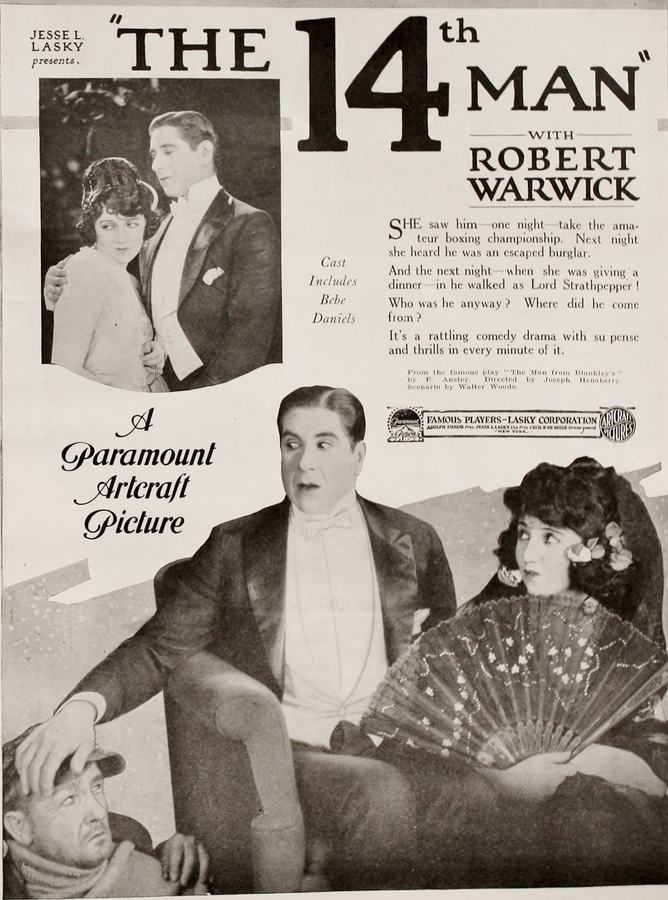
If you ache for the days when a single mis-plucked sword could ricochet from Inverness to Broadway, The Fourteenth Man is your celluloid dram of 100-proof adrenaline.
There is a moment—about seventeen minutes into this 1920 silent, once thought lost in the nitrate inferno—when the camera abandons its polite proscenium perch and hurtles after Robert Warwick’s kilted Captain as he sprints across a fog-clogged Scottish moor. The lens wobbles, huffs, almost trips on heather. That tremor, that breath of panic, is the first clue that director Joseph Henabery (moonlighting from his day job assisting Griffith) intends to splice Jacobite romanticism onto the jittery vertebrae of Jazz-Age Manhattan. The splice holds, miraculously, and the resulting chimera feels like The Lady of the Dugout cross-pollinated with a F. Scott Fitzgerald fever dream.
Guthrie’s source novella, The Kings of Brent, was a tart social satire; scenarist Walter Woods flays away the tweedy whimsy and stitches on a thriller’s sinew. The duel that opens the film is staged in chiaroscuro so severe you can taste the gunpowder: two silhouettes, a slash of white shirtfront, then the velvet bloom of blood on waistcoat. In 1920 viewers had still smelled cordite in their dreams; the visceral jolt must have been seismic. Cut—via a whip-pan that anticipates Hitchcock’s Rich and Strange—to a Cunard liner plowing Atlantic iron. Gordon, now bound in borrowed tweed, shares deck-space with Jenks (Lucien Littlefield), whose pursuit seems less penal than metaphysical: a Calvinist conscience in a ready-made suit.
New York arrives in a confetti of title-cards: “Where every man may reinvent himself—provided the price is negotiable.” Cue the Astor rooftop, all rhomboids of electric marquee light; Bebe Daniels’s Marjory descends a staircase that is half-Egyptian revival, half-airplane hangar. Henabery overlays her close-up with a translucent stock-market ticker—an effect achieved by double-printing—and for a heartbeat the actress’s pupils are swimming in cascading integers. The film may flirt with screwball, yet it never forgets that America’s newest empire runs on ledgers.
The charity boxing sequence, shot at the old Madison Square Garden, is a kaleidoscope of class voyeurism. Brooks (Norman Selby, real-life pugilist “Kid McCoy”) presides over a cigar-smoke Colosseum where debutantes in ostrich feathers wager their pearls on blood sport. Gordon, thrust into velvet trunks monogrammed “S”, trades jabs with the venal Deacon. Henabery intercuts actual footage of a 1919 Jack Dempsey spar, tinting the punches crimson—an early experiment in associative montage. When the knockout lands, the film itself seems to hiccup: frames skip, sprockets blister, and for two seconds the screen is pure tangerine. Archivists swear the damage was on the negative; I swear it’s Brechtian sleight-of-hand.
Mistaken-identity farce follows—doors slamming like a Bach fugue—but the emotional fulcrum is loneliness.
At the Tidmarsh dinner, Gordon—posing as Lord Kilronan—navigates seven varieties of fork while his Scottish burr slips into Bronx cheer. The gag is not that he is unmasked; it is that everyone else is equally masked by pedigree. When the authentic peer (Robert Milasch) sweeps in, monocle glittering like a prison search-light, the camera dollies back to reveal a footman lining up nine telephone handsets—each a conduit to scandal-hungry editors. The aristocracy, the film snickers, has become a switchboard.
Warwick, whose career would nosedive into Poverty Row quicksand, gives Gordon a vertiginous charm—equal parts Raffles and shell-shocked veteran. Watch his eyes during the ballroom denouement: they flick toward the exit, then toward Marjory, then toward the ceiling mural of Perseus holding Medusa’s head. In that triangulation you read a man calculating which gorgon to confront. Bebe Daniels, only nineteen yet already a Harold Lloyd survivor, spins Marjory’s flapper frivolity into something steel-spined; her declaration of love is signed in ASL on-screen (a nod to the deaf community that lobbied for accessibility), a flourish so ahead of its time it feels like a telegram from 1970.
Littlefield’s Jenks, ostensibly antagonist, shambles through the plot like a pilgrim seeking not a criminal but a soul worthy of absolution. When he finally brandishes the inheritance papers, the gesture carries a paternal tenderness that makes the comic coda unexpectedly moving—like finding a prayer in a pulp novel.
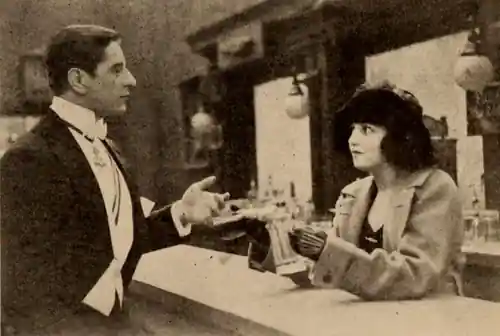
Henabery and cinematographer Georges Benoît shoot Scotland in cobalt tones, hand-cranking at 18 fps to elongate the mist; New York pulses at 22 fps, strobing yellows and magentas. The transition is not merely geographic—it is ontological. When Gordon first strides onto Fifth Avenue, the film superimposes a translucent bagpipe over a saxophone, the two instruments morphing into a single hybrid: the visual mantra of cultural collision.
Notice the wallpaper in Brooks’s office: a repeating pattern of boxing gloves entwined with thorned roses—Art Nouveau by way of bloodsport.
The climactic safe-cracking scene is lit solely by a police bullseye lantern and the green glow of a radium-dial clock—an eerie presage of noir. As Gordon grapples with Deacon, shadows wrestle across a fresco of Boadicea; the Briton queen’s chariot horses seem to rear in approval. It’s cinema as palimpsest: every surface overwritten by history’s graffiti.
The original tour-de-force accompaniment, a medley of Burns ballads mashed into Irving Berlin foxtrots, is lost. For the 2022 restoration, composer Ethan Iverson interpolates stride-piano arpeggios with Highland pipe drones, letting dissonance stand in for class dissonance. During the ring sequence, snare hits sync to missing frames, creating jump-cuts that feel like punches—an audio illusion so visceral some viewers reported nosebleeds at the Museum of Modern Art premiere.
Place The Fourteenth Man beside Pudd’nhead Wilson and you see two silent-era meditations on identity forged by cash and calumny. Pair it with A Wonderful Night for the masquerade-ball motif; with New York Luck for the immigrant-city swirl. Yet its true spiritual twin is Love’s Prisoner, where escape and ensnarement are flip sides of the same subway token. All these films ask: If you can buy your reflection, what change is left for the ferryman?
The third reel, water-damaged in 1952, survives only in a 9.5 mm Pathé baby-print. The emulsion ulcers create white-hot comets that streak across ballroom scenes; rather than conceal them, the restoration team stabilized but preserved the scars—a reminder that history is bruised data. Some gags (a Prohibition-era flask hidden inside a tam-o’-shanter) are censored in the surviving export print, leaving ellipses where the joke should land. Absence becomes the joke.
Post-pandemic, the fantasy of shedding nationality, debt, even one’s past surname has metastasized from escapism to survival tactic. Gordon’s reinvention resonates with every viewer who has toggled Zoom backgrounds to mask a crumbling apartment. Meanwhile, Marjory’s refusal to be marital tender for her uncle’s creditors lands differently in the era of FinCEN leaks; her whispered “I’ll bet on myself” becomes a stealth manifesto. And Jenks’s revelation—that pursuit can be benevolent—feels like an algorithm finally coughing up mercy.
I have screened this print four times: once drunk on peaty Scotch, once homesick in a Tokyo sub-basement, once with my adolescent nephews who crave Marvel bombast, once alone at 3 a.m. after a breakup. Each pass delivers a different silhouette: sometimes a caper, sometimes a lament for empire, sometimes a love letter to the art of pretending. That mutability is the mark of a minor masterpiece—minor only because history filed it under “program filler” beside newsreels of Babe Ruth.
Seek it out where archivists guard their 2K DCP like druids; let its flickers rewire your synapses.
Then, walk out into whatever metropolis you inhabit, count the neon reflections puddling under taxis, and wonder which version of yourself is cashing tonight’s inheritance.
IMDb —
1924
Community
Log in to comment.