DbcultAccessing Vault...
4.9/10
Senior Film Conservator
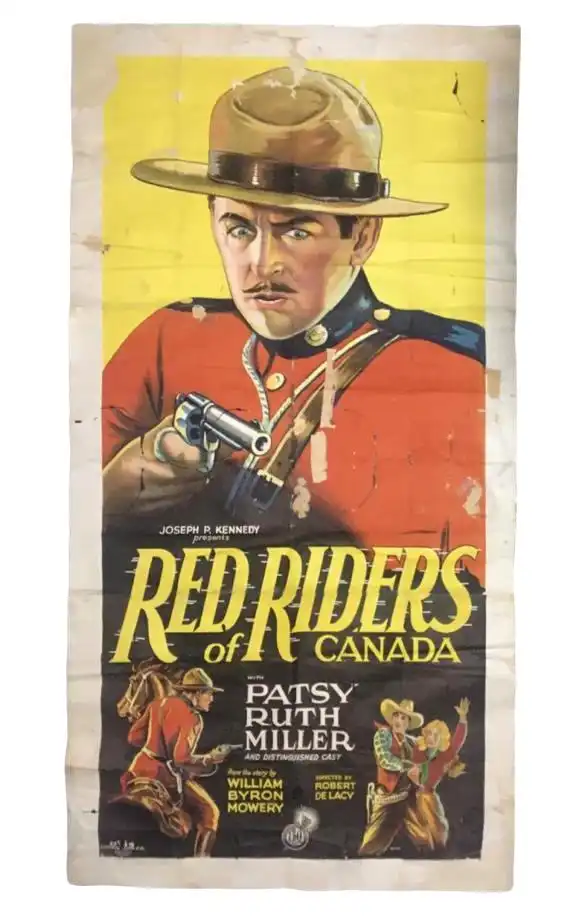
A definitive 4.9/10 rating for a film that redefined the boundaries of cult cinema. Red Riders of Canada remains a cornerstone of transgressive art.
If you’re looking for a lost masterpiece of the silent era, keep moving. Red Riders of Canada isn’t that. It’s the kind of movie you watch because you’ve already seen the greats and you’re starting to get curious about what the average, workaday B-movie looked like in 1928. It’s for the person who likes the texture of old film grain and doesn’t mind a plot that feels like it was written on a napkin during a lunch break.
If you hate slow-moving melodramas where people stare intensely at nothing for six seconds too long, you will probably find this unbearable. But if you’ve ever enjoyed something like The Wolver or those old outdoor adventures that feel more like historical artifacts than stories, there’s a weird, clunky charm here.
Charles Byer plays the lead Mountie, and he has this incredibly rigid way of standing. It’s like he’s trying to hold his breath for the entire scene. Every time he enters a room, he does this little pause that I think is supposed to be 'commanding,' but mostly it just looks like he forgot his next move. His uniform is almost too clean. In a movie where everyone is supposed to be trudging through the wilderness, his coat looks like it just came off a mannequin. It’s a distraction.
Then there’s Harry Woods. He’s the heavy. Woods has one of those faces that was built for silent film villainy—all eyebrows and suspicious squinting. There’s a scene where he’s plotting in a dimly lit cabin, and the lighting is so flat that his shadow on the wall is more expressive than the actual performance. He does this thing with his hands, a sort of nervous twitching, that actually works. It’s one of the few moments where the acting feels like it belongs to a real person rather than a stock character.
The pacing is... let's call it 'leisurely.' There is a sequence involving a chase through the woods that seems to go on forever. You see a man on a horse. Then you see another man on a horse. Then a shot of the trees. Then back to the first man. It repeats until the rhythm of the editing starts to feel like a hypnotic trance. It reminds me of the pacing issues in The Haunted Valley, where the landscape takes over the movie because the plot doesn't have enough gas to get to the finish line.
Patsy Ruth Miller is here to be the 'girl,' and she does what she can. She has these wide, expressive eyes that the camera loves, but the script gives her so little to do other than look worried. There’s a specific shot where she’s standing by a window, watching the snow, and the way she adjusts her shawl feels totally natural. It’s a tiny, throwaway gesture, but it’s the most human thing in the first thirty minutes. It’s the kind of moment that makes you realize she was a better actress than the material deserved.
The snow itself is a character, mostly because it looks miserable to work in. You can see the actors' breath in a few shots, and the horses look genuinely exhausted. There’s a moment where a horse stumbles slightly on a rocky patch near a stream, and for a split second, the movie feels dangerous. It’s a reminder that these old productions were often just people out in the middle of nowhere with a camera, hoping nothing broke.
The dialogue cards are pretty standard, though some of the phrasing is strangely formal even for 1928. It lacks the punchy energy you find in something like Galloping Ghosts. Everything here is very 'by the book.' The 'Red Rider' of the title is, of course, the Mountie, and the movie treats the Royal Canadian Mounted Police with a level of reverence that feels almost like a recruitment film.
One weird detail: the interiors of the cabins. They are so obviously sets. The logs look like they might be made of painted cardboard, and the lighting never quite matches the 'outdoor' light coming through the windows. It gives the whole movie a disjointed feeling—one minute you’re in the rugged, beautiful Canadian wilderness, and the next you’re in a drafty studio in Los Angeles. It breaks the immersion, but in a way that’s kind of funny if you’re in the right mood.
The ending is exactly what you think it is. No surprises. No subverted expectations. The bad guys get what’s coming to them, and the hero gets the girl. It’s the cinematic equivalent of a ham sandwich. It’s fine. It fills the time. But you’re probably going to forget the specifics of the plot by tomorrow morning. What sticks is the image of those heavy wool coats and the way the wind looks when it’s whipping through the pines.
It’s not a 'must-watch,' but it’s a decent piece of genre history. If you’ve got a soft spot for the silent era’s obsession with the Great White North, you could do worse. Just don’t expect it to change your life.
IMDb —
1925
Community
Log in to comment.