DbcultAccessing Vault...
6.6/10
Senior Film Conservator
A definitive 6.6/10 rating for a film that redefined the boundaries of cult cinema. The Ghost of the Canyon remains a cornerstone of transgressive art.
Steel arteries carve the Old West, pumping Manifest Destiny across a vertiginous gorge. Two corporations—one backed by Wall-Street plutocrats, the other by local cattle-barons—vie for a federal contract worth more than a king’s ransom. Smoke, cinders, and whispered treachery thicken the air.
Enter Helen, played with feral magnetism by Helen Gibson, the original daredevil actress who performed her own stunts long before the term “scream queen” ever tainted the lexicon. She’s not a damsel; she’s the fuse. Astride a chestnut mustang, she spots dynamite tucked beneath a trestle and gallops hell-for-leather to warn the approaching locomotive. Her whistle is cut short by three silhouettes—henchmen in derby hats, faces half-lit by the infernal glow of a kerosene lantern.
Cue one of silent cinema’s most enduring tableaux: the heroine bound supine across the rails, blouse fluttering like a battle standard, the iron behemoth’s cyclopean headlamp blooming larger with every frame. Intertitles scream “HELP!” in jittery, hand-drawn letters. Yet the tension is less about whether the train will pulverize flesh—audiences in 1914 already trusted melodrama to cheat death—and more about watching a woman weaponize panic into strategy. Notice how Gibson flexes her wrists against the rope: the subtle torque of an athlete calculating slack. The camera, stationary yet electric, frames her against a sky bruised by sodium flares, turning her prone body into a crucifix of industrial modernity.
Director S.D. Wilcox edits locomotion like a serialist composer: every fourth shot is a detour—hooves, gears, telegraph needles—then back to the human core. The rhythm mimics the very rails it glorifies, forging a visual ostinato of expansionist zeal. Compare this kinetic syntax to the pastoral longueurs of Merely Mary Ann, where static camera meditations on tenement life privilege sentiment over speed. The Ghost of the Canyon inverts that gaze: landscape is not a sanctuary but an arena; nature must be conquered by timetable.
Color-tinted 16mm prints (rare, but viewable at the George Eastman House) alternate between cobalt night-for-night blues and sulphuric amber dusk, each hue an emotional semaphore. The yellow segments feel like inhaling gunpowder; the blues, like drowning in moonlit kerosene. Monochrome purists insist tinting vandalizes photographic truth, yet here chromatic adulteration amplifies the moral chiaroscuro: greed glows yellow, justice burns blue.
Gibson’s corporeal audacity—she insisted on lying inches from an actual 40-ton Southern Pacific locomotive—renders CGI-laden superhero spectacles of the 21st century flaccid by comparison. No wires, no green-screen, just sinew and timing. Her struggle against hemp ropes becomes an allegory for women’s suffrage then cresting the national consciousness: the more the patriarchy tightens, the more the female body finds occult leverage.
Supporting players Burton Law and Millard K. Wilson furnish stock villainy—oiled moustache, black waistcoat, eyes glinting like spent shell-casings. Yet even they are granted fleeting interiority: notice Wilson’s hesitation before tightening the final knot, a micro-hesitation that hints at conscience, swallowed almost instantly by the voracious plot. Such granular acting, dependent on eyebrow semaphore, is easy to lampoon until you recall that 1914 moviegoers decoded these gestures like second languages.
At a lean 18 minutes, the film compresses a three-act structure into an adrenaline ampoule. Exposition? A single intertitle: “The Iron Horse must race the clock to win the government mail contract.” Rising action? Dynamite on the trestle. Climax? A woman versus 200 tons of iron. Denouement? A jump-cut to Helen astride her steed, waving her Stetson in triumph as the villains are hog-tied atop a flatcar, human spoils of war. This compression feels almost modern in the TikTok era, yet the pacing is symphonic, not algorithmic.
Place The Ghost of the Canyon alongside Dr. Jekyll and Mr. Hyde and you witness the dialectic of the era’s imagination: duality of man versus unity of woman; interior horror versus exterior wilderness; London fog versus Arizona dust. Where Jekyll’s laboratory dramatizes the schism of good and evil within a single psyche, Canyon projects evil as a corporate entity, good as an individual female body. The ideological pendulum swings from ontological anxiety to populist valorization.
Or contrast it with Love’s Prisoner, another Gibson vehicle, where her pluck is filtered through romantic sacrifice. Canyon strips sentiment clean: no flirtatious subplot intrudes upon the Darwinian struggle for dominion over steel and stone. The result is proto-feminist noir: desire replaced by survival, courtship by combat.
Shot on location in the Santa Susana Pass, the production leveraged the freshly constructed Southern Pacific spur line, a logistical coup that lent verisimilitude impossible on back-lot sets. The camera, mounted on a flatcar dolly, achieves proto-tracking shots that prefigure John Ford’s later railroad vistas. Shadows of the camera crew occasionally ghost the frame—blemishes to purists, yet hieroglyphs of authenticity to archivists.
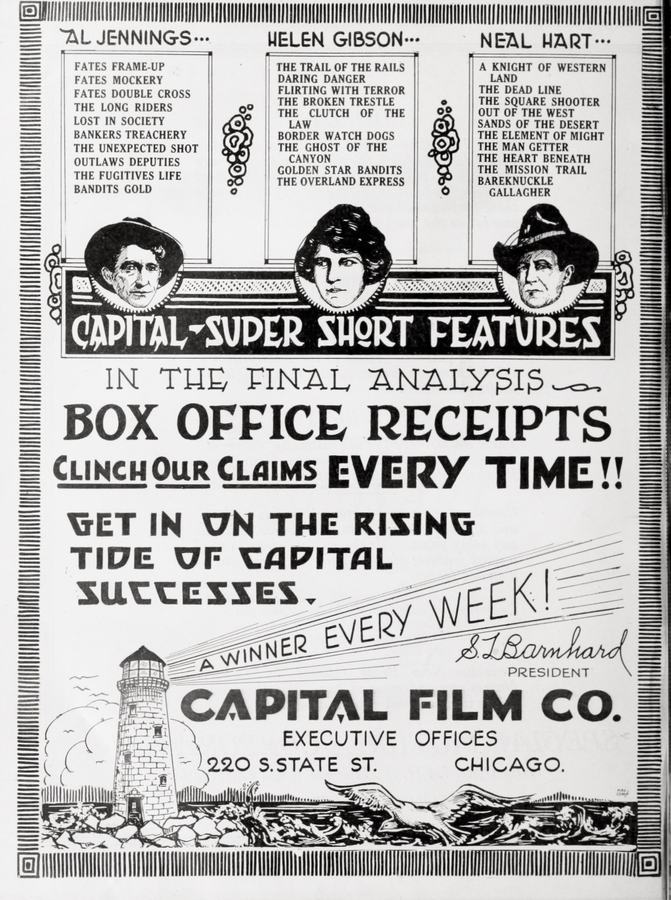
Contemporary trade rag Moving Picture World (Oct 31, 1914) praised the film’s “pulse-accelerating realism,” code for “we feared the leading lady might actually die.” Such press cultivated Gibson’s mythos as the girl who could outrun a locomotive, a tagline later recycled in Depression-era pulp comics.
In an era when #MeToo exposes systemic bondage, the image of a woman lashed to corporate rails reverberates beyond nickelodeon nostalgia. The film becomes a cultural palimpsest: each generation inks its own marginalia onto Helen’s writhing form. For 1914 audiences, she is Everywoman imperiled by cutthroat capital; for 2024 cine-feminists, she is the whistle-blower punished for exposing graft, her body a public battleground.
Moreover, the short’s environmental unconscious—railroads slashed across pristine canyon—anticipates today’s eco-critical debates. The saboteurs’ dynamite aimed at timber trestles is both felony and ecological rupture; Helen’s salvation of the train is, obliquely, a salvage of nature from industrial vandalism. Read through a green lens, the film’s antagonists are proto-petrobros; Helen, an eco-warrior avant la lettre.
No artifact is immaculate. The ethnic shorthand—an uncredited Mexican peon skulking with a sombrero larger than his torso—registers as cringeworthy caricature. The intertitles indulge in pidgin English: “Much bad hombres try keel de train!” Such linguistic minstrelsy undercuts the film’s progressive gender politics, reminding us that early cinema’s egalitarianism rarely extended past the color line.
The resolution, too, is abrupt. After Helen’s rescue, a single iris-out whisks us to a title card announcing “Justice served.” We never see the boardroom machinations that punish the corporate overlords; the narrative’s systemic critique collapses into individual comeuppance. One wonders what a Sernerian remake might yield—an extended third act where Helen testifies before a Senate committee, exposing railway trusts, her voice still echoing across C-SPAN a century later.
The film lapsed into public domain, but pristine 2K restorations circulate via boutique labels. Kino Lorber’s 2022 anthology “Railroaded: Women of the Iron Horse” includes a tint-faithful transfer accompanied by Donald Sosin’s piano score—ragtime arpeggios that mutate into Stravinskian dissonance during the truss-trembling climax. Silent Sundays on Turner Classic Movies occasionally slip it between feature slots; DVR vigilance is advised.
For the Letterboxd generation, the short’s brevity makes it an ideal palate-cleanser between three-hour auteur epics. Pair it with The Brazen Beauty for a Gibson double bill, or counter-program with The Cheater to witness early Hollywood’s moral parables ricochet from feminine agency to masculine perfidy.
Great silent cinema doesn’t merely narrate; it embosses the retina. Long after the projector’s clatter fades, Helen’s outline—arms akimbo against a horizon of steel—lingers like an afterimage from a welding torch. She is both ghost and gauntlet, daring contemporary filmmakers to craft heroines whose courage is not bestowed by spandex or algorithm, but hammered, like rail spikes, through pure kinetic will.
Watch The Ghost of the Canyon not as relic, but as ricochet. Let its 18 minutes detonate inside your synapses, and you may find yourself listening for phantom locomotives in the hush of midnight, wondering if that distant rumble is merely a freight train—or the echo of a woman who refused to be tied down by history’s tracks.
IMDb 7.1
1929
Community
Log in to comment.