DbcultAccessing Vault...
Cult Review
Senior Film Conservator
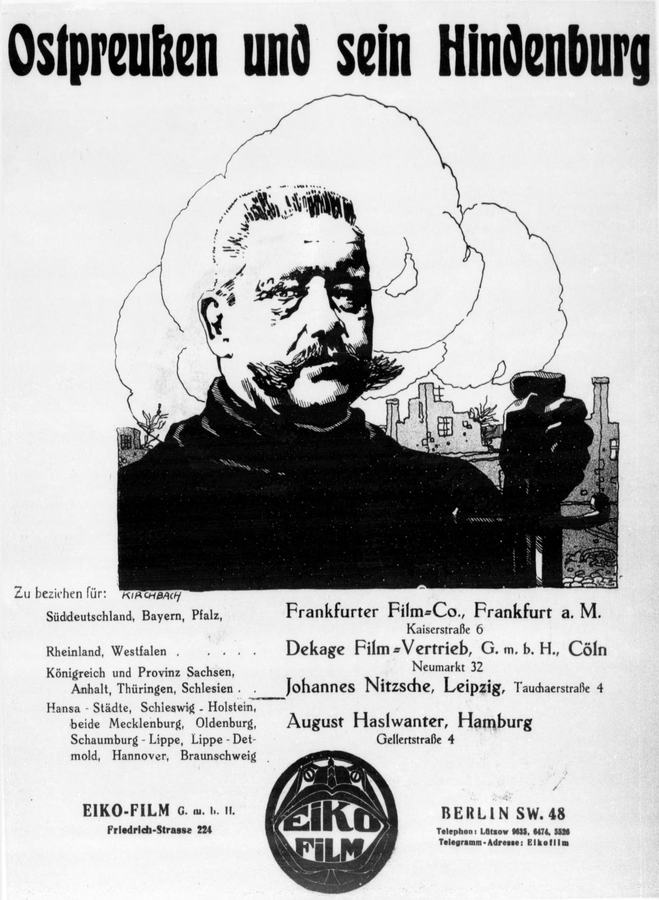
Imagine a film whose very emulsion seems steeped in iodine and peat smoke, whose intertitles flicker like sabre scars across the screen. Ostpreussen und sein Hindenburg is that rarity among survivors of the Teutonic silent era: a work which refuses to be either propaganda or elegy, instead spiralling into a hypnagogic interrogation of how nations hallucinate their heroes. Director-writers Richard Schott and Heinrich Lautensack—both barely 26 when the cameras rolled in Königsberg’s derelict horse barracks—concoct a narrative that behaves like a fever chart: temperatures spike, identities merge, and the provincial landscape itself becomes a character wheezing with asthma of the soul.
The plot, or rather the séance, begins with Aschenbach’s Baron Heinrich von Lebensborn (the surname a cruel premonition of later historical ironies) pacing a dining hall whose baroque stucco is flaking like psoriasis. Creditors have stripped the oak panels; only a fresco of Tannhäuser remains, its Venus overpainted crudely with a field-grey Hindenburg in breastplate and pickelhaube. The Baron’s sole remaining property is a stack of stereoscopic plates showing the Marshal at various victory parades. Each plate, when inserted into a mahogany viewer, emits a faint click—less a sound than the audible shrinking of a soul. Aschenbach plays the scene in one protracted take: shoulders angled at 45 degrees, eyes glittering with the same fanatic gleam later witnessed in Fanatics, yet suffused with the melancholy of someone who already intuits the hollowness of his idol.
Enter Trautschold’s Herr Silbermann, a cinematographer whose surname (“silver man”) literalises the alchemy of cinema itself. He arrives lugging a Debrie camera modified with a Zeiss lens gouged from a downed French observation balloon. Silbermann’s goal is ostensibly mundane: to shoot local colour for a cultural-reel titled Deutsche Heimat. Yet the moment he cranks the handle, the footage blossoms into double-exposed apparitions: cavalry that charge through milk-maidens, rye fields that morph into trenches, children’s maypoles that stand in for barbed posts. The film’s negative, we intuit, is haunted not by the dead but by futures that never materialised.
Käthe Haack’s performance as Baronin Vera constitutes the moral phosphor of the picture. With bobbed hair that feels scandalously post-war, she drifts between the two men less a love interest than a corrective lens. In one extraordinary sequence, she commandeers Silbermann’s camera to film her own close-up, manually adjusting the aperture so her face blooms from chiaroscuro pallor to solarised yellow. The resulting image—projected onto a bedsheet in the estate’s orangery—becomes a secular Veronica’s veil: soldiers on leave weep, convinced they see the Virgin of Ostland; landwehr officers salute, mistaking her for the mythical Brunhilde of the Vistula. Vera’s response is to tear the sheet from its hooks, wrap herself in it, and stride into the frozen night, her silhouette a living splice between Germania and the New Woman.
It is she who proposes the film’s central coup de théâtre: to stage a living rendition of Hindenburg’s 1914 victory at Tannenberg in the manor’s courtyard, using estate workers, orphaned children, and convalescent veterans. The Baron, desperate to reclaim patrimonial legitimacy, bankrolls the spectacle; Silbermann agrees to film it; Vera insists on playing the Russian Rennenkampf to her father’s Hindenburg. The gender inversion is never remarked upon in the intertitles, yet it electrifies every frame: a woman in papier-mâché epaulettes orchestrating the defeat of her own bloodline.
Cinematographer Willy Großstückhausen (uncredited, as was common in 1917) achieves a palette that anticipates the arsenical greens of Les Vampires yet remains rooted in Baltic topography. Interiors swim in Prussian sea-blue shadows, the tint achieved by bathing the film in copper-sulphate solution; exteriors flare with dark orange sodium flares that turn snow into molten slag. When the reconstructed battle erupts, the frame rate fluctuates between 12 and 26 fps, producing a jerky, cardiac rhythm. Shell bursts are hand-painted directly onto the negative—each frame a miniature Kandinsky.
The editing, attributed to an elusive “Dr. K,” anticipates Soviet montage by at least four years. A shot of Vera’s eye dissolves into a map contour of East Prussia; the map then folds into the shape of a wolf, which leaps across the screen to become an actual wolf shot in the Masurian forest. This zoopraxic leap is more than bravura—it is the film’s thesis: identities (national, filial, gendered) are origami that history creases and re-creases until the paper tears.
Though silent, the film weaponises absence of sound. During the Baron’s climactic monologue—an intertitle reading: “I am Hindenburg, therefore I am not nothing”—the projector gate visibly warps, creating a flutter that viewers of 1917 interpreted as shell-shock stutter. Contemporary accompanists reported audiences leaning forward as if to supply the missing boom of artillery. One diarist noted: “The silence screamed so loudly my ears bled memories of cousins buried at Masurian Lakes.” Compare this to the uncanny sonic void in Alone in London, yet here the absence is architectonic, not budgetary.
Written while the Great War still chewed through Europe, the screenplay uncannily foreshadows post-1919 anxieties: fears of territorial amputation, the humiliation of reparations, the neurotic need for redeeming strongmen. Yet unlike the naked revanchism of The Conqueror, Ostpreussen opts for auto-pathology. The Baron’s final act—burning the stereoscopic plates one by one, each effigy of Hindenburg curling like a dying star—reads as a mea culpa decades ahead of its time. The flames paint his face yellow, the colour of both cowardice and parchment, suggesting that history’s tyrants begin as paper effigies before they ossify into bronze.
Aschenbach, primarily a stage tragedian, modulates his gestures for the camera with surgical restraint. Watch the micro-shrug of his left shoulder when Vera calls him “Kaspar Hauser in uniform.” That twitch contains an entire Junker code: pride, panic, the dawning realisation that caste is merely a costume. Trautschold, more accustomed to comic roles, gifts Silbermann a Chaplinesque bounce—note the little hop he gives when the camera crank jams—yet undercuts it with eyes that record atrocity like a ledger. Haack, only twenty during shooting, carries herself with the aqueous grace of someone who has read too much Wedekind and not enough Paul de Lagarde. Her final smile—captured in freeze-frame before the closing iris—collapses the distance between Mona Lisa and Medusa.
For decades the film was known only through a censorship card in the Königsberg archive, misfiled under “Hindenburg, Educational.” Then in 1998 a Lithuanian cellar yielded a 35 mm nitrate reel labelled “Ostpr. Hbn. – 2te Akt.” Chemically unstable, it was rushed to the Hamburg lab, where restorers discovered an additional 14 minutes previously unknown: a dream sequence in which Hindenburg’s moustache detaches and crawls across a map like a woolly caterpillar, devouring borders. Digital 4K scans reveal pores in Aschenbach’s nose, freckles on Haack’s clavicle, the fibres in the papier-mâché epaulettes. The restored tinting follows contemporaneous notes: ferric cyanotype for night, curcumin for candlelight, and for the final conflagration a custom dye named “Königsberg Ember.”
Cinephiles weaned on Griffith’s The Battle of Life will find a more dialectic treatment of warfare here: no gallant charges, only the residue of myth. Likewise, viewers of Love Never Dies may recognise the trope of a woman projecting herself into history’s blind spots, though Haack’s Vera refuses redemptive martyrdom. And in the film’s sly critique of militarist idolatry one detects pre-echoes of What Happened to Father, where paternal authority is exposed as a fraying stage curtain.
Because it offers neither comfort nor catharsis, only a hall of mirrors where every triumph is a trompe-l’oeil and every defeat a doorway. Because it predicts, with unnerving clarity, how technological reproduction can turn human beings into paper dolls—yet also hints that the same machinery might unmake the idols it forges. And because, in an age when monuments are toppled and resurrected in weeks, this 1917 time-capsule reminds us that the images we burn onto celluloid—or servers—can outlast the very ground we stand on. Watch it, and you may never salute a bronze giant again without hearing the faint click of a stereoscopic plate snapping shut.
IMDb 4.8
1934
Community
Log in to comment.