DbcultAccessing Vault...
Cult Review
Senior Film Conservator
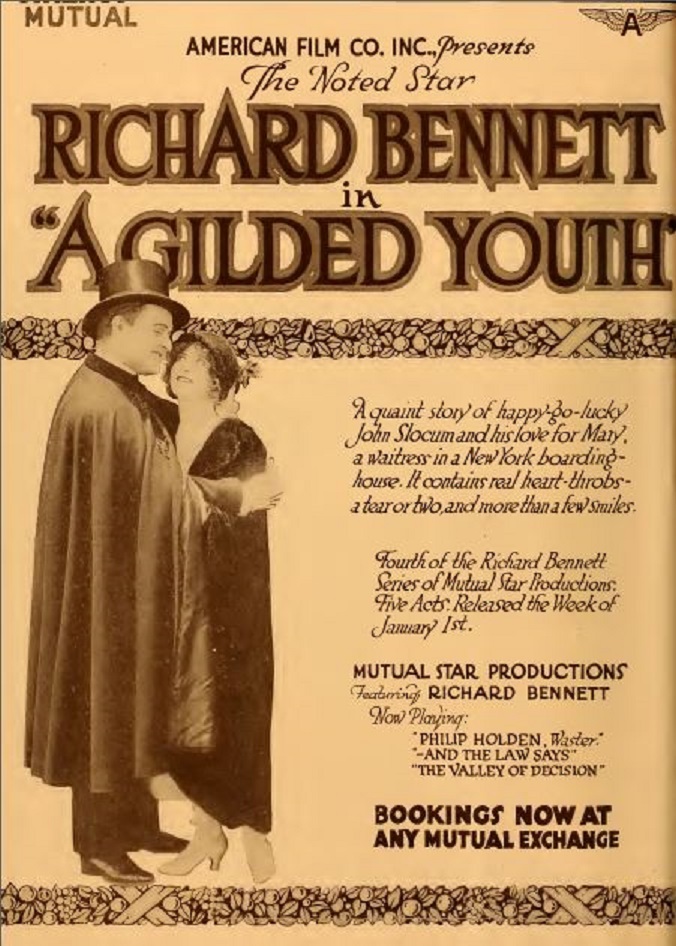
Stepping back into the annals of cinematic history, one encounters 'The Gilded Youth' – a film that, even in its silent grandeur, speaks volumes about the enduring human condition. It's a narrative that, despite its early 20th-century setting, resonates with startling clarity in our contemporary world, exploring themes of social mobility, the illusion of appearance, and the often-fraught journey toward financial prosperity. This isn't just a quaint relic; it’s a profound commentary on the sacrifices, deceptions, and sheer audacity required to climb the ladder of success, particularly when starting from the lowest rung.
The film introduces us to Mary, portrayed with a quiet dignity by Adrienne Morrison, a maid in a bustling boardinghouse whose life is one of tireless service. Her world, however, is brightened by the presence of John Slocum, a fellow boarder, brought to life with a compelling blend of earnestness and later, calculated ambition by Richard Bennett. Their love story, devoid of grand declarations yet palpable in shared glances and unspoken understandings, forms the emotional bedrock of the narrative. It’s a romance born of mutual respect and a shared vision for a better tomorrow, a stark contrast to the transactional relationships often depicted in silent cinema. Their decision to open a joint savings account isn't merely a practical step; it's a symbolic act, an investment in a future woven together from their modest dreams.
John Slocum's initial approach to wealth accumulation is one of almost monastic asceticism. He deprives himself of the barest necessities, a testament to his singular focus on their shared financial goal. This period of self-imposed austerity is depicted with a stark realism that underscores the hardships faced by the working class. Bennett’s portrayal here is particularly poignant; his gaunt features and threadbare attire communicate a man utterly consumed by his objective. However, this relentless self-sacrifice comes at a social cost. His scraggly appearance, a badge of his financial discipline, ironically makes him the target of ridicule in his office. This pivotal realization – that his visible poverty is an impediment rather than a virtue in the eyes of society – forces a radical re-evaluation of his methods. It's a brutal awakening to the superficiality of social perception, a theme that echoes in other films exploring class divides, such as The Poor Little Rich Girl, albeit from the opposite end of the spectrum. John understands that to be taken seriously, to gain access to opportunities, one must first *look* the part.
This shift marks a critical turning point for John. The film deftly illustrates how external validation, often dismissed as superficial, can be an indispensable tool in the pursuit of success. The narrative doesn't condemn John for this realization; rather, it presents it as a pragmatic adaptation to the harsh realities of a class-conscious society. His initial, honest efforts were met with scorn, pushing him towards a more calculated, less transparent path. This moral ambiguity is one of the film's greatest strengths, refusing to paint its protagonist in simplistic strokes of 'good' or 'bad'.
The deus ex machina arrives in the form of a lottery win, a stroke of serendipity that provides John with the capital for his next audacious move. This isn't merely a lucky break; it's the catalyst that allows him to execute his newfound understanding of social dynamics. Instead of pouring the winnings directly into their savings, he invests them in an impeccable wardrobe. This decision, seemingly frivolous to Mary and perhaps to an audience expecting direct financial prudence, is revealed as a strategic masterstroke. Fine clothes become his passport, granting him entry into exclusive restaurants – bastions of the financial elite where the real money is made, not just saved. This sequence is a fascinating study in social engineering, demonstrating how attire can be a powerful key to unlocking doors previously bolted shut. It brings to mind the transformative power of disguise and appearance seen in films like The Lone Wolf, where identity is fluid and manipulated for specific ends, though John's intentions are purely financial rather than criminal.
Within these opulent settings, John adopts a new persona. He becomes an astute observer, a silent eavesdropper, meticulously collecting stock tips from unsuspecting brokers. This method of intelligence gathering is ethically dubious, yet the film presents it as a necessary step in his ascent. The tension here is not just about John’s financial gamble, but the moral tightrope he walks. Is this truly 'earning' his wealth, or is it a sophisticated form of deception? The film invites the viewer to ponder the fine line between shrewd business acumen and outright opportunism. The performances from the supporting cast, particularly George Periolat and Alfred Hollingsworth, as the unwitting sources of John’s information, are subtle yet effective, conveying the casual confidence of men accustomed to their station.
While John navigates the treacherous waters of high finance, Mary is left to contend with her growing anxieties. His sudden transformation – the fine clothes, the unexplained absences, the air of mystery – fuels her suspicion. Rhea Mitchell, as Mary's friend, provides a sympathetic ear, reflecting the common societal fears of infidelity and betrayal that often accompany a partner's sudden change in fortune or behavior. Mary's internal struggle is portrayed with a quiet pathos, her love for John warring with her fear of losing him to another, or to a life she cannot comprehend. Her journey from hopeful fiancée to suspicious partner and finally to pleasantly surprised millionaire's wife forms a crucial emotional arc, grounding John's ambitious machinations in a relatable human drama.
The climax of Mary's emotional journey, and indeed the film's narrative resolution, arrives with the revelation of John's success. The stock tips pay off handsomely, transforming him into a millionaire. The moment of truth, when Mary realizes the true purpose behind John's secretive endeavors, is handled with a delicate touch. Her initial relief at the absence of infidelity likely gives way to awe, and perhaps a touch of bewildered pride, at his audacious success. This unexpected turn of events, where deception leads to prosperity, challenges conventional notions of morality and success, a theme explored in other narratives where unconventional means lead to desired ends, such as The Dividend, which also delves into the impact of sudden wealth.
The screenplay, credited to Alfred Santell, Aaron Hoffman, and Anthony Coldeway, is a testament to the power of concise storytelling, a necessity in the silent era. They weave a narrative that is both economically paced and rich in thematic depth. The character arcs are clear, the motivations, though sometimes morally ambiguous, are understandable, and the emotional stakes are always present. The writers skillfully navigate the complexities of class, ambition, and personal relationships without the benefit of spoken dialogue, relying instead on visual storytelling, character expression, and intertitles. This demands a nuanced understanding of human psychology and societal structures, which they clearly possessed.
The direction, though uncredited in the provided information, demonstrates a keen eye for visual detail and emotional resonance. The contrast between the dingy boardinghouse and the opulent restaurants is starkly drawn, visually reinforcing John’s journey across social strata. The use of close-ups on the actors' faces, particularly Adrienne Morrison and Richard Bennett, allows the audience to connect deeply with their internal struggles and triumphs. The pacing builds effectively, from the quiet domesticity of the opening to the heightened tension of John’s secret dealings, culminating in the satisfying, if somewhat morally complex, resolution. One can draw parallels to the directorial precision required in films like Champagneruset, where visual storytelling alone must convey complex emotional states and societal critiques.
Richard Bennett’s portrayal of John Slocum is the lynchpin of the film. He transitions seamlessly from the earnest, self-sacrificing lover to the shrewd, calculating social climber. His transformation is not merely external; Bennett conveys an internal shift, a hardening of resolve, and a growing confidence that is captivating to watch. His performance is a masterclass in silent acting, relying on subtle gestures, expressive eyes, and a commanding physical presence to convey a wealth of emotion and intent. It’s a performance that holds its own against the dramatic intensity seen in films like Peer Gynt, where a protagonist's ambition drives a complex narrative.
Adrienne Morrison, as Mary, provides the emotional anchor. Her character's journey, from hopeful romantic to suspicious partner and finally to bewildered recipient of fortune, is rendered with sensitivity and grace. She embodies the virtues and vulnerabilities of her class, making her character deeply sympathetic. Her reactions to John's changes are entirely believable, providing a crucial human perspective on his audacious gamble. The chemistry between Morrison and Bennett, though understated, is convincing, making their eventual reunion all the more satisfying. Rhea Mitchell, as Mary’s confidante, adds another layer of realism, reflecting the societal pressures and concerns of women in that era, a dynamic often explored in films like Do Men Love Women?
The supporting cast, including George Periolat, Alfred Hollingsworth, and Charles Newton, contribute significantly to the film’s authenticity. Their brief but impactful appearances create a credible world, populated by distinct characters who, even in their brief moments, convey their roles within the social fabric. This ensemble work elevates the film beyond a simple character study to a broader societal commentary.
At its core, 'The Gilded Youth' is a compelling examination of the American Dream and the often-unconventional paths taken to achieve it. It questions whether genuine success can be built on a foundation of less-than-transparent means, and what sacrifices, both personal and ethical, are deemed acceptable in the pursuit of wealth. The film suggests that appearances are not merely superficial; they are powerful tools in a society obsessed with status. John's transformation is not just about accumulating money, but about changing his perceived social standing, a theme that resonates deeply in a world where image often dictates opportunity. This central conflict between inherent worth and perceived status is a timeless one, explored in various forms across cinematic history.
Moreover, the film touches upon the nature of trust and deception within relationships. Mary's fear of infidelity is a universal human experience, and the film deftly uses it to heighten the emotional stakes, only to subvert expectations with a revelation that, while positive in outcome, still stems from a period of secrecy and emotional strain. It prompts reflection on whether the ends justify the means, and if the ultimate reward can erase the anxieties and moral compromises made along the way. The ending, though outwardly triumphant, leaves a lingering question about the true cost of their 'gilded youth'. The film's nuanced take on these complex themes ensures its enduring relevance, making it a valuable piece for anyone interested in early cinema's capacity for profound social commentary.
In conclusion, 'The Gilded Youth' stands as a powerful and thought-provoking silent film, a testament to the era's storytelling prowess. With its compelling narrative, strong performances, and incisive thematic explorations, it remains a captivating watch. It’s a film that not only entertains but also encourages introspection into the very fabric of ambition, love, and the elusive nature of success in a world where perception often holds more sway than reality. It's a reminder that even in silence, stories can resonate with thunderous impact, leaving an indelible mark on the viewer long after the final frame.
IMDb 6.9
1932
Community
Log in to comment.