DbcultAccessing Vault...
Cult Review
Senior Film Conservator
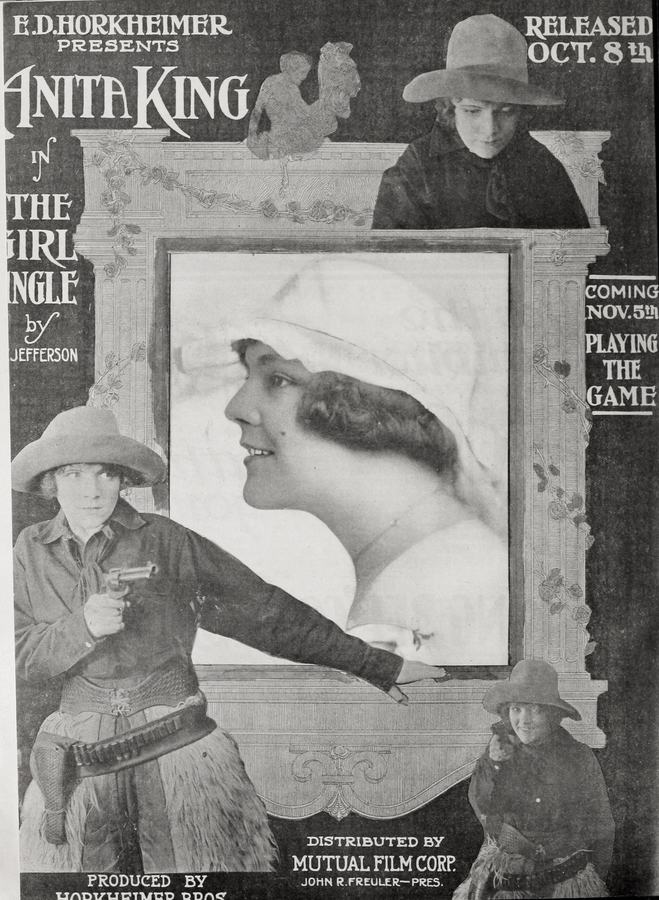
Maud Wainwright’s wedding dress never made it to the altar photographs; instead it fluttered across salt-flat vistas like a surrender flag dipped in gall. In the 1917 one-reel marvel The Girl Angle, director L.V. Jefferson and scenarist Julian La Mothe spin a fable that is half derring-do, half scalding satire on gender expectation. What could have been a stock Western revenge tale becomes, through sheer narrative bravado, a cracked mirror in which every bullet hole reflects a social shrapnel wound.
From the first iris-in on Ruth Lackaye’s angular cheekbones, the film announces its intent to weaponize silence. Intertitles arrive sparingly, forcing the viewer to decode micro-gesture: the tremor of Maud’s gloved fingers as she signs a marriage contract that will never be honored; the fractional lift of Three Gun Smith’s left brow when he registers her contempt. Even the Mojave itself is shot as character rather than backdrop—sun-bleached horizons that feel like parchment upon which the heroine might inscribe a new doctrine of selfhood.
Cinematographer Gordon Sackville—moonlighting here before larger assignments—relies on chiaroscuro tableaux that look stolen from Caravaggio’s sketchbook. Interiors of Smith’s cabin are drenched in tungsten pools, the lantern glow ricocheting off brass cartridges to create a cathedral of violence. Note the moment Maud discovers the mail pouch: the camera racks focus from her dilated pupils to the burlap fibers, then to a spider threading across the seal—an ellipsis of fate condensed into three planes of field depth. Such thrift-store grandeur rivals the pictorial ambition of Lucíola’s Brazilian baroque, yet achieved with nothing grander than kerosene and nerve.
Compare this to the sheriff’s office, shot in high-key light that exposes every pore of Daniel Gilfether’s performance as Kennedy. The ethical rot under the badge is telegraphed not through Snidely Whiplash mustache-twirls but through lighting that renders his eyes two vacant opals—windows to a soul foreclosed. When Maud finally barges in with her damning evidence, the camera dollies back as if recoiling from moral pestilence.
The film’s real shootout occurs in the arena of gender performativity. Maud’s declaration of lifelong misandry is not a footnote but the engine. She chops firewood with a Remington revolver tucked in her apron knot; she brands her cattle using the same monogram once destined for marital handkerchiefs. Each gesture is a middle finger to the cult of the angel in the house, making The Girl Angle a proto-feminist gauntlet hurled a decade before Fifty-Fifty dared split domestic assets.
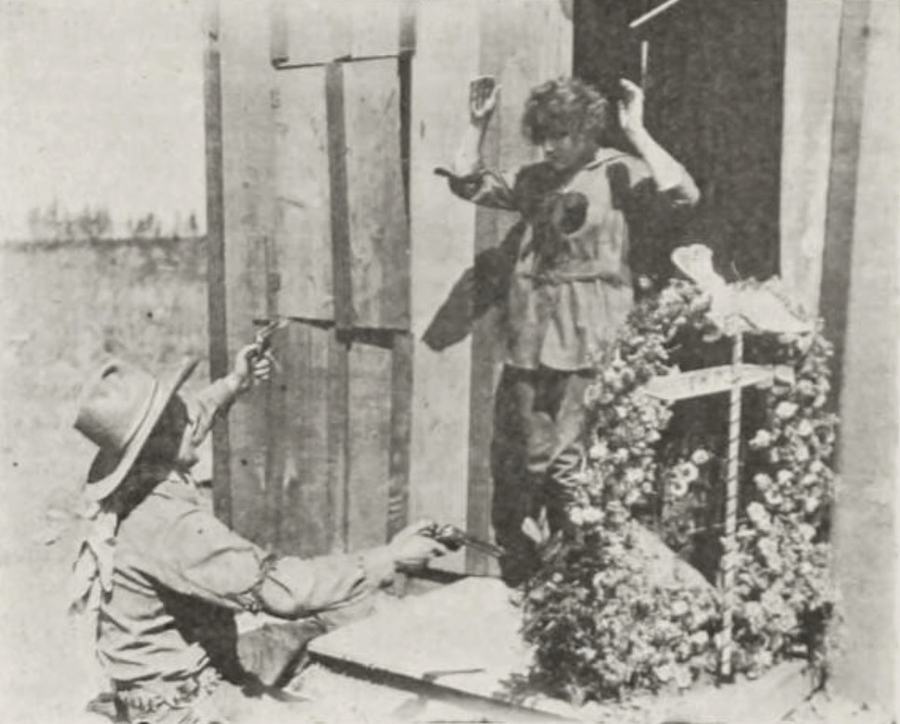
Yet the screenplay refuses easy triumph. When she finally rescues Smith, her declaration of love is framed in medium shot, both lovers astride a single horse—a visual reminder that even emancipation is tethered to partnership. The final intertitle reads: “The desert taught her to hate; a lie taught her to judge; only love taught her to see.” It’s a line that could cloy, but Lackaye delivers it with such gravel-throated conviction that it lands like manifesto, not motto.
Ruth Lackaye’s Maud oscillates between flint and fragility without ever splitting the difference. Watch her fingers worry the rim of a coffee tin after the cabin explosion: the gesture is private, almost feral, a glimpse of PTSD before that acronym existed. William Reed’s Three Gun Smith, by contrast, is all minimalist swagger—he seems to have studied the laconic gravity of Japanese ronin, yet his eyes betray a bureaucrat’s fatigue. When he finally confesses his covert identity, the admission escapes not as heroic fanfare but as weary exhalation, as though espionage were merely another shift at the quarry.
Gordon Sackville’s Sheriff Kennedy is the film’s true villain, a man whose villainy lies in believable banality. He polishes his star with the same spit he uses to slick back his hair—governance reduced to grooming ritual. In the climactic lynch-mob scene, he does not twirl a mustache; instead he tightens the rope with the blank efficiency of a factory foreman, making mob justice feel like civic routine.
Jefferson and La Mothe’s script is a contraption of reversals that would make The Fixer applaud. Every alliance flips on a dime: the sheriff becomes outlaw, the outlaw becomes federale, the bride becomes savior. Yet these turns feel earned because each character’s core desire—Maud’s hunger for self-authorship, Smith’s for lawful subterfuge, Kennedy’s for dominion—remains constant. The mail-pouch MacGuffin is not merely plot lubricant; it is Pandora’s satchel, spilling letters that carry the whispers of homesteaders, con artists, and lovesick soldiers—an epistolatory chorus commenting on the frontier’s moral sprawl.
Editor Joe Ryan sculpts tension through asymmetrical cutting. The cabin reconstruction sequence alternates two-second shots of hammers pounding nails with twelve-second vistas of circling buzzards, creating a metronome of dread. Conversely, the rescue ride is stitched in accelerating single-frames that slap the viewer into the posse’s panic. Such rhythmic daring rivals Soviet montage, yet predates 49-17’s historical pastiche by several years.
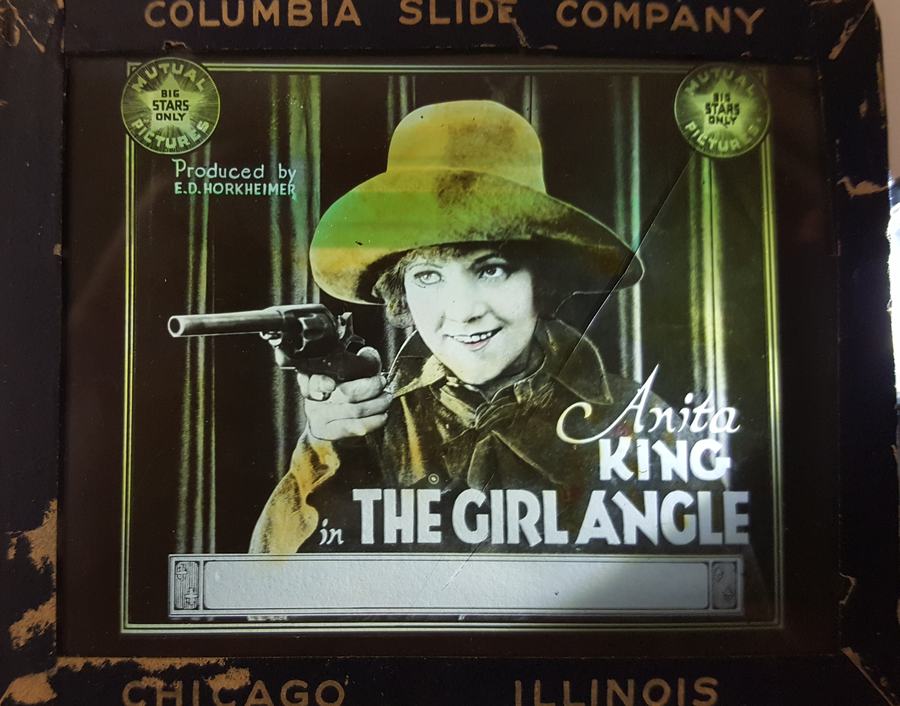
Though originally released without designated score, modern festival presentations often commission new accompaniment. I caught a 2019 MoMA restoration with a trio wielding banjo, musical saw, and breathy slide whistle—an atonal tapestry that transformed every hoofbeat into cardiac percussion. The absence of authoritative soundtrack invites perpetual reinterpretation, making The Girl Angle a living artifact rather than embalmed relic.
Where Carmen weaponized sexual candor to dismantle macho pride, and Kreutzer Sonata framed marriage as spiritual strangulation, The Girl Angle locates emancipation in geographic exile. Its closest tonal cousin might be The Seekers, yet where that film seeks transcendence through mystic communitas, Maud’s salvation is insistently individual—etched in gun-smoke and her own hoof prints.
Meanwhile, spectators of Silks and Satins will recognize the costuming trope of feminine apparel as battle standard; however, Maud’s wardrobe here is progressively stripped to utilitarian denim, signaling not seduction but sovereignty.
Today the film exists only in a 35mm nitrate print at the Library of Congress and a 2K scan circulated among cinematheques. Bootlegs on video-sharing sites are marred by phantom-frame watermarks, yet even through digital murk the cinematographic verve singes the retina. Critics have cited it as a missing link between A Regiment of Two’s buddy militarism and the flapper freedoms soon to erupt in the roaring decade ahead.
Academics specializing in frontier iconography have traced how the overturned cabin became a visual shorthand appropriated by John Ford in later works, while queer theorists highlight the film’s subtext of performative masculinity—note the lingering shot of Smith shaving his comrade’s neck with a Bowie knife, an intimacy that whispers outside heteronormative contract.
Is The Girl Angle flawless? Hardly. A subplot involving Mollie McConnell’s saloon madam evaporates without residue, and the film’s treatment of Indigenous presence is the usual 1910s null void. Yet its willingness to let a woman own both rage and redemption, to let narrative hinge on bureaucratic paperwork rather than six-shooter virtuosity, renders it startlingly modern.
Watch it for the sun-scorched lyricism, for the way a mail pouch becomes Pandora’s box, for the singular sight of a spinster turning lynch mob into wedding procession. In a canon saturated with cowboys who draw first and ask never, here is 63 minutes that dare to posit love as the ultimate act of insurgency—and do so with a stylistic audacity that leaves scorch marks on the retina long after the iris-out.
IMDb 5.4
1935
Community
Log in to comment.