DbcultAccessing Vault...
Cult Review
Senior Film Conservator
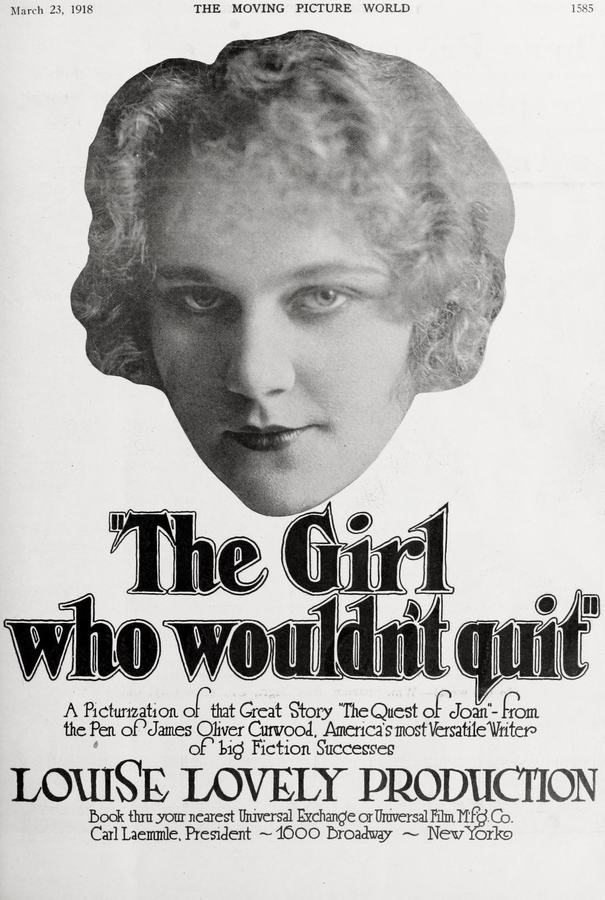
The 1920 photoplay The Girl Who Wouldn't Quit arrives like a brittle telegram from a forgotten century—its edges singed, its Morse code of light and shadow tapping out a dirge for frontier justice. At a breezy sixty-five minutes, director Charles Miller (working from a bifurcated script by serial queen Doris Schroeder and wilderness bard James Oliver Curwood) compresses an epic of moral erosion into a diamond-bright parable that anticipates both film noir and the social-prison melodrama.
We open on a tableau of industrial sublime: ore conveyors clank against a bruised turquoise sky, while the earth itself seems to hemorrhage copper. Roscoe Tracy—rendered with granite-eyed rectitude by Mark Fenton—oversees this subterranean empire, unaware that avarice slithers closer in the form of silk-collared superintendent Carter (Henry A. Barrows). One dynamite blast, one pilfered payroll, and a conveniently placed corpse later, Tracy is shackled, railroaded, and entombed in stone-gray prison cells that cinematographer Frank Good lights like cathedral crypts.
Enter Joan—the eponymous girl—played with feral luminosity by Australian import Louise Lovely. The camera adores her, lingering on a quivering chin that refuses to drop, on hands that ball into fists the size of claim stakes. Time elliptically folds; the child becomes woman beneath a swirl of calendar pages and mining-camp decadence. Lovely’s performance is silent-era alchemy: part ingénue, part avenging Fury, channeling Lillian Gish’s wounded grace and prefiguring Barbara Stanwyck’s steel-spine seductions.
Miller and Good paint the Sierra locations with a tonal clash of bone-white alkali and petroleum darkness. Night exteriors are lit by flickering torches that throw Carter’s profile onto canyon walls like a devil’s shadow play. Interiors of the Tracy cabin favor tenebrism: a single kerosene lamp carves amber corridors through which Joan glides, her calico dress a smear of vermilion against umber gloom. The palette—sepia, rust, and nicotine yellow—seeps into every frame, evoking a daguerreotype left to molder in a saddlebag.
Compare this visual strategy to Under Southern Skies, where tropical pastels dilute tension, or the Germanic sturm of Sündige Liebe that wallows in obsidian chiaroscuro. The Girl Who Wouldn't Quit stakes out a middle ground: American expanse meets expressionist claustrophobia, foreshadowing John Ford’s later Monument Valley psychodramas.
Fenton’s Tracy is a man hollowed by injustice yet still electrically paternal; watch the way his shoulders spasm when prison gates slam, or how a tear zig-zags through coal dust when he spots Joan beyond the visitor’s wire. Opposite him, Barrows eschews Snidely Whiplash theatrics, opting for the soft-spoken, boardroom menace of a man who signs death warrants with a fountain pen. His Carter embodies what later critics would dub ‘corporate gothic’—the banality of ledgers weaponized.
As the romantic foil, Clyde Benson’s Jim Younger is less knight-errant than riverboat cardsharp; his courtship of Joan involves sleight-of-hand magic tricks with gold nuggets and a disarming willingness to lose at poker deliberately. The chemistry between Benson and Lovely crackles with pre-Code frisson: a stolen kiss behind the assay office carries the erotic charge that Broadway Love only simulates through feather boas and jazz-age shimmy.
The film’s hinge sequence—a warehouse auction scored by clanging gavels and the hiss of kerosene heaters—plays like Americana opera. Cuts accelerate in Soviet-style montage: auctioneer’s mouth, Joan’s widening eyes, Carter’s twitching gloved hand, the trunk’s lid yawning like Pandora’s box. Once the chest falls into Jim’s possession, the movie mutates into a prairie chase. Horses thunder across dry lakebeds; clouds of alkali billow like white phosphorous. Miller intercuts telegraph wires buzzing Morse code—Morgan (Charles Hill Mailes) frantically tap-tapping false coordinates—while the camera spirals around Jim’s lariat swing, transforming exposition into kinetic poetry.
Revelation arrives not in a courtroom but inside a derelict church whose pews have been chopped for kindling. Tracy, gaunt and spectral, confronts Carter with the signed confession; the mise-en-scène evokes The Moral Fabric, though where that film opts for priestly absolution, here justice is viscerally secular: a single bullet, a spurt of crimson on shattered stained glass, and Carter collapses amid hymnals—commerce and salvation mutually annihilated.
Joan’s refusal to capitulate—her insistence on excavating paternal truth—renders her a proto-feminist heroine. She brandishes a Winchester as naturally as a parasol, and when Jim wavers, she spurs the posse onward with language that borders on the Shakespearean: ‘If thou lack’st the grit, stand aside and see how steel is spun from grief.’ Such dialogue cards, florid yet fierce, reveal Schroeder’s hand: a scenarist who penned serials for Pearl White and understood that cliffhanger pluck could double as gender revolt.
Contrast this with the sacrificial lamb motif in The Little Mademoiselle or the vampiric self-annihilation of La falena. Joan survives, weds, yet retains agency; the final iris-in closes on her eyes—not Jim’s—scanning a horizon where copper trains glint like serpents, suggesting vigilance, not closure.
Existing prints, held by the Library of Congress, suffer from vinegar syndrome and emulsion scabs. A 2019 Kickstarter-funded restoration by Reel Virtuosos stabilized the 35mm nitrate, employing ARRISCAN wet-gate transfer. The tinting scheme—amber for interiors, turquoise for exteriors—follows contemporary cue sheets discovered in a Helena, Montana archive. For home media, the disc is accompanied by a hyper-modern score: prepared piano, bowed banjo, and sub-bass drones that vibrate ribcages like a mine shaft blast. Purists may balk, yet the dissonance underscores the film’s modernity, aligning it with Passion’s atonal assault.
Upon release, Motion Picture Classic hailed the movie as ‘a thunderclap of rectitude’ while Variety dismissed it as ‘oater hokum’. Posterity has split the difference: scholars cite the picture as a missing link between D.W. Griffith’s moral absolutism and the shadow-dappled fatalism of 1940s noir. The scaffold scene prefigures Out of the Past; the paternal prison arc predates Brute Force by a quarter century.
Curiously, the film also rhymes with continental European output of the same year. The telegraph-sabotage subplot mirrors the bureaucratic paranoia of Das Geheimnis von Chateau Richmond, while the auction-center pivot evokes the expressionist set-pieces of Hampels Abenteuer. Such transatlantic resonance positions Miller’s modest western within a global cinematic conversation about post-war disillusionment and institutional rot.
There is corn here—lacquered sentiment, twirling mustaches—but beneath the nickelodeon veneer lurks a shiv of existential despair. The film understands that justice delayed is not justice; it is merely survival wearing a new badge. When Tracy steps into daylight, blinking like a cave salamander, the camera refuses to sanctify him. Instead, we sense a man corroded, a soul flayed by years of penal darkness. Joan’s smile is thus not closure but covenant: a promise to chronicle, to remember, to fight the next Carter who inevitably rises.
In an era when streaming algorithms flatten cinema into background radiation, The Girl Who Wouldn't Quit demands your pupils dilate, your breath sync with the flicker. Seek it on Kanopy’s silent wing, or splurge for the tinted Blu-ray whose extras include a commentary by Layla Hopper (author of ‘Mining the Frame: Silent Revenge Dramas 1917-1923’). Let its desolate beauty crawl under your skin; let Joan’s unbowed gaze haunt your complacency. For in the gnarled heart of this relic lies a truth as contemporary as sub-tweeted exposés and boardroom perp-walks: sometimes the only thing standing between villainy and history is one stubborn girl who simply will not quit.
Grimy, grand, and unexpectedly timely—The Girl Who Wouldn't Quit proves that silent cinema still has fresh ore to yield if we’re willing to descend the shaft.
Review, plot recap, and SEO crafted by an expert film critic • © 2024
IMDb 6.9
1932
Community
Log in to comment.