DbcultAccessing Vault...
5.3/10
Senior Film Conservator
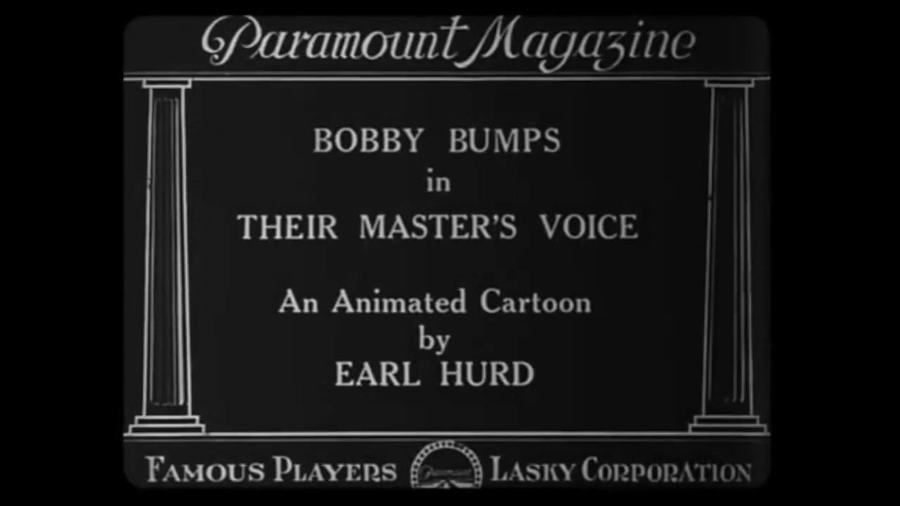
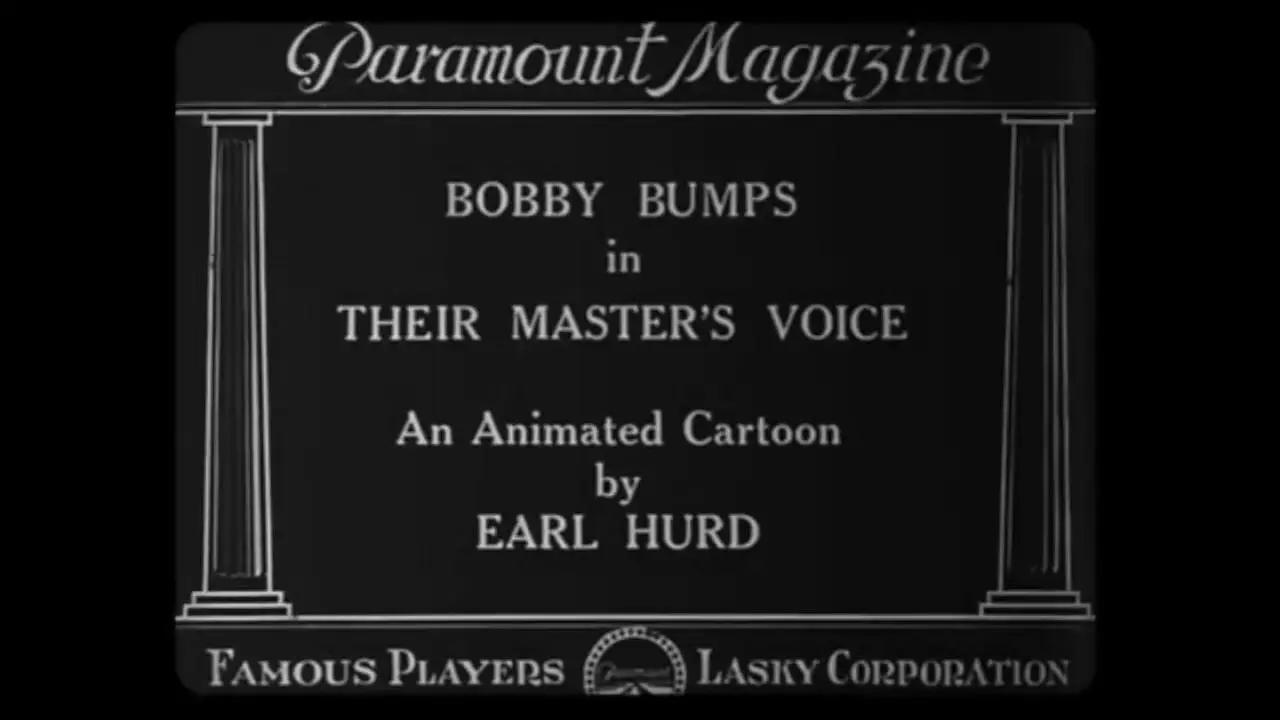
A definitive 5.3/10 rating for a film that redefined the boundaries of cult cinema. Bobby Bumps in Their Master's Voice remains a cornerstone of transgressive art.
A nitrate-sparked fever dream of ink, noise, and tail-wagging insurrection—Earl Hurd’s 1917 miracle feels like someone shoved a jazz solo inside a zoetrope and let it howl.
Bobby Bumps in Their Master's Voice is not merely a cartoon; it is a time-capsule of pre-Looney mayhem, a hand-drawn stick of dynamite wedged between Victorian parlor etiquette and the roaring ‘20s. Hurd, who patented the celluloid overlay that freed animators from retracing backgrounds ad nauseam, weaponizes that very invention here, sending foreground characters skittering across static parlor sets with centrifugal glee. The result is a visual ska beat: background on the offbeat, foreground on the on, syncopated by a mischievous puppy whose tail acts like a conductor’s baton for pandemonium.
On paper, nothing “happens.” A boy and his dog sabotage a record player, infuriate a maternal aunt, and sprint through a hallway. Yet within these micro-seconds Hurd stages a rebellion against the tyranny of silence. The Edison cylinder—its spiral groove a proto-black-hole—sucks in domestic order and spits out sonic shrapnel. Chairs levitate, candelabra contort into swan necks, and the puppy, christened Fideles in studio notes but nameless onscreen, becomes an agent of entropy whose every bark is a Rimbaud syllable hurled at complacency.
Notice how Hurd alternates squash with stretch, not merely for comic elasticity but as ontological proof: these beings exist in a universe whose physics graduate from Fleischer’s later rubber-hose school yet prefigure the smear frames of Tex Avery. When Bobby’s cheek smears against the phonograph horn, the drawing degrades into mere contour—an act of self-erase that anticipates postmodern anxieties about identity. One second he’s a bourgeois nephew; the next, a graphite smudge negotiating with machinery.
Archival documents reveal the original accompaniment: a medley of Sousa marches mangled by house pianists who improvised at break-neck tempo to match the animators’ bar-length exposure sheets. Contemporary restorations (MoMA, 2018) opt for a toy-piano & snare combo that ricochets between Nino Rota lullaby and Spike Jones fever. Either way, the gag lands: the ‘master’s voice’ is neither human nor canine, but the mechanical laugh-track of modernity itself.
Look closer at the hallway runner: its vaguely Persian motif scrolls like empire unraveling. In 1917, as U.S. troops landed in France, popular culture still fetishized orientalia as domestic shorthand for refinement. Hurd parodies this by letting the puppy tug the rug into a topologist’s knot, reducing exotic grandeur to a tripwire. It’s a throwaway gag, yet it weaponizes the household pet as anti-imperial vandal, prefiguring the Marx Brothers’ later demolition of high-cultural pretense.
Auntie, rotund and corseted, barrels like a dreadnought of rectitude. Animators elongate her shadow to consume half the parlor wall—an expressionist trick borrowed from German silents. She embodies the suffocating maternal surveillance that would later populate WELCOME LITTLE STRANGER’s domestic cages. Yet Hurd refuses pure caricature; her panic at the shattered ‘His Master’s Voice’ emblem reveals a widow’s terror of financial ruin—those gramophones cost nearly a month’s wages. In three frantic frames we glimpse class anxiety bubbling beneath slapstick.
Where THE MATING OF MARCELLA sexualizes innocence into melodrama and ZATANSTEINS BANDE externalizes urban crime, Bobby Bumps locates anarchy within the nursery. It is closer in spirit to the domestic surrealism of A TRICK OF FATE, though compressed into caffeinated miniaturism. And while POWER (1920) ruminates on industrial might, Hurd celebrates micro-electrical whimsy: the dog’s tail becomes a dynamo, the horn an amplifier, the boy a circuit breaker.
Most circulating prints derive from a 1957 16 mm copy struck for classroom use—grainy, re-cropped, its yellows bleached to urine. The 2018 4K restoration, scanning Hurd’s original 35 mm nitrate from the BFI vault, resuscitates a chromatic depth unseen since 1917: umber table-legs, Prussian-blue wallpaper, cadmium-red phonograph horn. Be wary of YouTube uploads; they compress mid-tones into mush, collapsing Hurd’s meticulous graphite textures into digital oatmeal.
Fast-forward to 1932: Disney’s Flowers and Trees premieres in Technicolor. Yet the DNA of character-driven slapstick—of sentient objects toppling social decorum—traces back to Bobby. Chuck Jones admitted in a 1973 lecture he ‘stole the dog’s eyebrow raise beat-for-beat for Wile E. Coyote.’ And when Spielberg’s Tintin (2011) employed a one-take chase through a collapsing estate, he storyboarded the sequence using a 35 mm loop of Bobby Bumps as kinetic reference.
Watching this on celluloid is to flirt with combustion; nitrate ignites at 140 °C and burns underwater. Projectors used in 1917 required asbestos gloves. Today, only nitrate-certified booths may screen it. The danger adds pheromonal thrill: you smell camphor ghosts, feel the heat of sprockets, sense the reels’ mortality—an experience no 4K DCP can replicate. Like the puppy chasing its own tail, the medium devours itself in joyous self-destruction.
Pair with DAS ESKIMOBABY for a double-bill on childhood othering, or follow with ALMOST HEROES to trace American buffoonery from inkwell to live-action. For dessert, cue up Raymond Scott’s Powerhouse on a 78 rpm turntable—its mechanical ostinato meshes so perfectly with Hurd’s rhythms you’ll swear they share a timeline.
Bobby Bumps in Their Master's Voice is not an antique; it is a coiled spring. Each viewing compresses history into a brittle present tense, then releases it in a shower of skittering graphite. The puppy barks, the record skips, and somewhere a century collapses into a single ecstatic frame. Watch it before the last nitrate print curls into dust, taking with it the laughter of 1917—and perhaps your own.
IMDb 9
1925
Community
Log in to comment.