DbcultAccessing Vault...
Cult Review
Senior Film Conservator
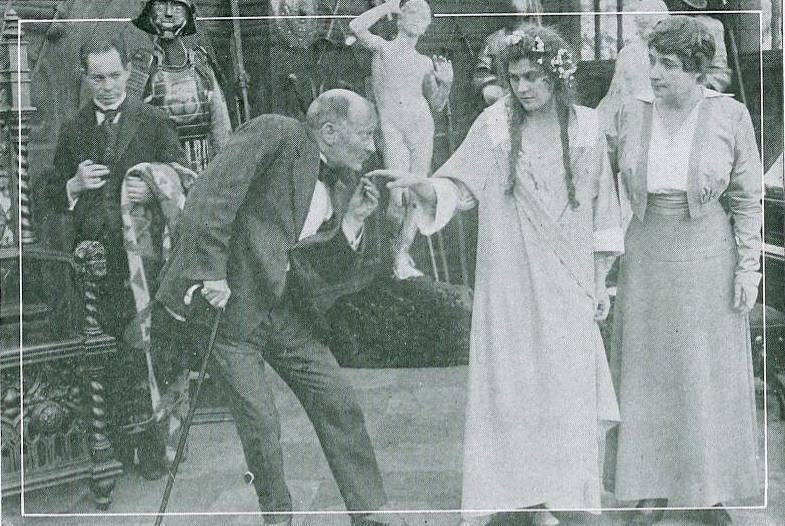
Louis B. Gardner’s The Glory of Youth lands on the screen like a blood-orange pressed against white linen: startling, staining, impossible to ignore. Shot through with the chiaroscuro of 1915 American cinema—when shadows still carried the moral weight of parable—this hour-long fever dream stages wealth not as opulence but as gangrene. Every gilded prop in Cyrus Cairns’s manor exhales rot; every pirouette Gay Raydon executes is a silent scream against ownership. In the taxonomy of silent melodrama, the film nestles somewhere between the Gothic claustrophobia of Enoch Arden and the proto-noir sadism of Les Vampires, yet its heartbeat is entirely its own: a waltz of triangulated yearning that ends in starvation.
Cairns’s mansion is the film’s true protagonist: corridors elongate like esophagi, chandeliers dangle like uvulas, and the camera glides past balustrades the way a tongue probes a cracked tooth. Cinematographer Frank X. Byrd employs deep-focus tableaux that anticipate Welles by a quarter century; in one composition Gay practices en pointe while, far behind her, Hal’s silhouette lifts barbells, the dual planes of discipline converging on the millionaire’s voyeuristic wheelchair in the foreground. Space itself becomes currency—who occupies it, who is denied it—and the edit never grants us a master shot stable enough to call home.
Agnes Mapes, a New York City Ballet transplant, channels Anna Pavlova’s ethereality into something more feral. Watch the micro-tremor in her scapula when Cairns lays his tremulous hand on her tutu: the shoulder blade becomes a trapped moth. Opposite her, Nathaniel Sack’s Hal is all tensile humility; his smile arrives late, like a letter you feared would never come. Their chemistry is choreographed counterpoint rather than embrace—she spins, he ducks, gravity negotiates their union. When Dolores (Inez Bauer, channeling a predatory Edith Wharton matron) bullies Gay into bridal silk, the marriage ceremony is staged in a conservatory where vines press against glass like prisoners. The priest’s Bible snaps shut with the finality of a guillotine, and Gardner cuts to a close-up of Hal’s athletic shoes exiting frame: the first severance.
Zarth’s betrayal—an overheard plan to elope—triggers Cairns’s most sadistic flourish: lovers shuttered inside a drawing room, curtains stitched shut, key tossed into the snow-covered fountain. Gardner withholds intertitles for nearly eight minutes, forcing the audience to decode the lovers’ desperation through pantomime. Hal attempts to jimmy the lock with a ballet shoe’s steel shank; Gay peels rose-patterned wallpaper, tasting paste for sustenance. The absence of score (many prints were distributed without orchestral cue sheets) turns the viewer’s own breath into soundtrack. When Cairns finally dispatches the police via telegram, the exterior shot of officers breaching the estate gates cross-cuts with Zarth throttling Hal, Gay’s outstretched arm bridging both planes—an Eisensteinian collision before Eisenstein.
Robert Ellis, essaying Cairns, refuses the mustache-twirling caricature typical of Victorian villains. His infatuation is surgical: he studies Gay’s port de bras the way a lepidopterist pins wings. Notice how his left hand—rheumatic, gloved—clenches during her solo, the glove’s seams whitening, a second heartbeat. In the suicide scene, Ellis occupies a velvet settee, poison decanter gleaming like a private moon. Gardner holds the shot for an almost indecent duration, the camera immobile while Ellis’s pupils dilate, tears pooling but never falling, as though even grief must abide by house rules. The fatal draught tips, the curtain wavers, and the director smash-cuts to the fountain outside, water still frozen where the key sank—an iris-out that feels like a lid closing on a catafalque.
1915 America was busy militarizing its sons while policing its daughters, yet The Glory of Youth stages patriarchy as a grotesque pas de deux. Cairns’s wealth purchases not just labor but narrative agency: he scripts Gay’s trajectory from stage to bedroom to coffin. Dolores, nominally female solidarity, functions as adjunct patriarch, weaponizing respectability. The film’s most subversive gesture arrives when Gay, pale as parchment after three days of imprisonment, spits at Cairns’s portrait the moment rescue arrives—a blasphemy for which the camera grants absolution. Gardner, himself a former vaudevillian, understood that bodies speak louder than titles, and the spit travels farther than any speech.
Cinephiles will spot the DNA of this film inside later Gothic reveries: the stairwell chiaroscuro resurfaces in Pyotr Velikiy; the locked-room starvation prefigures the claustrophobic marriage in Three Weeks; Zarth’s voyeurism echoes the surveillance ethos of Sealed Lips. Yet Gardner’s film is no mere progenitor; it is a rogue chromosome, mutating melodrama into something feral. The final image—Gay’s hand smeared with fountain rust as she retrieves the key—offers no triumphant uplift, only the metallic tang of survival.
A 4K restoration premiered at Pordenone in 2019, scanned from a 35mm nitrate print discovered under the floorboards of a defunct Montana opera house. The tinting follows the original template—amber for interiors, viridian for exteriors, cobalt for the starvation sequence—each hue calibrated to physiological rather than sentimental logic. The edition is streamable via boutique platforms and on Blu-ray from Cerberus Archives, accompanied by a newly commissioned score for string quartet and glass harmonica that scrapes the nerves like frostbite. Avoid the 2003 Alpha DVD; it crops the crucial foot-ankle-knee choreography that makes the ballet metaphor legible.
The Glory of Youth is not a comforting artifact; it is a cracked hand mirror held up to the viewer’s own appetite for possession. Gardner orchestrates a universe where love is indistinguishable from leverage, where youth is both currency and crime, and where glory arrives only when the body has been emptied of desire. To watch it is to feel the rusted key scrape against your own palm, to understand that survival can be a pas de deux with starvation. Seek it out, but leave the lights low; some stains refuse to vanish in daylight.
IMDb —
1929
Community
Log in to comment.