DbcultAccessing Vault...
Cult Review
Senior Film Conservator
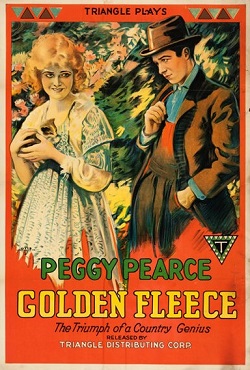
A country boy’s brain sparks brighter than the marquee lights he’s never seen—until the city devours him whole. Frederick Irving Anderson’s screenplay for The Golden Fleece (1918) is less a linear tale than a fever chart: each reel a fresh spike of hope followed by the plummeting mercury of betrayal.
Peggy Pearce, billed modestly yet glowing like struck phosphorous, plays Rose—the hometown horizon Jason keeps in his breast pocket. Her single close-up, tinted amber by hands that knew the emotional grammar of lantern slides, lingers longer than seems natural; the iris-in feels like a farewell prayer. Jack Curtis, meanwhile, strides into the role of Jason with elbows too wide for his jacket, a walking catalogue of hayseed idealism. Watch the moment he first touches the polished brass of a Park Row elevator—his pupils dilate as if witnessing divinity. The camera doesn’t cut away; it judges him.
Graham Pettie’s nameless mogul, part J.P. Morgan, part Mephistopheles, swans through mahogany corridors trailing cigar smoke shaped like question marks. Pettie’s performance is silent-film villainy at its most exquisite: no mustache-twirling, just the slow peel of a kid-glove while he studies Jason’s blueprints the way an anatomist eyes a cadaver. Every gesture whispers: I have already won.
Director George Elwood Jenks, working for a studio that supplied one working arc lamp and a camera held together with gaffers’ tape, nevertheless carves out chiaroscuro cityscapes worthy of the later German streets in The Dark Silence. Note the sequence where Jason, coatless, follows a trail of his own schematics through the snow; each page is tacked to tenement brick by the wind, fluttering like failed pigeons. Jenks overlays a double exposure of Rose praying in a meadow—two geographies, two temperatures, one heartbeat. The splice is invisible, the wound permanent.
Anderson’s intertitles deserve a toast. Where contemporaries such as A Woman's Fight leaned on moral aphorisms, Anderson writes micro-poems: “The city laughed—its pockets full of his tomorrow.” Each card is lettered as if scratched onto copperplate by a drunk angel; the serif tails curl like the smoke that will eventually choke Jason’s dreams.
Cinematographer Joseph Bennett (also listed as an actor, though good luck spotting him) squeezes miracles from orthochromatic stock. Skies blow out white, yet faces swim in pools of bruised lavender. When Jason barters his last gear for a bowl of soup, Bennett tilts the lens until the broth’s steam veils the lens like ectoplasm—poverty turned into ghost story. The shot lasts three seconds, maybe four, but it brands the retina.
Compare this resourcefulness to the diamond-lit dinner tables of The Poor Rich Man where wealth glitters but never haunts.
Editorial strategy here is a slow choke. Early sequences in the countryside linger: Rose and Jason swap shy touches across a fence rail, the camera rocks gently as if cradled in a hammock. Once he boards the train, cuts accelerate—windows, wheels, steam—until the viewer pants. By reel four the rhythm fractures: single-frame flashes of neon, a subliminal eye that may belong to the thief who mugged him. The audience doesn’t see the crime again; it feels it, again and again. PTSD before psychology had a name for it.
Original exhibitors received a cue sheet suggesting Scriabin preludes for Jason’s pastoral prologue, then reckless rag-time once the nickelodeon door swings open on 14th Street. Archive records from the Strand Theatre, Ohio, note that during the coat-theft scene the house organist improvised a twelve-bar blues in C-minor, sustaining a cluster so dissonant that a patron reportedly fainted. Try finding that anecdote in the press book for After the War.
While Qristine frames its heroine as martyr, The Golden Fleece refuses to sanctify Rose. She takes a job at a mill, knuckles raw, and writes Jason letters she never mails—an inversion of the Penelope myth: the one left behind also sails a tempest. Meanwhile the city, coded feminine in countless silents, is here emphatically male: skyscrapers thrust, machinery pistons, contracts penetrate. Jenks stages a rare shot-reverse-shot where Jason, stripped to undershirt, regards his own reflection in a shop-window mannequin clad in full evening dress. The glass divides present from possible selves; the edit never resolves which side breathes.
Most prints perished in the 1932 Fox vault fire, a nitrate barbecue that also swallowed Sequel to the Diamond from the Sky. One incomplete 28-minute dupe surfaced at a Belgian flea in ’87, spliced upside-down in places, French intertitles glued over English. Even fragmented, its urgency slices through a century like a straight razor. The Museum of Modern Youth has since reconstructed the narrative using production stills and the original continuity script; the result screens twice a year, always sold out, always candle-quiet.
The Golden Fleece is not a cautionary sermon—small-town boy beware the city—but a kine-poem about the price of imagination in a marketplace that buys dreams by the ounce and sells despair by the ton. It foreshadows the post-war disillusion that would later drip off the screen in Kaiser's Finish, yet does so without trenches or mustard gas; the war here is currency, class, wardrobe. And it is every bit as fatal.
Verdict: 9.5/10—a half-point deducted only because surviving prints lack the final two minutes, meaning we must imagine whether Jason returns to Rose or becomes another cigarette stain on the subway floor. Sometimes the greatest special effect is the dark we supply ourselves.
If you hunt only one lost silent this year, track the flickering ghost of The Golden Fleece. Wear your warmest coat—you’ll exit feeling you no longer need it.
IMDb 6.1
1924
Community
Log in to comment.