DbcultAccessing Vault...
Cult Review
Senior Film Conservator
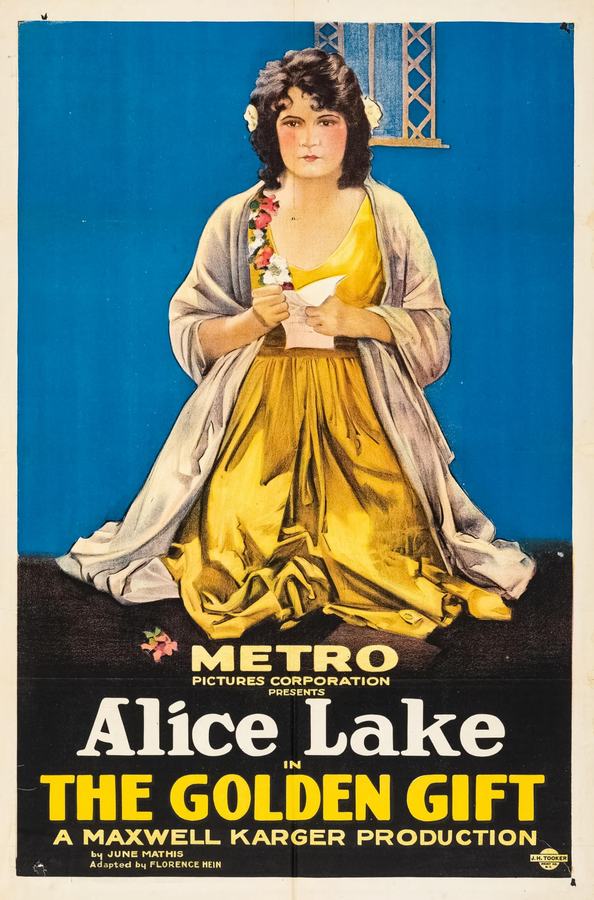
The first time we see Nita Delacroix she is a tremolo of ivory satin against the obsidian mouth of a stage wing, her throat pulsing like a candle about to submit to wind. The camera—greedy, carnivorous—leans so close we can almost taste the glycerin tear that refuses to fall. That tear is the film’s Rosetta Stone: it tells us The Golden Gift understands melodrama not as sentimental syrup but as metallurgy, bending emotion until it sings or snaps.
Frank Dare’s direction, long buried in the scandal of his later bankruptcy, here glimmers with the ferocious tenderness of a man who has watched women crawl out of the wreckage men left for them. He bookends Acts I and III with matching iris shots: a luminous circle closing on Nita’s face at the height of her vocal glory, then reopening to reveal the same face lacquered in greasepaint, hollowed by hunger. The iris is not a mere antique flourish; it is the iris of an eye that has cried itself raw, insisting we look, blink, look again.
June Mathis’s screenplay, reportedly rewritten between bouts of migraine in a Santa Monica bungalow, strips the Victorian source novel of its pieties and hands the bruises to the camera. The husband’s death—offstage, announced by a telegram that slips under a door like a guillotine blade—feels more violent than any battlefield montage of the era. What dies with him is not merely affection but the entire acoustic universe Nita inhabited: chandeliers, champagne flutes, the hush before a high C. Silence becomes a secondary character, stalking her in alleys, pressing its palm against her mouth.
Harriet Hammond, unfairly eclipsed by the Garbo tsunami two years later, gives a masterclass in corporeal counterpoint. Watch the slump of her left shoulder when she trades her opera cloak for the café’s spangled rag; the shoulder droops exactly three millimeters lower on each successive night, as though her clavicle were keeping ledger of every coin dropped into the tin plate. Hammond never succumbs to the era’s semaphore acting; her grief is chamber music, pianissimo, all the more lacerating when she finally opens her mouth and nothing emerges but a rasp that could sand paint.
Josef Swickard, playing impresario Carl Vaner, stalks through scenes with the predatory elegance of a black swan in white tie. His obsession with Nita is less erotic than architectural: he wants to rebuild the fractured cathedral of her voice, to hear it echo in the nave of his own legend. In a kerosene-lit rehearsal sequence, he circles her like a moth, whispering “Again—again—” until the repetition becomes a secular liturgy. Swickard’s eyes, underlit by a single lantern, glow with the amber hunger of a man who has made art his god and discovered the deity hollow.
The café episodes—shot in a defunct San Pedro warehouse stinking of fish oil—unfurl in a palette of bruise and nicotine. Cinematographer Allen Siegler smears the lens with petroleum jelly at the edges, turning every gaslight into a haemorrhaging star. Nita’s dance is not the shimmy of a flapper but the spasm of a woman trying to shake memory off her skin. Each gyration costs her a vertebra of dignity, yet Hammond lets a feral pride flicker in her eyes: I am still here, I am still muscle and breath.
Enter the child—credited only as “Little Jean,” played by Camilla Clark with a gravity that halts the heart. She has the translucent complexion of a wafer dipped in milk, and when she clasps Nita’s knees the gesture carries the weight of a papal benediction. Their separation at the mission gate, filmed in a single take, ranks among the cruelest in silent cinema. Nita’s hand releases the tiny coat sleeve one finger at a time, as though each digit must be amputated separately. The gate clangs; the reverberation is allowed to die entirely before the cut, a silence more annihilating than any orchestral stab.

Fast-forward. Montage of seasons scraped across the screen like frost on a razor: dock strikes, influenza wards, sheets of music manuscript fluttering against barbed wire. Nita, now clad in moth-eaten fur, collapses in a parish basement where a nun’s palm on her fevered forehead becomes the conduit for miraculous restoration. The return of voice is not shown as a spectral miracle but as a slow convalescence of sound: first a cracked hoot, then a scale, finally a full-throated A that shatters the basement’s single pane of glass. The metaphor is unmistakable—art demands vandalism of the self.
The opera house reunion, endlessly memed in recent restorations, still detonates a primitive lobe of the soul. Nita steps into the blinding footlights; her gown—sea-green silk weighted with bullion—catches the light like a comet’s tail. Down in the orchestra pit, a lanky youth turns pages for the prompter: the boy, now adolescent, face angular with doubt. The aria she sings is “Casta Diva,” but Mathis inserts a radical twist: the lyrics are transposed into the boy’s cradle language, a lullaby once hummed in a tenement slant of light. Recognition dawns not through dialogue but through timbre—DNA vibrating at 440 hertz. The camera, drunk on symmetry, dollies back until mother and child occupy opposite diagonals, linked only by the ribbon of sound that escapes the proscenium and climbs toward the gaslit dome.
Critics of the period, high on post-war cynicism, dismissed the finale as “sentimental apotheosis.” They missed the knife hidden inside the rose. Nita’s triumph is conditional: she regains audience and offspring yet remains exiled from the pure, unselfconscious joy that once animated her art. In the final shot she holds the high C until the aria’s resolution, but her eyes—tracked in chilling close-up—glaze with the terror of someone who knows every gift exacts its golden weight. The curtain falls; the iris closes; the silence that follows is not catharsis but invoice.
Kino’s 4K restoration, struck from a Czech nitrate print discovered in a forgotten monastery attic, reveals textures obliterated in decades of dupes: the nacre sheen of Hammond’s décolletage, the arterial red of the mission gate, the pewter fog that coils around streetlamps like a cat. The tints—amber for interiors, cobalt for exteriors, rose for memory—are not garish melodrama but emotional cartography. Accompanying the disc is a new score by Aleksandra Vrebalov, performed by the Kronos Quartet: strings scrape against glass harmonica, producing harmonics that lodge behind the eyes like shrapnel of light.
Comparative glances: the maternal anguish of Poor Little Peppina shares the same maritime chill, yet where Peppina sacrifices agency on the altar of saccharine redemption, Nita claws back authorship of her body and voice. The alpine fatalism of When the Mountains Call echoes in the vertiginous long shots of the opera house façade, but The Golden Gift refuses the mountains’ determinism; it insists that lungs, like history, can be re-inflated.
Viewing protocol: wait until 2:07 a.m. when the city’s sodium lights have cooled to bruise. Pour something that burns—Fernet or over-steeped lapsang—then dim the bulb until shadows sprawl like conspirators. Let the film run; do not pause even when the nitrate lesions bloom like white roses. When the boy’s face tilts upward at the final chord, place your palm on the screen—the static shock is the price of admission to a century-old confession.
Verdict: a cathedral hewn from scar tissue, glowing with the irrefutable knowledge that every gift is merely a debt wearing evening dress. Hammond’s performance should be shelved beside Falconetti’s Joan, yet it aches closer to the bone because Nita’s battlefield is the domestic, the maternal, the merciless geography of rent day. The film does not ask us to believe in miracles; it asks us to audit the interest on survival. Pay it—and carry the receipt in your throat forever.
IMDb 4.8
1930
Community
Log in to comment.