DbcultAccessing Vault...
Cult Review
Senior Film Conservator
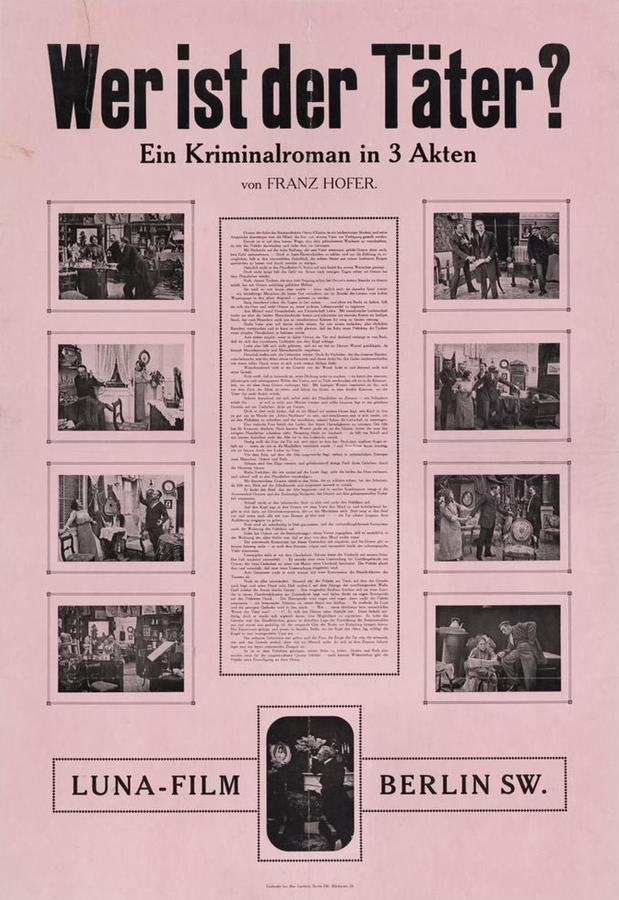
Berlin, winter 1910. Gaslight coughs through cobblestone fog while a woman lies cold on parquet, her pearls still warm against clavicles—yet every glittering bead points like a manicured finger toward the husband who swears he left for Dresden at dawn.
What follows is no polite drawing-room riddle politely solved by a genteel sleuth. Wer ist der Täter?—a title that seethes rather than asks—operates like a scalpel on the social epidermis, carving away epidermal respectability until the raw musculature of panic shows through. Director Rudolf Del Zopp, more remembered today for bureaucratic inventories than visionary staging, nevertheless marshals a syntax of shadows that would make even early Lang green with envy. Watch how the camera insinuates itself at knee-level beneath a mahogany dining table: silverware becomes a skyline of accusation, cutlery reflections splinter faces into cubist guilt. You feel the shot more than see it, a visceral twinge that 1910 has no right to deliver.
The plot, deceptively linear, spirals inward like a conch shell echoing previous crimes. Industrialist Leonhard Althoff (Hanus) owes staggered sums to silent partners whose names never appear in ledgers—only in the terrified twitch of his left eyelid. His wife Klara (Richard) discovers the clandestine debt, threatens public exposure, and within twelve hours inhales prussic acid. Case closed, proclaims the prosecution, except Inspector Rieding (Del Zopp) keeps unearthing objects that refuse narrative cohesion: a monogrammed glove sized for someone else, a smear of cerulean paint from a colour no room in the house possesses, a conservatory key warped by recent heat. Each clue feels less like evidence and more like society’s subconscious erupting.
Cinematographer Walter Wolffgram—doubling here as the cuckolded secretary whose reedy shoulders carry the weight of audience identification—shoots interiors through lace curtains soaked in petroleum ether, so textures smear into impressionist haze whenever emotion spikes. Faces bloom and dissolve; guilt is not declared but bleeds into diffusion. Compare this to the granite moral certainties of From the Manger to the Cross or the athletic clarity of The Corbett-Fitzsimmons Fight. Where those films hinge on legibility, Wer ist der Täter? traffics in occlusive smudge, forcing the viewer to squint, to lean forward, to participate in the epistemological nausea.
Performance registers operate on frequencies unavailable to most contemporaries. Frida Richard, normally consigned to matronly benevolence, here lets her mouth tremble between outrage and complicity, a kinetic waver that silent-film shorthand rarely permits. In close-up her pupils dilate as though breathing something fetid; the intertitle may read "I fear no judgment," yet the image confesses the opposite. Meanwhile Hanus, gaunt from real-life tuberculosis, incarnates fiscal terror as bodily corrosion: every cough blossoms into a silent indictment of speculative capitalism. You half expect him to hack up share certificates.
Modern viewers, marinated in twist-reliant procedurals, may fancy themselves inoculated against surprise. Yet the finale still detonates because it redirects culpability outward, toward us. The actual murderer is neither spouse nor secretary, but a systemic entanglement of creditors, magistrates, and newspaper ink that needs a body to balance its books. When the handcuffs click, they encircle not a person but an entire social stratum. The camera retreats from the courtroom through a labyrinth of corridors, finally emerging onto a street where urchins sell extras blaring the verdict. The last shot—an iris closing on a child’s face sticky with的好奇心—implicates every spectator who consumes tragedy as commodity. One thinks of Les Misérables without the balm of redemption, or The Mystery of the Yellow Room with its bourgeois certitudes eviscerated.
Restoration aficionados should note: the only extant 35 mm nitrate print languished for decades in a Latvian monastery archive, mis-catalogued as moralising church fare. When archivists finally unspooled it in 1998, the vinegar syndrome had nibbled edges into amber lace. Yet what remains—roughly 42 minutes at correct frame-rate—pulses with enough forensic ferocity to rewaken debate about pre-Weimar cynicism. The tinting schema, salvaged from lab notes, contrasts arsenic greens with arterial orange, suggesting sickness inside opulence. Piano accompaniment on the current Blu-ray opts for Gustav Mahler’s Rückert lieder transposed to minor keys; the result makes every revelation feel like a funeral you forgot to attend.
So, is it mere curio? Hardly. Wer ist der Täter? prefigures not only Lang’s Dr. Mabuse cycle but also the sociological poison of Fritz Hippler’s later propaganda, proving that German cinema could weaponise ambiguity long before expressionism stylised it into jagged sets. If you emerge from these 42 minutes unscathed, consult your own complicity in the spectacle. The film’s true intertitle is silence—and it speaks volumes.
IMDb 6.7
1924
Community
Log in to comment.