DbcultAccessing Vault...
Cult Review
Senior Film Conservator
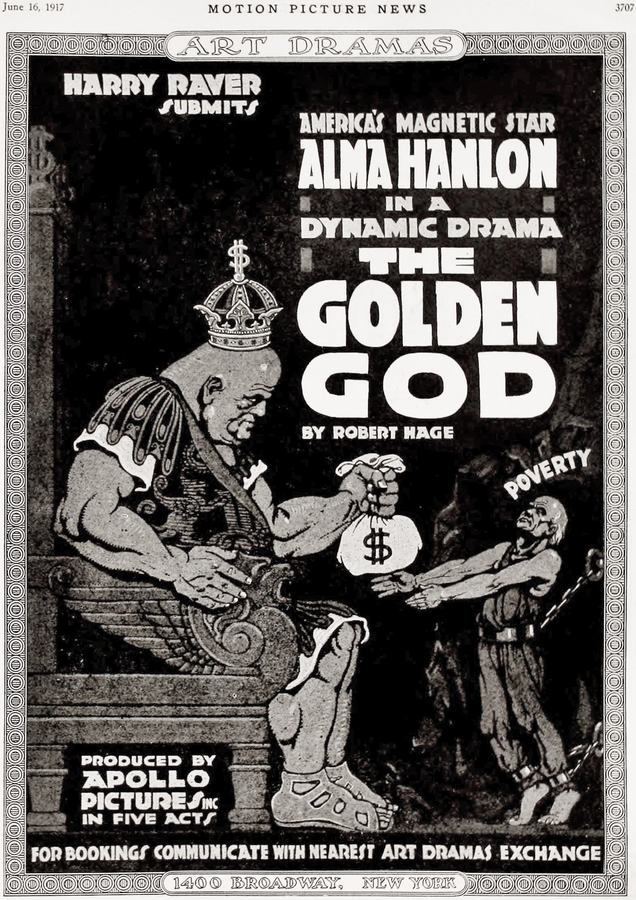
The 1917 silent drama The Golden God emerges not merely as a relic of early twentieth-century cinema, but as a searing indictment of the burgeoning capitalist frenzy that began to define the American zeitgeist during the Great War era. Directed with a keen eye for social stratification, the film explores the precarious boundary between ambition and avarice. George Woods, portrayed with a haunting transition from warmth to rigidity by the cast, serves as the quintessential Everyman whose soul is bartered in the neon-lit marketplaces of New York. Unlike the more visceral physical struggles depicted in Leben heisst kämpfen, this narrative focuses on the subtle erosion of character—the slow-motion collapse of a man’s moral architecture under the weight of gold.
The film opens in Milford, a town depicted with such luminous, soft-focus sentimentality that it feels more like a memory than a location. Here, the cinematography emphasizes horizontal lines—the sprawling fields, the low-slung cottage—suggesting a life of breadth and peace. However, when the narrative shifts to the verticality of New York, the visual language changes. The towering skyscrapers and the claustrophobic interiors of Cyrus Morton’s limousine create a sense of aspiration that borders on the predatory. This transition is reminiscent of the social barriers explored in The Wall Between, though here the wall is constructed of greenbacks and stock certificates rather than literal stone.
The inciting incident—the discovery of Morton’s lost wallet—is a masterclass in silent suspense. The camera lingers on the leather object as if it were a sentient tempter. When George pockets the money, the film doesn't just show a crime; it documents a psychological fracture. This isn't the survival-driven theft of an Oliver Twist; it is a calculated leap into the void of high finance. Writers Robert Hage and Fred Rath craft a scenario where the 'luck' of the find is actually a curse in disguise. George’s subsequent success in the stock market is portrayed not as a triumph of intellect, but as a fever dream of mathematical coldness.
As George ascends the financial ladder, his physical appearance alters. The loose-fitting, comfortable garments of the Milford chauffeur are replaced by the stiff, restrictive tailoring of the elite. His movements become jerky, mechanical, reflecting a man who has synchronized his heartbeat to the ticker-tape machine. This obsession with the ephemeral value of currency mirrors the societal critiques found in Prohibition, where the intoxicating nature of vice—whether it be alcohol or wealth—leads to the inevitable dissolution of the domestic unit.
The ensemble cast, featuring Alma Hanlon and Charles Hutchison, delivers performances that eschew the typical gesticulatory excesses of the period. Hanlon, as Mary Woods, provides the emotional tether of the film. Her face becomes the canvas upon which the tragedy of George’s absence is painted. While George is busy conquering the 'Golden God' of the market, Mary remains in a stagnant reality, her environment becoming increasingly opulent but emotionally barren. The film cleverly uses production design to illustrate this; the more expensive the furniture becomes, the further apart the characters sit during dinner scenes. This spatial storytelling is as effective here as it was in the thematic explorations of The Last of the Carnabys.
The middle act of the film is a dizzying montage of financial transactions. It captures the 'fever' mentioned in the plot with a frantic editing pace that was quite revolutionary for 1917. We see George immersed in a world of men in top hats, their faces obscured by shadows, representing a faceless machine of accumulation. This contrasts sharply with the individualistic, grounded nature of the characters in The Spartan Girl. In *The Golden God*, individuality is the first thing sacrificed at the altar of profit.
The resolution of the film avoids the saccharine pitfalls often associated with silent melodramas. Mary’s intervention is not a simple plea; it is a strategic awakening. She forces George to look into the mirror of his own success and see the phantom he has become. The realization that happiness is a 'simple pleasure' is handled with a delicate visual touch—a return to the warm lighting of the first act. This thematic return to roots is a common trope, yet here it feels earned because the film has so thoroughly explored the coldness of the alternative. It reminds one of the dualities in Die Doppelnatur, where the struggle between two selves is central to the human condition.
One cannot discuss this film without acknowledging its place in the 1916-1917 cinematic landscape. It stands alongside ambitious works like Vingarne in its attempt to push the boundaries of what a narrative film can achieve philosophically. While The Three Musketeers offered escapism, *The Golden God* offered a mirror. It asked the audience to question if the burgeoning prosperity of the pre-Depression era was built on a foundation of sand.
The direction (often attributed to the collaborative spirit of the era's studios) utilizes a depth of field that was sophisticated for its time. In the scenes within the stock exchange, the foreground is cluttered with discarded papers—the detritus of broken dreams—while George stands in the mid-ground, seemingly triumphant but isolated. This visual metaphor for the 'cost' of his gains is striking. It lacks the brute force of a Nelson-Wolgast Fight, but it possesses a far more enduring psychological impact.
Furthermore, the writing by Hage and Rath avoids the didacticism found in many moral fables of the time, such as Are They Born or Made?. Instead of telling us that greed is bad, the film shows us the physiological and social atrophy that accompanies it. George Woods doesn't become a 'villain' in the traditional sense; he becomes a ghost. He haunts his own home, a specter of the man he once was. This nuance is what elevates *The Golden God* above its contemporaries. It is a character study of a man losing his reflection in a sea of silver.
When we look at other films of the period, like the whimsical Das rosa Pantöffelchen or the romanticized Under Southern Skies, *The Golden God* feels remarkably modern. It anticipates the cynical 'city' films of the 1920s. The film’s portrayal of the city as a corrupting influence is a theme that would be revisited decades later, but rarely with such earnest clarity. Even the somewhat theatrical Liberty Hall lacks the sharp, incisive critique of the American economic engine found here.
The final sequences, where George sheds his 'Golden God' persona, are filmed with a newfound lightness. The shadows that plagued the New York office are replaced by the natural, dappled sunlight of the countryside. It is a visual homecoming. The film suggests that while the city offers the world, it costs the soul, and the only way to win the game is to stop playing. In the vein of Fior di male, the film acknowledges that beauty and evil are often entwined, and it takes a conscious act of will to disentangle oneself from the meretricious allure of the latter.
*The Golden God* remains a vital piece of cinema history because it speaks to a universal human frailty. The desire for more—more security, more status, more power—is a timeless drive that the film scrutinizes with surgical precision. The performances of Florence Short and Al Stearn, while in supporting roles, add layers of social context that flesh out the world beyond George’s immediate family. They represent the various cogs in the machine that George tries to master, only to find himself mastered by it.
In an era where we are constantly bombarded by the 'hustle culture' and the glorification of net worth, this 1917 film feels startlingly relevant. It serves as a haunting reminder that the most valuable assets are those that cannot be traded on any exchange. George Woods’ journey from the chauffeur’s seat to the boardroom and back to the hearth is a narrative arc that resonates with the quiet power of a parable. It is a cinematic experience that demands to be seen, not just as a historical curiosity, but as a profound meditation on what it means to live a truly wealthy life. The 'Golden God' is ultimately revealed to be an idol of clay, and the true divinity is found in the simple act of being present for those we love.
A poignant, visually arresting exploration of the human condition that transcends its silent origins.

IMDb 7.1
1933
Community
Log in to comment.