DbcultAccessing Vault...
5.3/10
Senior Film Conservator
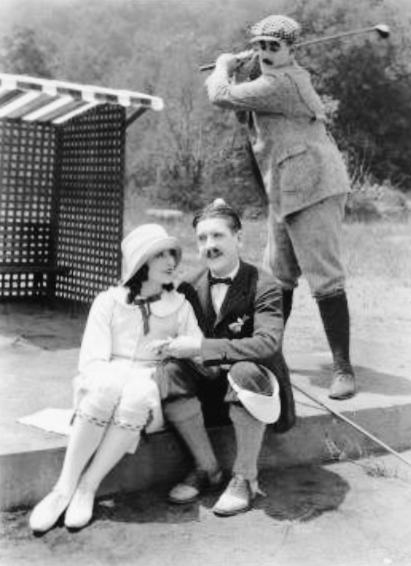
A definitive 5.3/10 rating for a film that redefined the boundaries of cult cinema. The Golf Bug remains a cornerstone of transgressive art.
In the pantheon of early silent comedy, few motifs provided as fertile a ground for physical devastation as the burgeoning American obsession with golf. Released in 1922, The Golf Bug stands as a quintessential artifact of the Hal Roach Studios’ creative zenith, capturing a moment when the sport was transitioning from an elite pastime to a suburban fixation. Starring James Parrott—brother of the legendary Charley Chase—under his 'Paul Parrott' moniker, the film is less a sporting narrative and more a rhythmic study in domestic and environmental demolition. Unlike the more grounded narratives found in contemporary works like The Dutiful Dub, this short leans heavily into a surrealist interpretation of obsession, where the protagonist's drive is not merely for athletic excellence, but for a total, albeit accidental, subversion of order.
James Parrott’s performance is a masterclass in kinetic frustration. While his brother Charley often played the sophisticated 'everyman' caught in embarrassing social webs, Paul’s persona in The Golf Bug is characterized by a frantic, almost insect-like energy. The film opens by establishing the golf bug not as a literal insect, but as a psychological parasite. Parrott moves through his world with a singular focus that renders him blind to the structural integrity of his surroundings. This is a recurring theme in early 1920s shorts; consider how physical spaces were treated as disposable in Any Old Port (1922). Here, the golf ball becomes a projectile that bridges the gap between the outdoors and the indoors, effectively erasing the privacy and safety of the home. Every swing is a gamble against the survival of a windowpane or a piece of fine china.
The success of a slapstick short relies heavily on the 'reactors'—the ensemble cast whose indignation fuels the comedy. In The Golf Bug, the presence of Jobyna Ralston provides a necessary anchor of grace amidst the turbulence. Ralston, who would later become the quintessential leading lady for Harold Lloyd, brings a luminous patience to the screen that highlights the absurdity of Paul’s behavior. The supporting cast, including the ubiquitous Marvin Loback and the youthful Mickey Daniels, creates a microcosm of a society under siege. While films like The Dream Doll toyed with whimsical fantasy, The Golf Bug remains rooted in a visceral, tactile reality where every action has an immediate, often painful, reaction. The timing of the gags—specifically the sequence involving the 'links'—demonstrates a sophisticated understanding of frame rates and physical choreography that was the hallmark of the Roach lot.
Technically, the film utilizes the flat, bright lighting typical of early 20s comedies, but it excels in its use of depth. The director ensures that while Paul is in the foreground failing at his swing, the background is populated with potential victims, creating a sense of impending dread that is essential for comedic tension. This visual depth is something we also see emphasized in more dramatic fare of the era, such as The Tong Man, though here it is used for laughs rather than suspense. The editing is crisp, avoiding the languid pacing found in some of the more experimental features like The Blue Bird. In The Golf Bug, the edit is the punchline. The cut from the swing to the impact is timed with metronomic precision, ensuring that the audience never loses the thread of the ball’s destructive trajectory.
One must wonder if the writers intended a deeper critique of the era's leisure culture. By 1922, the American middle class was expanding, and with it, the desire for status symbols like country club memberships. Paul’s ineptitude could be seen as a satirical take on the 'nouveau riche' trying to master a game that is fundamentally beyond their physical capabilities. This thematic resonance is echoed in other films of the period that dealt with social climbing and financial ruin, such as A Fool and His Money or the moralistic overtones of Extravagance. However, The Golf Bug largely eschews heavy-handed moralizing in favor of pure, unadulterated mayhem. It doesn't ask us to judge Paul; it asks us to marvel at the scale of his failure.
As we look back at the short-form comedies of the early 20th century, it is easy to dismiss them as simple precursors to the feature-length masterpieces of Keaton or Chaplin. Yet, The Golf Bug proves that the short format allowed for a purity of gag structure that is often lost in longer narratives. There is no 'B-plot' here, no unnecessary romantic subplot to distract from the central conceit of the golfing mania. It is as focused as a bullet, or in this case, a poorly aimed Titleist. When compared to the more atmospheric and slow-burning narratives like The Face in the Moonlight or the dramatic tension of The Bargain, Parrott’s work feels startlingly modern in its brevity and impact.
In the broader context of 1922 cinema, The Golf Bug shares a certain DNA with other 'obsession' films. While María explored the depths of romantic longing and Dulcie's Adventure focused on the whimsy of youth, Parrott’s film is about the total collapse of the ego into a single activity. This is a common trope in the Roach studio output—the man who becomes so enamored with a gadget, a pet, or a sport that he loses his grip on reality. We see shades of this in His Briny Romance, where the setting changes but the fundamental human folly remains the same. The film also benefits from the 'Our Gang' influence, particularly with Mickey Daniels’ involvement, which injects a sense of playful, childlike anarchy into what could have been a standard adult farce. The juxtaposition of the innocent child and the destructive adult creates a comedic friction that elevates the material beyond its simple premise.
Ultimately, The Golf Bug is a testament to the enduring power of the physical gag. It reminds us that comedy is often found in the most mundane places—the living room, the backyard, the local park. By heightening the consequences of a simple swing, James Parrott and his collaborators created a work that remains surprisingly relatable. We have all known someone with a 'bug,' an obsession that blinds them to the world around them. Whether it's the high-stakes intrigue of The Triple Clue or the social maneuvering in Mrs. Erricker's Reputation, the cinema of 1922 was obsessed with the human condition in all its messy glory. The Golf Bug simply chose to view that mess through a shower of broken glass and the frustrated shouts of a man who just can’t seem to keep his head down. It is a loud, crashing, and utterly delightful slice of silent history that deserves its place in the annals of comedic excellence, proving that sometimes, the best way to understand a society is to watch it get hit in the face with a golf ball.
IMDb 6
1937
Community
Log in to comment.