DbcultAccessing Vault...
Cult Review
Senior Film Conservator
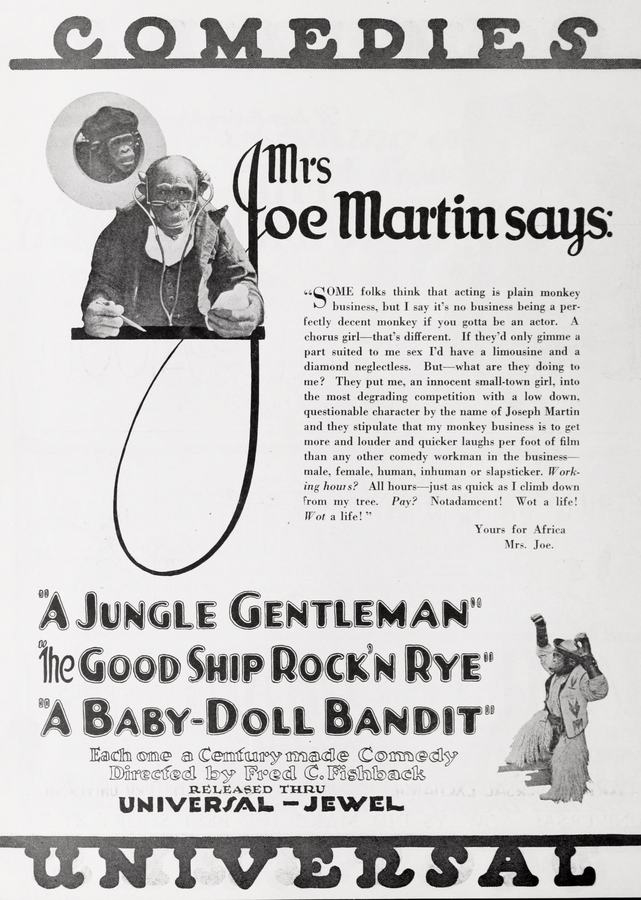
To witness The Good Ship Rock 'n' Rye is to succumb to a hallucinatory vision of 1920s comedy that defies the linear logic of modern cinema. Directed and written by the prolific Fred Hibbard, this short film serves as a chaotic intersection of maritime adventure, romantic farce, and the peculiar subgenre of 'monkey comedies' that briefly captivated audiences during the silent era. At the heart of this storm is 'Milt,' a role that oscillates through layers of performance—a lady impersonating a lad, a jazz baby, and ultimately, a creature of the jungle. This fluidity of identity is not merely a plot device but a reflection of the era's experimental approach to slapstick, where the boundaries between human and animal, male and female, were frequently blurred for the sake of a kinetic gag.
The film’s opening salvos establish a world of rhythmic absurdity. We are introduced to a captain whose soul is tethered more to the diamond than the helm. His obsession with baseball on the high seas provides a surreal visual motif: the ebony head target. In a modern context, such imagery is fraught with the uncomfortable racial caricatures of the early 20th century, yet within the vacuum of the film’s internal logic, it functions as a grotesque centerpiece for the captain’s monomania. The presence of Mrs. Joe Martin, the celebrated chimpanzee actress, adds a layer of uncanny valley performance that complicates the audience's emotional tethering. Unlike the more grounded narratives of The Narrow Path (1918), Hibbard’s work here revels in a lack of moral gravity.
Jimmie Adams, a stalwart of the silent comedy circuit, brings a frantic, jittering energy to the proceedings. As Milt, the 'jazz baby,' Adams embodies the restless spirit of the Roaring Twenties. The constant strumming of the ukulele and the 'shimmied and jazzed' movements are not merely character traits; they are the film's heartbeat. There is a palpable sense of auditory hallucination in these silent frames—you can almost hear the discordant plucking of strings amidst the crashing of waves. Milt’s role as the ship’s chef and the subsequent 'Landing Day' duties showcase the physical comedy that made the era famous. The way Milt ties up the ship is a masterclass in the 'clumsy-yet-calculated' choreography of the time, reminiscent of the frantic pacing found in Look Pleasant Please.
However, the narrative truly ignites when the ship docks. The introduction of Edith Roberts as the captain’s 'sweety' shifts the gears from maritime nonsense to domestic volatility. Roberts, an actress of considerable range who could pivot from the tension of The Flashlight to the levity required here, plays the catalyst for the film's second-act descent into mayhem. Her house is a fortress of suitors, besieged by a shotgun-wielding father—a trope that Hibbard leans into with reckless abandon. The elopement sequence, where the lovers unknowingly board an 'enemy' ship (which happens to be the captain’s own vessel), is a classic exercise in dramatic irony that keeps the motor of the plot humming.
The third act of The Good Ship Rock 'n' Rye moves into the realm of the pyrotechnic. Edith, relegated to the role of Milt’s assistant in the galley, becomes an agent of chaos. The decision to infuse cake dough with gunpowder is a quintessential silent-era gag—a literalization of the 'explosive' nature of the domestic sphere. When the cake inevitably detonates, 'blowing poor Milt to smithereens,' the film achieves a peak of absurdist violence that is both shocking and hilariously detached from reality. This culinary sabotage allows for the lovers' escape, leading to a sequence of maritime pursuit that rivals the stakes seen in The Ship of Doom.
The intervention of a naval cruiser, training its guns on the 'pirate' ship, serves as a deus ex machina that resolves the romantic conflict with a barrage of artillery. The sinking of the vessel and the demise (or at least the watery defeat) of the 'bad men' provides a satisfying, albeit abrupt, resolution to the captain's tyranny. Yet, the film’s most haunting and enigmatic image is reserved for the finale. Milt, having survived the explosion and the sinking, rows to shore, discards the 'civvy' clothes of human artifice, and retreats into the jungle. This return to the wild, punctuated by a vow never to leave again, suggests a profound disillusionment with the 'jazz baby' lifestyle and the complexities of human romance.
When placed alongside other works of the period, such as the more somber Once to Every Man, the sheer irreverence of The Good Ship Rock 'n' Rye becomes even more pronounced. Hibbard isn't interested in the moral fortitude or the sweeping romances of films like The Argonauts of California - 1849. Instead, he focuses on the friction between disparate elements: the grace of Edith Roberts vs. the manic energy of Jimmie Adams; the discipline of a naval cruiser vs. the anarchy of a gunpowder cake. It is this friction that generates the film's enduring heat.
The inclusion of Mrs. Joe Martin is particularly noteworthy. During this era, chimpanzees were often treated as interchangeable with human actors, yet Martin possessed a distinct screen presence that often upstaged her human counterparts. In The Good Ship Rock 'n' Rye, her performance as Milt (or at least the jungle-bound version of the character) provides a meta-commentary on the performative nature of the 'jazz' era. Was Milt ever a lady? Was Milt ever a sailor? Or was Milt always a creature of the jungle, masquerading in the costumes of a confused civilization? These questions linger long after the final title card fades.
From a technical standpoint, the film utilizes the limited spatial dimensions of a ship's deck to maximize the comedic impact. The framing is tight, emphasizing the claustrophobia of the captain's baseball games and the frantic activity in the galley. The editing, while perhaps not as sophisticated as the montage work in The Battle and Fall of Przemysl, manages to maintain a breathless pace that prevents the viewer from dwelling too long on the more improbable plot points. Hibbard’s writing is punchy, with intertitles that reflect the slang and rhythmic sensibilities of the 1920s.
The film also serves as a fascinating look at the 'rival suitor' trope, a staple of early comedy. The way the five suitors are depicted—hanging around the door like a swarm of bees—highlights the exaggerated physical language of the time. This isn't the nuanced courtship of The Revolt; it is a full-contact sport, where the prize is Edith Roberts and the penalty is a face full of birdshot. This kineticism is what defines the 'Rock 'n' Rye' experience—it is a film that moves with the wobbling, uncertain grace of a drunkard on a shifting deck.
In the grand pantheon of silent shorts, The Good Ship Rock 'n' Rye stands as a testament to the glorious, unbridled weirdness of early Hollywood. It is a film that refuses to be categorized, jumping from nautical slapstick to romantic elopement to jungle-bound existentialism without skipping a beat. While its racial imagery and treatment of animals are artifacts of a bygone (and often problematic) era, its energy and creativity are undeniable. For those looking to explore the fringes of silent comedy, away from the polished gems of Chaplin or Keaton, Hibbard’s maritime madness offers a raw, unfiltered glimpse into the heart of the 1920s. It is a journey worth taking, provided you have a taste for gunpowder cake and ukulele jazz.
IMDb 4.6
1931
Community
Log in to comment.