DbcultAccessing Vault...
Cult Review
Senior Film Conservator
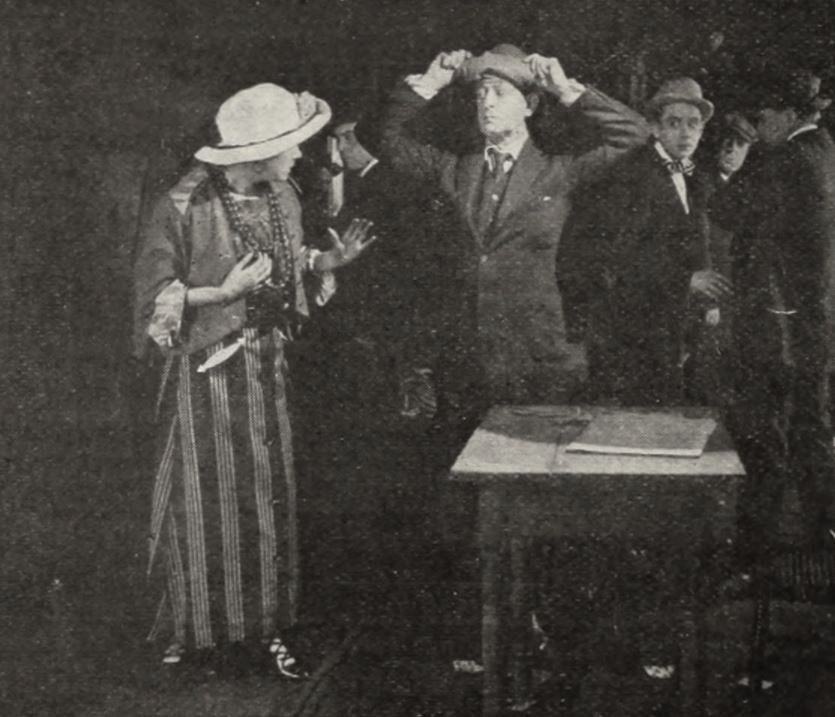
The first time the eponymous gray mask glides across the screen it feels less like a disguise than a confession—burlap moonlight stitched into human shape, absorbing every flicker of nitrate glow. Edwin Arden’s Garth dons it not as gimmick but as penance, as though only by erasing his own face can he read the topography of guilt etched on others. The year is 1920; the Great War’s soot still clings to the air, and American silent cinema is experimenting with the chiaroscuro of moral ambiguity. Director Wadsworth Camp, armed with a scenario that pirouettes on espionage, revenge, and chemical apocalypse, crafts a pulp-poetic fever dream that feels eerily prophetic—an ancestor to contemporary techno-noirs and wartime undercover thrillers.
Cinematographer George Richter treats every frame like a chemical reaction. Note the sequence where Garth shadows Nora through a rain-slick marketplace: stalls bleed into abstraction, lanterns smear into comet tails, and the lens seems to inhale steam and trepidation. It’s a masterclass in obfuscated geography—a city that exists only where sodium light kisses wet pavement, nowhere else. Compare that to the pastoral openness of The Book of Nature or the frontier romanticism of Utah Pioneers; here, nature is an intruder, and the streets constitute an organism alive with malice.
Arden’s Garth is a study in contained combustion. Watch his shoulders—never squared, always pitched slightly forward, as if carrying an invisible rifle. His eyes telegraph calculation rather than empathy, until Barbara Tennant’s Nora slices through his armor with the casual precision of a paper cut. Tennant, luminescent even in grayscale, plays grief like a piano string stretched to the cusp of snapping; her vow of vengeance isn’t declaimed but whispered into cigarette smoke, making it doubly venomous.
Frank Monroe’s Joe Kridel appears only in flashbacks and morgue shots, yet his corpse haunts the negative space of every scene—a reminder that justice delayed is not merely denied but weaponized. Johnny Hines supplies comic relief as a pickpocket-turned-informant, yet even his pratfalls feel like nervous tics in a city suffering post-viral paranoia. It’s a cast calibrated to make the viewer mistrust comfort.
The coveted explosive formula is introduced in a curt intertitle: “Enough to level a battalion—yet fit inside a lady’s purse.”
MacGuffin? Undoubtedly. But Camp refuses to let it remain an inert plot device. Instead, it metastasizes into moral radiation—every character who brushes against it glows with Faustian luminosity. The Hennions aren’t mere racketeers; they’re entrepreneurs of annihilation, anticipating the military-industrial anxieties that would later infuse The Iron Strain.
When Garth finally swipes the phial, notice how Richter’s camera lingers on his gloved thumb smudging the glass—a microscopic smear that could spell megadeath. Silent cinema can’t rely on ticking audio; instead, the tension is etched into the grain itself, each crackle of decay on the archival print sounding like distant artillery.
Classic noir would codify the femme fatale as spider-luring-fly, but Nora’s arc inverts the trope. She enters the Hennions’ parlour as prey turned predator, yet her resolve wobbles not from feminine softness but from the recognition of mirrored trauma—Garth’s pursuit externalizes her own hunt. Their repartee, conveyed via dexterous title cards penned by Camp, crackles with sublimated longing:
NORA: Revenge is a room with one door—once inside, the knob vanishes.
GARTH: Then let me stand guard outside.
She rejects him not out of caprice but because affection feels like infidelity to the dead. Only after the mask comes off—both literally and metaphorically—does she permit herself the vulnerability of reciprocation, a payoff earned rather than bestowed.
The film’s cutting rhythm mimics a sleepless pulse. Average shot length hovers around 3.2 seconds—virtually caffeinated for 1920. Yet Camp knows when to slam on the brakes: the climactic warehouse siege unfolds in a single 42-second take that glides past packing crates, up a ladder, and through a skylight, landing behind a sniper’s silhouette. The stunt required Arden to swap identities mid-shot, a feat that anticipates the fluid subjectivity of later Hitchcock thrillers.
Viewed today, the absence of synchronized dialogue amplifies peripheral noises—projector hum, seat creaks, your own heartbeat—until the theatre itself becomes conspiratorial. Scholars often compare this phenomenological immersion to the spiritual austerity of Life of Christ, yet here transcendence is traded for tectonic dread.
From Bond’s gadget-laden tuxedo to Bourne’s amnesiac quest, the genealogy leads back to Garth’s masked infiltration. Even the self-destructing secret
trope originates here: the inventor rigs his notebook to combust if opened by unauthorized thumbs—a gag gleefully recycled by the Mission: Impossible franchise.
A 4K restoration premiered last year at Il Cinema Ritrovato, scanned from a Dutch print discovered in an Amsterdam attic. The tinting—amber for interiors, cerulean for exteriors—has been reinstated using autochemical analysis of faded frames. While no home-media release exists yet, archival Blu-ray is rumored for Q4, bundled with an essay on wartime paranoia in early silent thrillers.
Unlike the pastoral optimism of The Hoosier Schoolmaster or the maritime bravado of Across the Pacific, The Gray Mask wallows in urban existentialism. It’s a spiritual sibling to Peterburgskiye trushchobi’s frozen nihilism, though predating it by several years and trading Russian fatalism for American pragmatism.
A century on, The Gray Mask still hisses like a fuse. Its gender politics, while period-bound, complicate rather than capitulate to patriarchal norms. Its cityscape, half-real half-nightmare, prefigures the expressionist sprawl of 1940s noir. Most crucially, its thesis—that identity is a garment one can don or shed like spy or lover—remains chillingly contemporary in an age of avatars and deepfakes. Seek it out, should the reels roll anywhere within travelling distance. Turn off your phone; the mask is listening.
IMDb 6.3
1922
Community
Log in to comment.